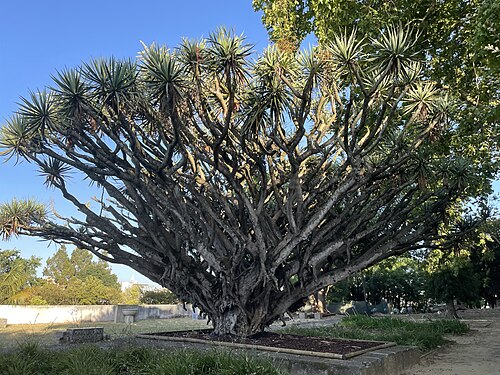
The Ancient Olive of Santa Iria de Azoia
Bairro da Covina, Pirescoxe
A road-widening scheme once looked at this olive and saw an obstacle. Rua 18 de Janeiro survived the argument, and so did the tree. In 2011 researchers from the University of Trás-os-Montes e Alto Douro measured its trunk, a buttressed, hollow mass over ten metres round at the base, and used a dendrometric method built for exactly this kind of ancient, ring-less wood to put its age at roughly 2,850 years. At the time, press called it the oldest tree in Portugal. That title has since moved to two other olives dated by the same method, one in Abrantes at around 3,350 years and one in Vidigueira at over 3,700, so this one is no longer the record holder, only one of the country's oldest confirmed and independently certified trees. It stands in the Covina neighbourhood of Loures, beside the ruins of Pirescoxe Castle, in what survives of an old olive grove that has otherwise given way to houses. A small square with information panels now marks the spot, the tree that nearly lost an argument with a road, and the reason the road bent instead. This is a genuine day trip from Lisbon rather than an in-town stop, about half an hour by train and on foot from the centre.
From people who stood here
No notes yet
Did you visit the tree? Leave a note for the next visitor.
Getting there
Rua 18 de Janeiro, Bairro da Covina, Pirescoxe, Santa Iria de Azoia, Loures
You can recognise it by the trunk, over ten metres round at the base, heavily buttressed and hollowed with age. It stands in a small dedicated square on Rua 18 de Janeiro, beside the ruins of Pirescoxe Castle.
Free. Stands beside a public street (Rua 18 de Janeiro) in the Covina neighbourhood, next to the ruins of Pirescoxe Castle (now a municipal cultural gallery). A small dedicated monument square with information panels marks the spot.
Santa Iria train station (CP suburban line from Lisboa Oriente/Santa Apolonia), then about 10 minutes on foot. Roughly 30-35 minutes door to door from central Lisbon; this is a Loures municipality day-trip case, not an in-town tree, and the page must say so honestly.
In fruit
October and November, during the olive harvest
The line is our estimate of how much there is to see, not a measurement. Typical for this species where this tree stands; exact weeks shift with the year.
Sources
Where the facts on this page come from. The story was written with AI from these sources, and readers who know the tree correct it.
- In the official register: Arvoredo de Interesse Público (ICNF), no. KNJ1/601
- sol.iol.pt
- rtp.pt
- euronews.com