The Belas-Sombras of Jardim António Feijó
Arroios
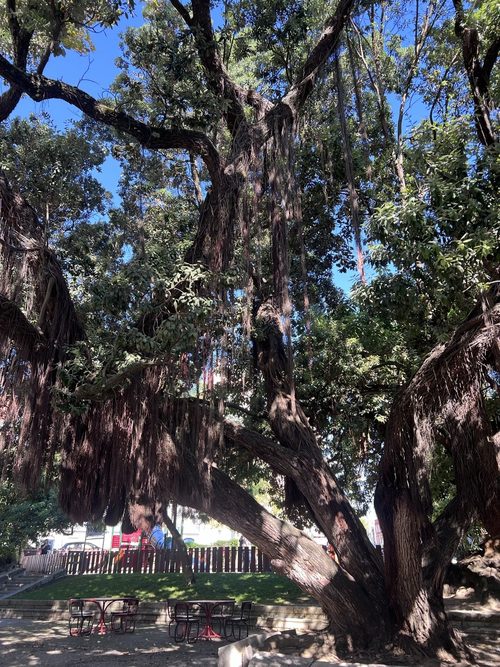
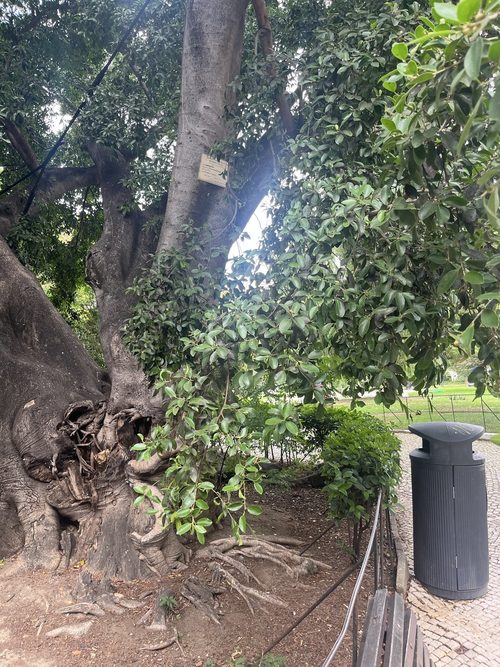
The two fattest trunks in this garden are not really wood. Phytolacca dioica, the bela-sombra, is a giant herb rather than a tree, and the swollen base that makes it look ancient is soft, water-storing tissue you could dent with a thumbnail. It grows fast, it produces no timber worth the name, and it falls apart earlier than its bulk suggests. There are two of them here, and they came out almost identical: 10.45 and 10.4 metres round, 17.6 and 16.4 metres tall. They stand about 30 metres apart, one at the southeast corner of the garden and one at the top of it, so the visit is both or neither. The garden wraps around the Igreja de Nossa Senhora dos Anjos, inaugurated in 1911, and the pair went in at roughly the time the church was finished. They were classified in 1947, among the earliest protection orders in Lisbon, and reclassified in 2018. The register recorded them at 105 years when they were measured in 2015, so roughly 115 now. With a bela-sombra that figure is softer than usual. The trunk does not lay down the tidy annual rings you could count in an oak, so any age for one is worked back from size and from whatever the planting records say.
From people who stood here
No notes yet
Did you visit the tree? Leave a note for the next visitor.
Getting there
Jardim Antonio Feijo, Largo do Intendente area, 1100 Lisboa
You can recognise them by two swollen, soft-wooded trunks over ten metres round, thirty metres apart. They stand around the Igreja de Nossa Senhora dos Anjos in Jardim Antonio Feijo.
Sources
Where the facts on this page come from. The story was written with AI from these sources, and readers who know the tree correct it.
- In the official register: Arvoredo de Interesse Público (ICNF), no. AIP11065606I
- ICNF, Arvoredo de Interesse Publico (CC BY 4.0), processos AIP11065606I and AIP11065605I
- pt.wikipedia.org
- informacoeseservicos.lisboa.pt