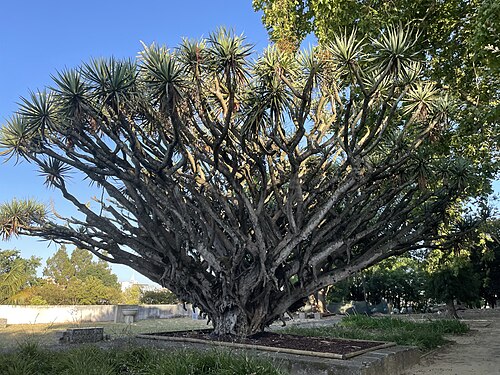
The Nettle Tree of Avenida de Berlim
One tree remembers the farms that used to be here. Before Lisbon's eastward expansion in the 1940s and 1950s paved over the quintas of Olivais with apartment blocks, this stretch of land was countryside, and a single European nettle tree from that era survived the building work, still standing at what is now the junction of Avenida de Berlim and Avenida Francisco Luís Gomes. Portugal's national registry of public-interest trees measured it in 2015 at 75 years old and 15.7 metres tall, younger than the round century once claimed for it but still older than the apartment blocks around it, with a broad symmetrical canopy that looks deliberately planted rather than accidentally spared, though it was almost certainly the latter. The species produces small sweet fruit that gives it a folk nickname referencing the birds that come to eat it, and its wood was historically valued for tool handles and whip stocks for its flexibility. Officially classified as a tree of public interest under process KNJ1/405, it now stands beside a bronze sculpture called Homem Sucata, Scrap Man, welded from actual car parts in 1993, an odd pairing of the area's rural past and its industrial present sharing the same traffic island. Commuters on the surrounding avenues have an older neighbour than the surrounding tower blocks suggest.
The line is our estimate of how much there is to see, not a measurement. Typical for this species where this tree stands; exact weeks shift with the year.
Avenida de Berlim, at the junction with Avenida Francisco Luís Gomes, 1800 LisboaYou can recognise it by its broad, symmetrical 15.7 metre canopy on a 4.00 metre trunk, beside the scrap-metal sculpture Homem Sucata. It stands on the traffic island at Avenida de Berlim.
Free, public street/traffic island
Roughly 15 min walk from Bela Vista station (Metro Red Line), or bus to Avenida de Berlim
Sources
Where the facts on this page come from.
- In the official register: Arvoredo de Interesse Público (ICNF), no. KNJ1/405
- theleafboutiquehotel.com
- getlisbon.com
- sigservices.icnf.pt