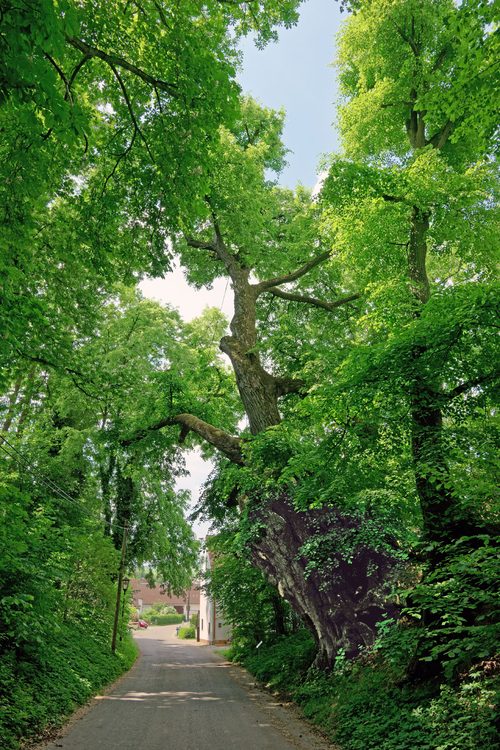
German Wikipedia calls this one of the most bizarre tree shapes in the country, and it is hard to argue.
Photo: Rainer Lippert
Tilia sp.
These are the limes nobody has narrowed to a single species, planted or grown before anyone thought to record which Tilia they were, which is common enough with a genus this widely hybridised that the honest label is simply Tilia sp. We map 45 of them, in 31 cities.
Amsterdam's Wilhelminalinde went into the ground on the Kalverstraat to mark Queen Wilhelmina's 1898 coronation and is a tidy, dateable 128 years old. Nuremberg's gnarled lime at the Hallerwiese has taken lightning and storm damage across some three and a half centuries and is still putting on growth, damaged and healthy in the same trunk. Frankfurt's eight-stemmed linden in Grüneburgpark is not one tree that happened to fork; it is a deliberate bundle planting, several saplings set into one hole so they would fuse into a single crown, rare enough to be a protected natural monument in its own right.
German Wikipedia calls this one of the most bizarre tree shapes in the country, and it is hard to argue.
Photo: Rainer Lippert
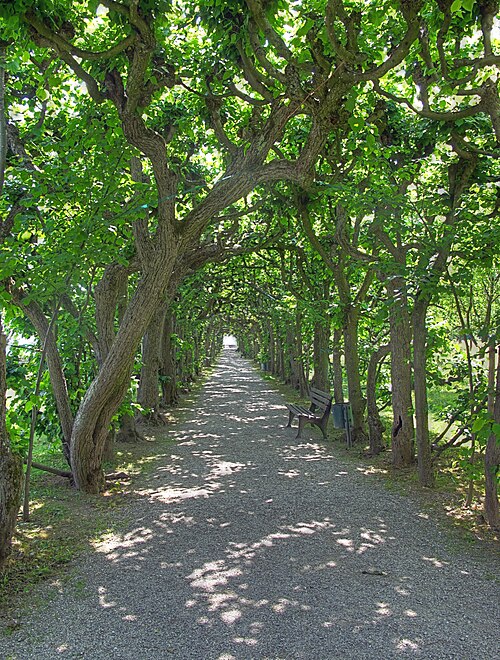
This is not one tree but a walk of limes clipped into a green tunnel, and by the county's estimate the limes are about 290 years old.
Photo: Richard Huber (CC BY-SA 3.0)
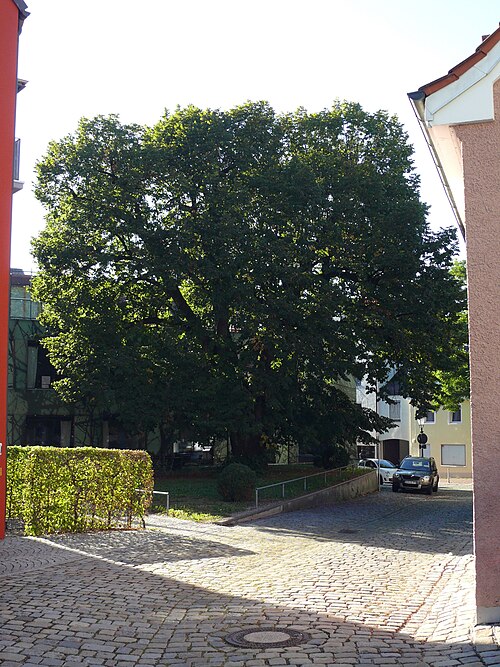
This lime was protected as an inn's courtyard tree, and the inn has moved on without it.
Photo: Martinus KE (CC BY-SA 4.0)
The cross at the foot of this lime still carries a prayer for field and house, written when the ground around it was grain fields.
Wilhelmina had been queen for eight years before anyone crowned her.
This lime went into the ground on 31 January 1938, the day Princess Beatrix was born.
Ten of these eleven lindens are hollow, and they are still standing because somebody bolted them back together in the 1980s.
This lime was planted for a wedding that took place five hundred kilometres away.
A map drawn in 1570 already marks this spot as het Maria en boomken, the Mary and the little tree.
Nijmegen crowned a queen with a tree.
Thirty metres from the cloister-park oak stands its neighbour with the matching name: the kloosterparklinde, the cloister-park lime, both named for a convent whose garden this ground used to be bef...
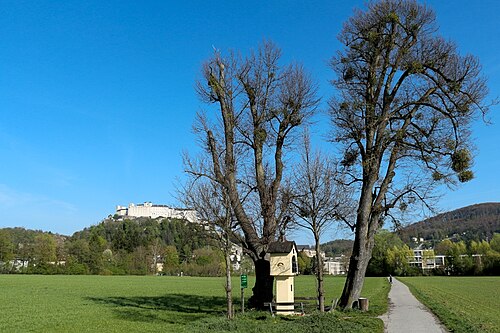
Four limes were planted around 1810 to stand guard over a roadside image of the Virgin Mary, and more than two centuries later they are still at their post.
Photo: Eweht (CC BY-SA 3.0 at)
The register calls this a 150-year-old lime.
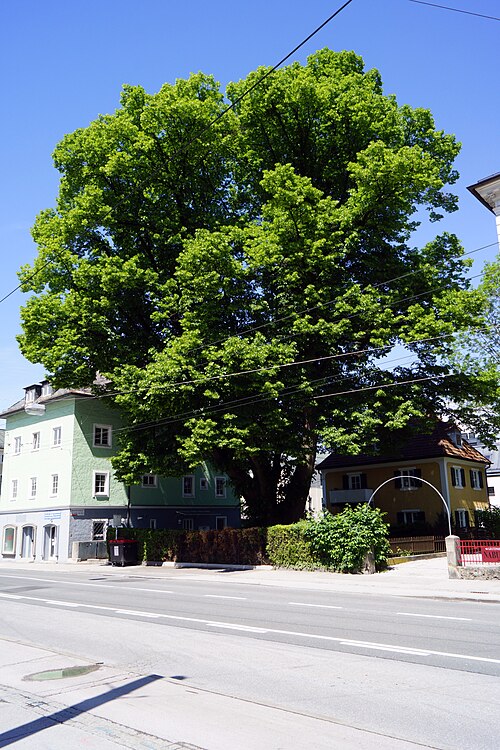
A lime with more than one trunk stands at a street corner in Riedenburg, visible enough that the register itself calls it out: it stands widely visible at the edge of its property, right where Neut...
Photo: Microble (CC BY-SA 3.0 at)
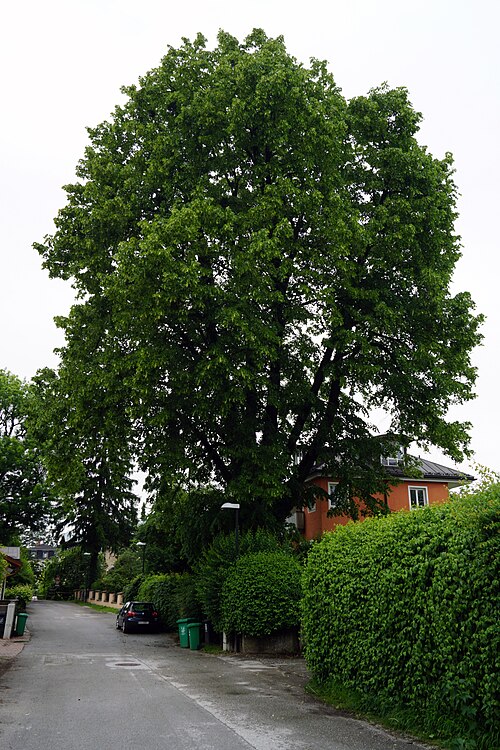
This lime once stood inside the grounds of a baroque manor.
Photo: Microble (CC BY-SA 3.0 at)
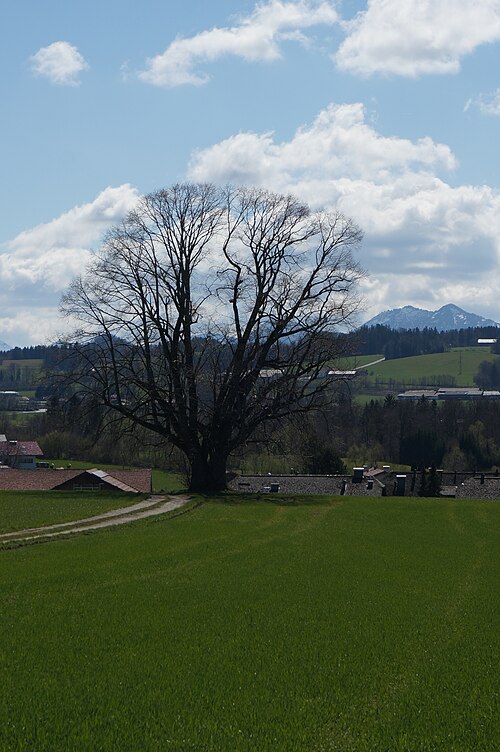
Lightning has hit this tree more than once, and the bark still carries the marks.
Photo: Flanierer (CC BY-SA 4.0)
In 1476 a messenger is said to have run from the battlefield at Morat to Fribourg waving a linden branch cut on the field, collapsed in the Bourg quarter, and the branch took root where he fell.
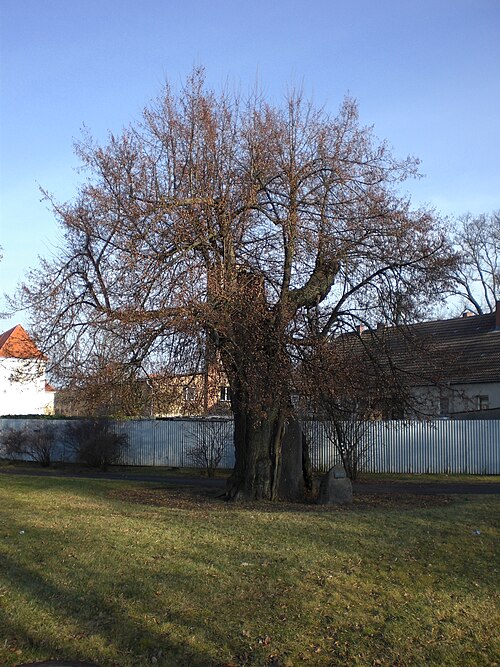
Zehdenick's oldest tree carries a name nobody can fully explain.
Photo: Olaf Meister (Olaf2) (CC BY-SA 4.0)
Local families bring their newborns to this lime, and older children climb through its hollow trunk to prove they are brave.
Eight trunks come out of the ground here in one tight ring, and they are a single tree.
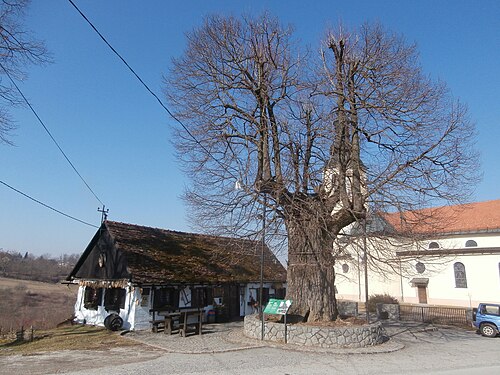
Croatia's most consequential peasant uprising is said to have started under this tree's canopy.
Photo: Public institutions archive (CC BY-SA 4.0)
For eighty years this was the only tree in Gothenburg with a nature monument order on it.
A ducal court sat at this lime from 1241, and the ground beside it was still being used for executions in 1859.
The register bands this lime to the 1600s, which would make it three to four centuries old, decades older than the plane tree across the road that already carries Heerlen's own claim to the city's...
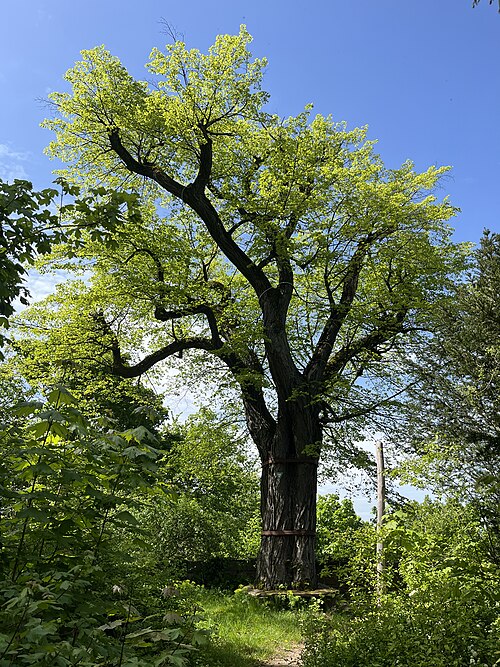
Hollow inside and completely vital.
Photo: Hartmut Schmidt Heidelberg (CC BY-SA 4.0)
This lime went into the ground the year Wilhelmina was crowned.
Three sources describe these lindens and no two agree on how many there are.
Once a year the village takes its Fete-Dieu mass out of the church and holds it under this lime instead.
The chapel is named after the trees.
For centuries the Walser community of Macugnaga gathered under this lime to run its own affairs.
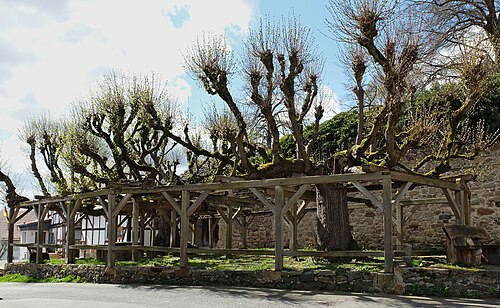
A sandstone table once stood under this pair of limes, and villagers gathered around it to settle disputes.
Photo: Yvonne Bentele (CC BY-SA 3.0)
Three lindens grow as one group here, trained and pruned together beside a historic stone table once used for village assembly, in front of Dagobertshausen's fortified church.
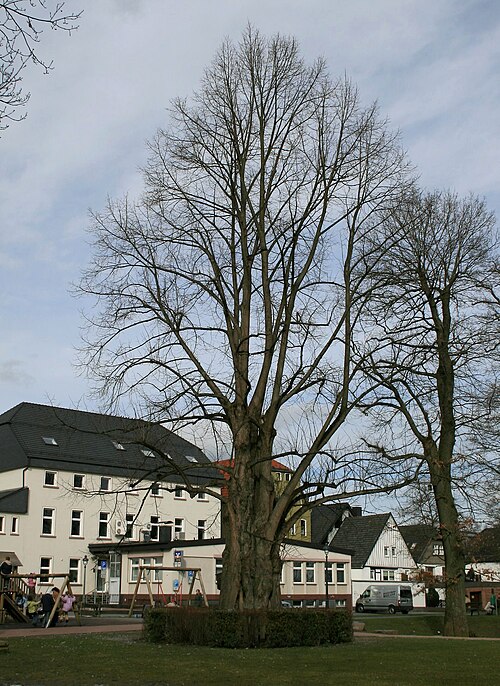
The court came before the town.
Photo: Bubo (CC BY-SA 3.0)
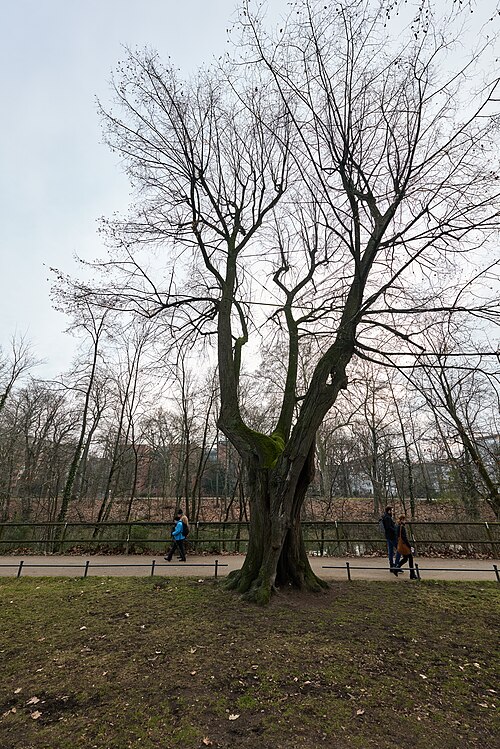
Lightning has struck this lime and a storm has taken pieces off it, and it is still putting on growth.
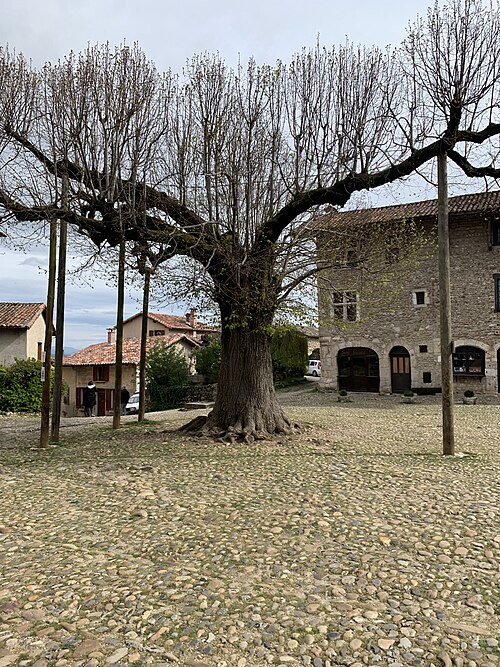
France planted liberty trees by the thousand in the 1790s and cut most of them down within a generation.
France has hundreds of trees called a Tilleul de Sully.
The tree listed just before this one in the same Bavarian register is gone.
The house beside this linden was built in the fifteenth century.
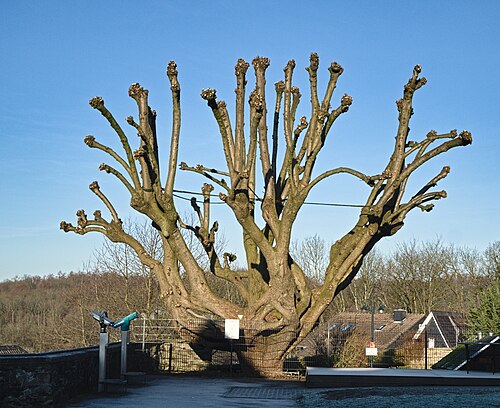
Members of a religious order pruned this lime into a room.
Photo: YvoBentele (CC BY-SA 4.0)
This lime was planted to mark the anniversary of a republic that Belgium has not belonged to for two hundred years.
The church behind this lime is the newcomer.
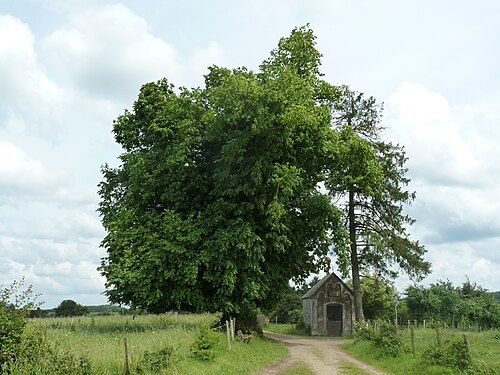
People came here to nail their illnesses into a tree.
A slab of white marble at the foot of this lime reads Vryheidsboom 1918-1968, and that inscription is the only thing dating the tree.
The peace tree on this square is not the peace tree.
Three limes at a farm gate in Boezinge are cut into candelabra, and somebody is still doing the cutting.
Explore by city: Munich · Amsterdam · Groningen · Nijmegen · Tilburg · Salzburg · Frankfurt · Heerlen · Heidelberg · Hoorn · Leuven · Malsfeld · Nuremberg · every city · or browse all species.