Malsfeld maps a scattered custom rather than a town: four "geleitete Linden", lime trees trained for centuries into wooden frames and stone-table court sites, standing in four Hessian villages within a few kilometres of each other. Guided lindens like these once hosted a village's dances, trials and gatherings under one shaped crown; most of the type has died out. These four are still alive, still pruned to shape, and reachable inside a short drive through the Schwalm-Eder countryside.
0 of 4 visited in Malsfeld
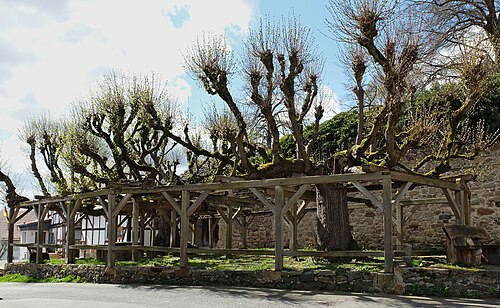
Lime (Tilia sp.); a paired summer lime and winter lime · 400 years · Berndshausen, Gemeinde Knüllwald
A sandstone table once stood under this pair of limes, and villagers gathered around it to settle disputes. Cadastral maps from 1756 and a tithe map from 1778 both mark the spot: two trees, community lindens, beside what the records call a court site. Nobody meets there for judgment anymore, but the trees are still shaped the way a court tree was meant to be shaped, trained over a wooden frame into a wide, level canopy a village could stand under together.
One is a summer lime, the other a winter lime, planted or grown together so long ago that the pairing itself became part of the tradition. The larger, measured at 2.78 metres round and 6.5 metres tall, is put at roughly 400 years old. Both carry double protection, as a Naturdenkmal and as a registered "Baumveteran", and both are part of Hessen's Tanzlinden-Route, a trail linking the region's surviving trained dance and court lindens.
The type is dying out. Berndshausen's pair is one of a handful left in the Schwalm-Eder district where a village still keeps its guided linden alive, still pruned into shape, standing exactly where the old maps say it always has.
Photo: Yvonne Bentele (CC BY-SA 3.0)
Lime (Tilia sp., a cultivated form locally recorded as "Holländische Linde"/Dutch Lime) · 120 years · Dagobertshausen, Gemeinde Malsfeld
Three lindens grow as one group here, trained and pruned together beside a historic stone table once used for village assembly, in front of Dagobertshausen's fortified church. Hollowed out by age and cut back hard and often, they are still, by the local environmental authority's own account, vital.
That authority placed the group under Naturdenkmal protection in 2008, estimating the trees were already at least 120 years old at the time, which puts them past 140 today. A 2017 survey measured the recorded specimen at 1.88 metres round and 5.5 metres tall, a cultivated lime the register lists locally as "Holländische Linde", Dutch lime, rather than a wild-growing tree.
The group is younger than its neighbours in Berndshausen and Hilgershausen, both a few kilometres away, but it belongs to the same practice: a Hessian village growing its meeting tree into a shape rather than simply letting it stand, so that people could gather under a canopy trained wide and low enough to shelter a crowd underneath it.
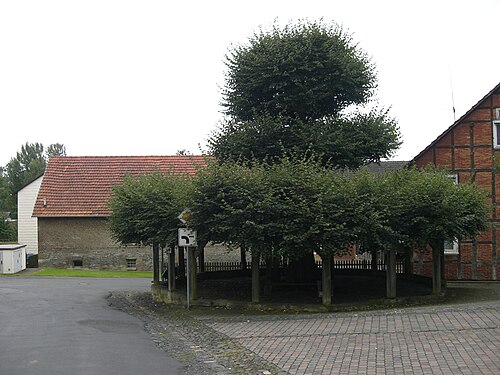
Small-leaved Lime (Tilia cordata) · 300-380 years · Hilgershausen, Stadt Felsberg
Step inside the trunk of this lime and there is a seat waiting: a square bench built into the hollow centre, framed by three tiers of branches trained out over an octagonal wooden support. Locals call it a Dreistufenlinde, a three-tiered linden, and rank it among the best documented guided lime trees in Germany. A new oak frame went up under it in June 2022, the latest in centuries of upkeep that kept its shape from collapsing under its own weight.
The village itself is not sure exactly when it was planted. The municipality's own estimate lands around 1748; a sign on site claims 1640, a century earlier. Nobody has resolved the gap, so both dates stand, giving the tree an age put loosely at 300 to 380 years by whichever is right. A 2021 survey found it 2.91 metres round, 9 metres tall, and healthy.
The square beneath it once hosted the village's dances and, before that, its court, the same double purpose that shaped guided lindens across this stretch of Hessen. It carries both Naturdenkmal and Baumveteran protection today.
Photo: Sipalius (CC BY-SA 3.0)
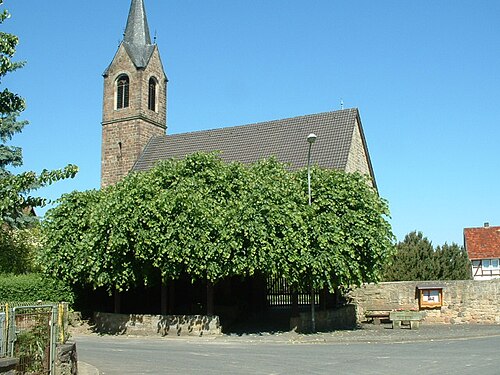
Small-leaved Lime (Tilia cordata) · 300-350 years · Ostheim, Gemeinde Malsfeld
This lime is the thickest of Malsfeld's four guided lindens, 3.34 metres round, and by some distance the shortest, cropped back so hard and so often that it stands just 5 metres tall. What is missing in height it makes up in girth: a hollow, heavily pruned trunk that a 2017 survey still rated vital.
It stands on a small sandstone common before Ostheim's church, on ground once used as a court site, the same combination of dance floor and judgment seat that runs through every guided linden in this corner of Hessen. The Elisabethpfad, a pilgrimage route named for the 13th-century Landgravine Elisabeth of Thuringia, passes close by.
Ostheim's tree was not on any list until a Wikimedia contributor's survey of the district's surviving guided lindens turned it up alongside its neighbours in Berndshausen, Dagobertshausen and Hilgershausen, all within a few kilometres. Together the four are what is left of a custom that used to be common across the region and now mostly is not.
Photo: Dr. Klaus Lambrecht (CC BY-SA 3.0)