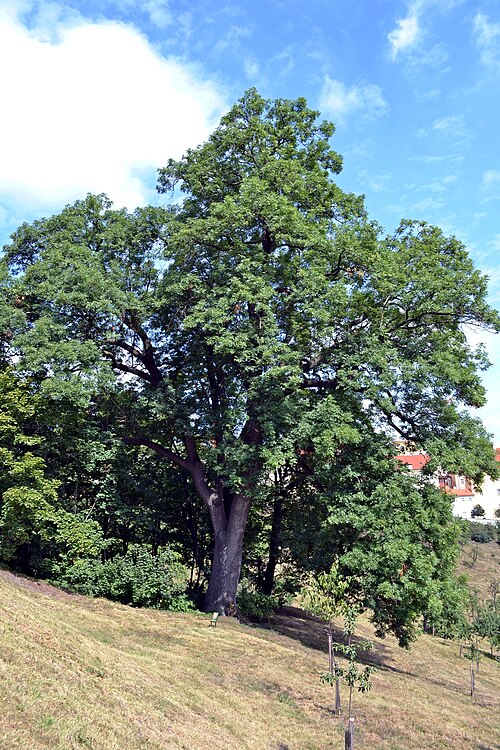
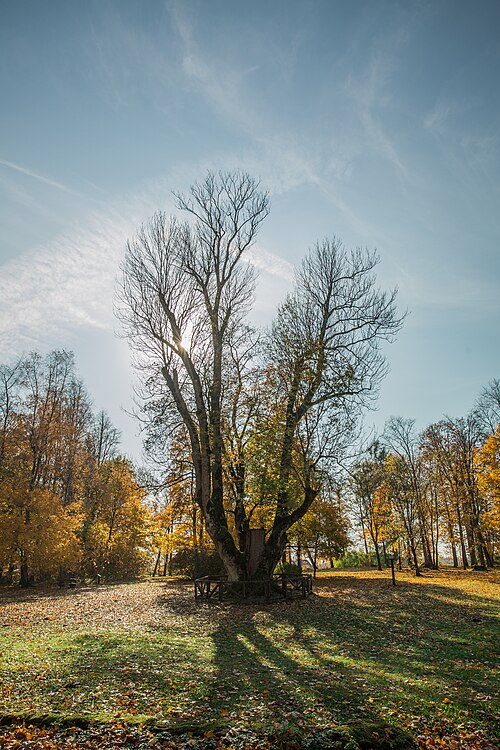
The tallest single trunk on this page grows in the one corner of Strahov Monastery the monks decided to share.
Photo: Sefjo (CC BY-SA 3.0)
Fraxinus excelsior
Ash is the tree Europe is losing right now. We map 28 of them, in 19 cities.
A fungus from east Asia, harmless to the ashes it evolved alongside, was first noticed in Poland in the early 1990s and has since worked its way west across the continent, which puts a different weight on every old one still standing. Lithuania's thickest, the Witch's Ash at Plateliai, is 7.41 metres round and looks like four trees knotted together, which local legend says it once was. In Stockholm, Carl Linnaeus wrote down Valkasken, the burl ash, in the 1740s, and it is still there on Langholmen. Gdansk's Ash of King Jan is 6.1 metres round. Prague's grows to 37 metres in the one corner of Strahov Monastery the monks left open to the public. And in Giethoorn an ash has heaved the ground under a farmhouse into a mound.
The tallest single trunk on this page grows in the one corner of Strahov Monastery the monks decided to share.
Photo: Sefjo (CC BY-SA 3.0)
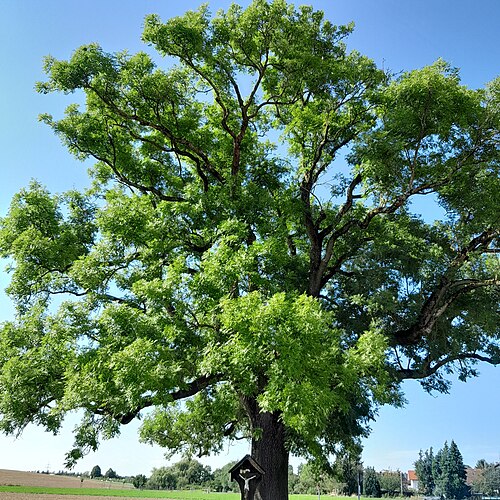
The Landkreis Ebersberg protects this tree under a name that is also a description: Esche frei im Landschaftsbild stehend, the ash standing free in the landscape.
Photo: W-R-Hesse-Fotos (CC BY-SA 4.0)
Munich's ordinance gives three words for why this tree is protected: extrem ausladende Krone, an extremely wide-spreading crown.
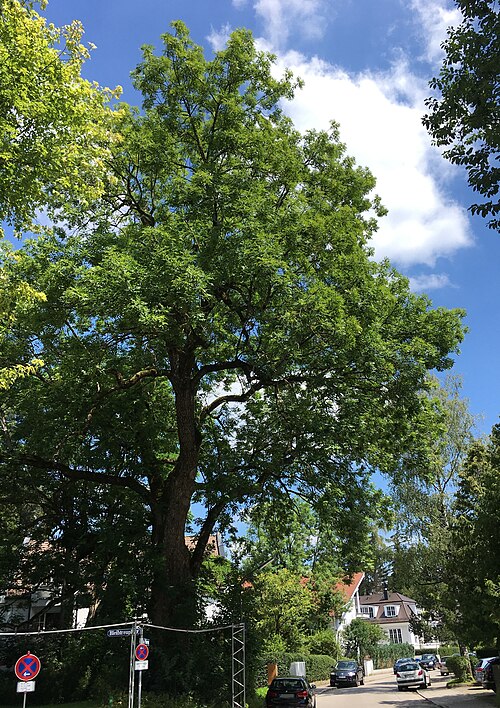
Europe is losing its ash trees, so a big one with a full crown is worth going to look at while it is there.
Photo: Peterf (CC BY-SA 4.0)
This ash branches low, and for an ash that is unusual enough to be the reason it is protected.
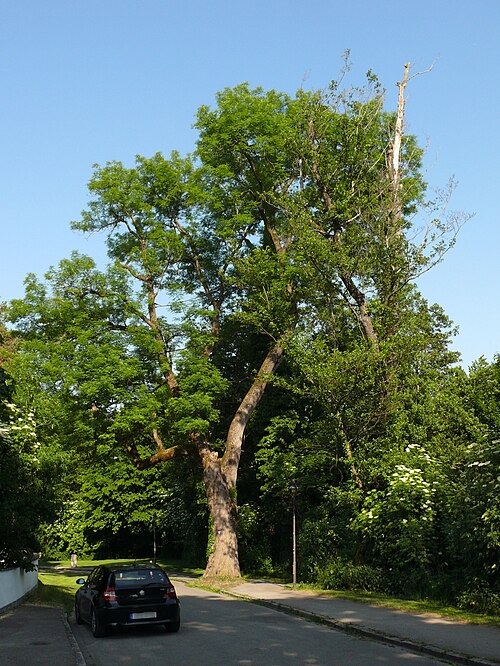
Look up at the top of this ash and you will see a bare dead spire standing out of a green crown.
Photo: Martinus KE (CC BY-SA 4.0)
The register calls this a very impressive specimen of the species and then adds, in the same breath, that its crown has developed one-sidedly because of the park trees standing next to it.
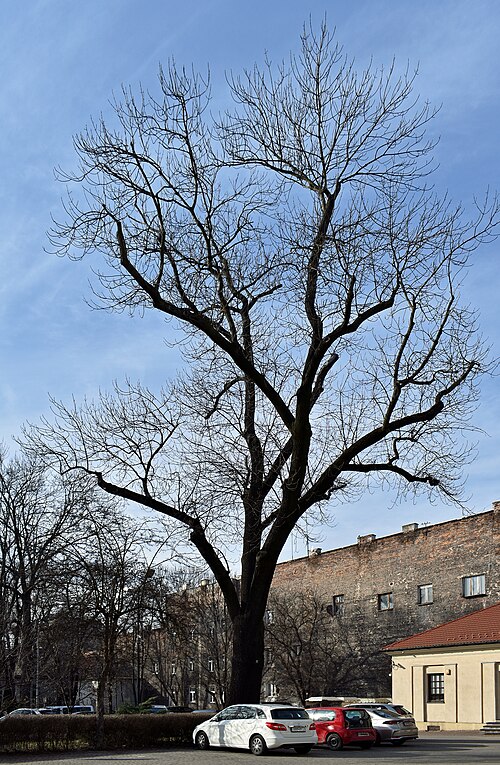
European ash is one of the commonest trees in Poland and a thick one is not common at all.
Photo: Zygmunt Put (CC BY-SA 4.0)
Plac Kossaka today is better known for parked cars and a kebab stand than for its trees, which is what makes the ash at number 4 easy to miss.
Krakow protects three European ashes, and this is the only one that does not grow out of a pavement.
Vienna made this ash a natural monument on 3 May 1946, less than a year after the war ended, while the city was still divided between four occupying powers and short of almost everything, firewood...
Vilnius has protected this ash since 1996 and nobody has recorded a single measurement of it.
Two official sources have counted this tree's trunks and come to different numbers.
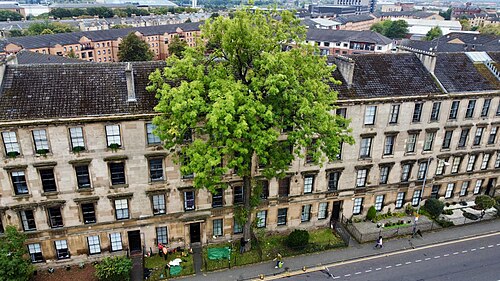
The only tree on Argyle Street arrived by accident, in the roots of a primrose.
Photo: Talesfromthecanopy (CC BY-SA 4.0)
One of the oldest ash trees in Edinburgh grows in a park with no house left standing in it.
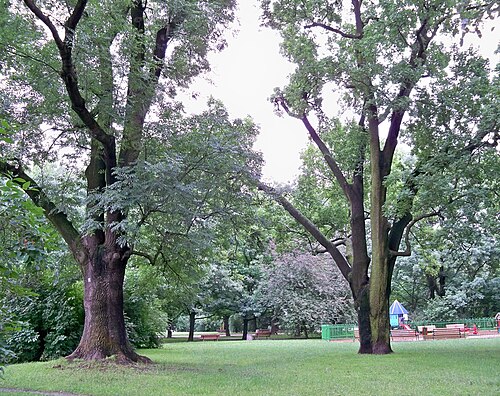
One set of papers, two trees.
Photo: Panek (CC BY-SA 4.0)
The disease now killing Europe's ash trees was first noticed in Poland, in the early 1990s, and has been working through the country's ash ever since.
Carl Linnaeus wrote this ash down in the 1740s and it is still standing.
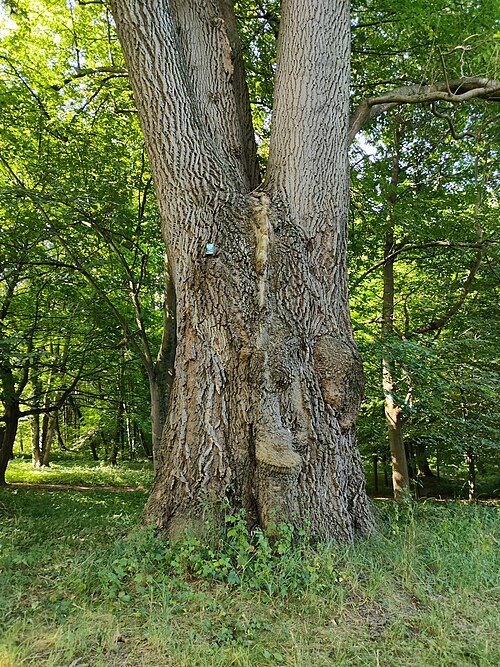
Six metres and ten centimetres round.
Photo: Fry72 (Karel Frydrýšek), CC BY-SA 4.0 (CC BY-SA 4.0)
This ash tree is older than the gun factory that grew up around it.
The general cemetery on the Kleverlaan is where Haarlem keeps its best trees, and this ash is one of the reasons guided tree walks stop here at all.
Somebody cut the top off this tree and it is still the largest ash in Cordoba.
This ash is holding up a farmhouse.
This ash stands on the square in front of St.
Europe is losing its ash trees, which is what makes a trunk like this one worth the short walk.
The village this ash grew up in is gone.
Lithuania's thickest ash looks like four trees knotted together, and by local tradition it once was.
Photo: Žemaitijos kelias (CC BY-SA 4.0)
A German tree register measured this ash in May 2026 and got 6.72 metres around the trunk, taken low at 60 centimetres.
Explore by city: Prague · Munich · Leeuwarden · Krakow · Vienna · Vilnius · Glasgow · Edinburgh · Warsaw · Stockholm · Gdansk · Haarlem · Cordoba · Bratislava · Ghent · Plunge · Stuttgart · every city · or browse all species.