Bratislava's register of protected trees produces seven worth the walk, five of them in one line from the Danube to the slope below the castle: a Japanese pagoda tree on the embankment, an ash on the square where Hungarian kings were crowned, a paulownia in a rebuilt park, an Adriatic oak at a public stairway, and a small birch further up. A plane over six metres round stands out in the forest park, and a black poplar just as thick waits a short train ride away in Grinava. All seven are free and in the open.
0 of 7 visited in Bratislava
Japanese Pagoda Tree (Styphnolobium japonicum) · 110 years · Staré Mesto (Old Town), on the Danube embankment
Slovakia's state register of protected trees keeps its reasoning short, and this one earned five separate lines: cultural, scientific, landscape, historical and aesthetic value, all cited when the tree was formally protected in 1996. A Japanese pagoda tree this size is an odd sight on a Danube embankment, a species more at home in East Asia than Central Europe, with a crown eighteen metres up and a trunk just over three metres round. The register put its age at eighty years back in 1996, which sets its planting near 1916, the last full year of the Austro-Hungarian empire this city once belonged to. It stands in a small public park along the riverside promenade, a few minutes' walk from Hviezdoslav Square, easy to miss among the plane trees that line the embankment proper unless you already know a pagoda tree is there to find. Nobody has re-measured it since the original designation, so its exact current girth is this project's own estimate rather than a fresh reading, and a reader with a tape measure would settle the question in a minute.
European Ash (Fraxinus excelsior) · Staré Mesto (Old Town), below Bratislava Castle hill
This ash stands on the square in front of St. Martin's Cathedral, where nineteen Hungarian kings and queens were crowned between 1563 and 1830, a coronation route that once ran past this exact spot toward the castle. Slovakia's state register lists the tree among the city's protected specimens, citing high biological and aesthetic value and a rare occurrence for the area, and a 2026 newspaper roundup of Bratislava's protected trees names it independently among the city's twenty nine. What neither source gives is an age, and this page will not guess one rather than invent it. The ash's own crown offers a rough clue any visitor can read for free: European ash grows fast when young and slows once it clears the surrounding rooftops, and this one has cleared them by some distance. It stands in the open, on a public square with no gate and no hours, reachable on foot from the castle grounds or the old town in a few minutes either way. If you know how old it is, or have a photograph from years back to compare against, this is exactly the kind of gap a reader can close.
Empress Tree (Paulownia tomentosa) · Staré Mesto (Old Town)
Two sources describe the same paulownia and disagree by ninety years. One, tracing to a 2008 press mention, calls it roughly a hundred and fifty years old. The other, closer to the state register's own catalogue figures, gives sixty. Paulownia tomentosa is one of the fastest growing trees planted in Europe, capable of adding real girth in a single decade, which makes the younger number the more biologically plausible one, but that is this project's own reasoning rather than either source correcting the other, so both stand on the page rather than one being quietly dropped. What both agree on is the tree itself: twenty metres tall, a trunk just over three metres round, protected since 1996 for its cultural and aesthetic value. It grows in Park Škarniclova, a small neighbourhood green space that volunteers rebuilt in the 2020s, adding a new path between the dormitory it fronts and a footpath used by a nearby school. In May and June the tree carries upright spikes of lavender flowers before the leaves fill in, the one month it stops being background greenery for the block.
Adriatic Oak (Quercus virgiliana) · 100-120 years · Staré Mesto (Old Town)
An Adriatic oak has no obvious business growing this far north. Quercus virgiliana belongs to the warm hill country around the Adriatic, and this specimen, twenty five metres tall with a trunk three and a half metres round, is protected twice over in Slovakia's state register, first in 1982 and again on review in 1996, cited for its rarity as much as its size. It grows at the top edge of the Šulekova stairway, one of the steep public staircases that climb the slope below Bratislava Castle, with its roots sitting right at the boundary the register itself describes between the public steps and a private plot next door. Stand on the stairs and the crown is directly overhead, no gate and no permission needed, though the tree's own base sits close enough to the property line that the honest advice is to admire it from the steps rather than step off them. The register's eighty year estimate at its 1996 review puts today's age past a century, an old tree for a young use, holding a slope that has been climbed on foot for as long as the neighbourhood above it has existed.
Paper Birch (Betula papyrifera) · 75-85 years · Staré Mesto (Old Town), above the castle hill
Paper birch is a North American tree, the species Indigenous canoe-builders once stripped bark from whole, and someone in this quiet residential street chose it as an ornamental planting decades before the idea of a native-species garden had much currency here. At eight metres tall with a modest trunk under a metre round, it is the smallest tree on this list by some distance, and it earns its place on rarity rather than size: Slovakia's state register protected it in 1996, giving it fifty years of age at that point, which puts planting close to the late 1940s and today's tree past its seventy fifth year. It stands on the street side in front of the house at Mišíkova 36, its pale, papery bark peeling in thin horizontal strips that catch the light differently than anything else growing nearby. A short, steep walk up from the castle district, past the grander oaks and cathedral ash elsewhere on this page, it is a reminder that a protected tree does not have to be a giant to be worth stopping for.
Plane (Platanus sp.) · 160 years · Bratislava Forest Park, near Železná studnička, roughly 3.6 km from the Old Town centre
Six metres and eleven centimetres round the trunk, standing in a wood where nobody planted it for show. The plane on the road up to Zelezna studnicka is Bratislava's protected tree number 231, and a measurer put a tape around it in 2012: 6.11 metres at chest height, 27.2 metres tall, and a planting he read as around 1880. That makes it roughly 160 years old now.
Which plane it is has never been settled, and the two sources that describe it disagree. The state register calls it platan zapadny, western plane, which in Slovak usually means the American sycamore. Monumentaltrees, whose measurer took the figures above, records it as the London plane, the hybrid that Europe planted along half its avenues. They are close relatives and easy to confuse without looking at the bark, which flakes into pale patches on the hybrid and stays more uniform on the pure American tree. If you get there and look up, you can settle it, and we would like to know.
The setting is the reason to go. Zelezna studnicka is the valley Bratislava walks in at weekends, a chain of ponds and paths along the Vydrica stream under the Small Carpathians, and this tree stands in the open beside the path rather than in anybody's garden. Most of the city's protected trees do not: they sit in front gardens and behind courtyard walls, which is why this page is shorter than the register would suggest.
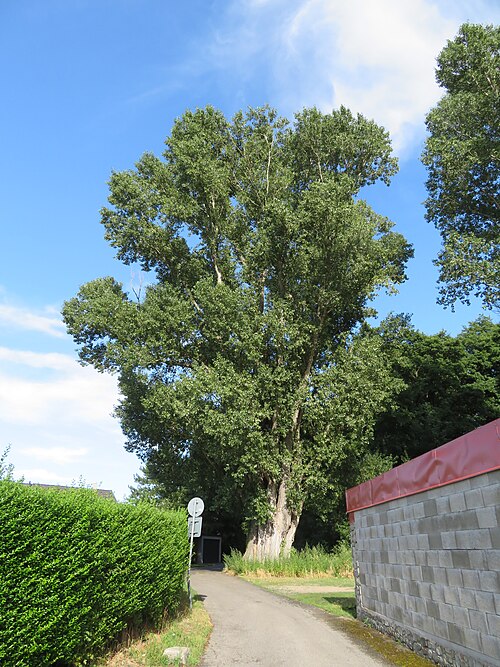
Black Poplar (Populus nigra) · 100 years · Grinava, Pezinok (day trip from Bratislava)
A black poplar this size usually means centuries of growth, but the Grinava Poplar is probably closer to a hundred years old, and it was protected in 2007 for its bulk rather than its age. The trunk measures seven metres and five centimetres round, one of the largest black poplars recorded in Slovakia, with a crown spreading nineteen metres and a height put at around forty metres, though one record makes it a touch shorter.
It stands on open ground beside Limbasska cesta on the edge of Grinava, a district of Pezinok, near the site of the old Strapak's Mill, with no fence or gate between the road and the trunk. A Wiki Loves Earth photograph taken in July 2023 shows it still standing, still in full leaf.
Black poplar is the wild ancestor behind Europe's ornamental poplars, and it has become genuinely rare in the wild as it interbreeds with planted hybrids, which is what makes a pure specimen this size worth a protection order on its own. Grinava sits on the Bratislava to Zilina railway, and the stop that once carried the district's own name comes before Pezinok's main station, comfortably inside a half hour of the capital: an easy addition to a Bratislava day rather than a trip of its own.
Photo: TomphanTK (CC BY-SA 4.0)