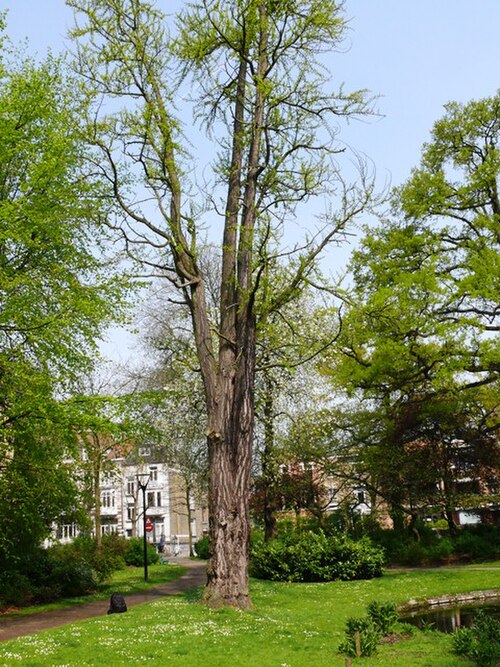
Europe is losing its ash trees, which is what makes a trunk like this one worth the short walk. Ash dieback, a fungal disease that arrived from east Asia and has been moving across the continent since the 1990s, kills young Fraxinus excelsior faster than the species can replace itself. This one measures over three metres round and belongs to the first planting generation of Muinkpark, the ground the Ghent natural history society bought in 1851 and stocked with animals. The register lists it, the weeping lime and the ginkgo as three survivors of the same planting. Ash is the plainest of the three and by far the most useful. The wood splits clean and bends without snapping, which is why Europe made tool handles, cart wheels and oars out of it for centuries, and why nobody has ever planted one for the view. It is also the last tree in a park to come into leaf and among the first to let go, so for a good stretch of the year you are looking at bare grey branches and hard black buds while everything around it has already turned green. The heritage inventory dates it to a planting generation rather than a year. Roughly a century and a half is the register's own margin, not ours, and it is as close as anyone has got.
The line is our estimate of how much there is to see, not a measurement. Typical for this species where this tree stands; exact weeks shift with the year.
Muinkpark, GentThe northernmost and plainest of the three Muinkpark trees, still bare and grey-branched in May when the lime and the ginkgo are in full leaf.
Free, public park, open daylight hours
Ghent-Sint-Pieters railway station, roughly 20-25 minutes on foot; De Lijn buses serve the surrounding Sint-Pietersnieuwstraat/Kortrijksepoortstraat area
Sources
Where the facts on this page come from.