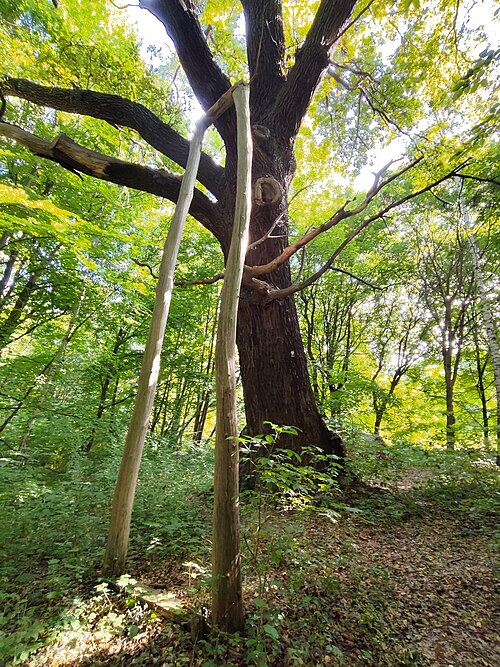
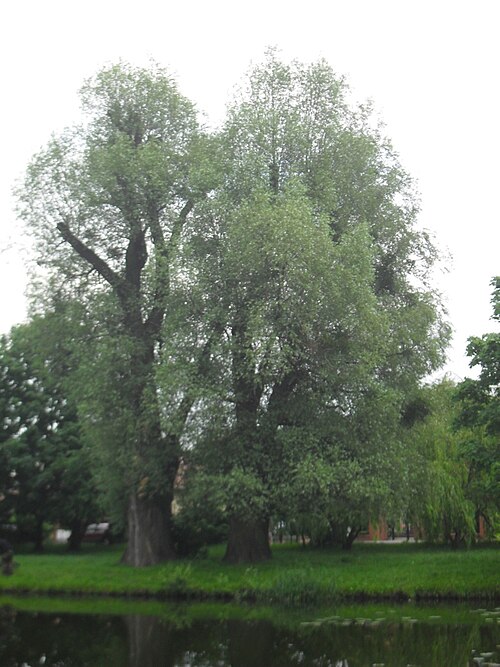
Six metres and ten centimetres round. For an ash that is close to the limit of what the species does, and it is the thickest tree in this park by a wide margin, wider than the famous oak two hundred metres downhill that everybody comes to see. Ash is not a tree people expect to find ancient. It grows fast, it dies at two hundred years in most places, and across Europe it is currently being killed in enormous numbers by a fungus that arrived from Asia. This one is about 320 years old and standing, in the park that belonged to Jan III Sobieski and that carries his name on the tree. What you see at the base is two trunks growing hard against each other, fused along the seam, with the bark ridged into the diamond pattern old ash makes. The register plaque is screwed to the fork. Poland entered it as a natural monument on 5 May 2012, which is late: the oak in the same park had been protected since 1966. Nobody seems to have measured this one until much later. It stands back from the main path, in the trees, which is why it is easy to walk past.
The line is our estimate of how much there is to see, not a measurement. Typical for this species where this tree stands; exact weeks shift with the year.
Park Kolibki, deeper into the park beyond the manor, Gdynia OrlowoTwo trunks fused into one at head height, deeply ridged grey bark in a diamond net, a small metal register plaque screwed into the fork, standing back from the path in the trees.
Free. Public park, open in daylight. The ash stands off the main path among other trees, so look for the plaque on the fork.
SKM train to Gdynia Orlowo, about 35 minutes from Gdansk Glowny and 12 from Gdansk Oliwa, then roughly twelve minutes on foot into the park.
Sources
Where the facts on this page come from.
- In the official register: Centralny Rejestr Form Ochrony Przyrody (GDOŚ)
- crfop.gdos.gov.pl
- krajoznawcy.info.pl