Eight of these twelve trees stand within a kilometre of Cathedral Square, four in Bernardinų sodas and four in the old university's courtyards, which makes most of the list one afternoon on foot. The garden's speciality is trunks in multiples: a lime with four, an ash whose sources cannot agree on three or four. A protected pine adds 1.3 km up the Song Valley slope, Antakalnis holds a storm-topped old lime and an alpine Swiss pine grown far from home, and one more oak stands further still, in Dvarcionys.
0 of 12 visited in Vilnius
Pedunculate Oak (Quercus robur) · 400 years · Užupis / Old Town
This oak lost roughly eighty percent of its root system and is still alive. The damage was done slowly and out of sight, by construction and transformer works beside it, and only became clear when Bernardinai Garden was overhauled in 2012. The rescue was blunt. Arborists took some twenty tonnes of weight out of the crown so the roots still working could carry what was left, then cleaned and treated the cavities in the trunk. Fourteen years later it is still the tree the city points people towards.
Its official entry does not bother with a name. It is listed simply as Seniausias ąžuolas, the oldest oak, protected as a municipal heritage object since 29 May 1996, with a trunk about five metres round. The sources put it at over four hundred years and none of them says how that figure was arrived at, so read it as the received number rather than a measurement.
It stands at the southern end of the garden, close to the footbridge over the Vilnia, which puts it a few minutes from Cathedral Square and a few steps from Užupis. Three more protected trees stand within a few hundred metres of it, so this is a stop on a walk rather than a destination on its own.
Pedunculate Oak (Quercus robur) · 45-50 years · Old Town / Vilnius University
The tree commemorates a walk. Simonas Daukantas, the 19th-century historian, came to Vilnius University on foot from Žemaitija, and the oak that carries his name in the courtyard named after him was grown from an acorn brought back from that same corner of the country.
It is not an old tree, and it is not here for that. Nobody has published a planting date. Lithuanian Wikipedia says it went in for the university's 400th anniversary, and since the university was founded in 1579 that points at 1979 and an age of about forty-seven. The year is arithmetic on the anniversary, not something any source states.
The planting did not go smoothly either. Two earlier saplings failed and were replaced, and some of those survivors are now said to stand next door in the Sirvydas Courtyard, which is why accounts of which oak is which do not entirely line up. The tree Vilnius protects under this name, listed as a heritage object since 29 May 1996, is the one at this pin.
Daukantas walked from Žemaitija to study here, which in the 1810s was a serious undertaking rather than a gesture. The tree is the university's way of keeping the walk in the ground. If you know which oak is which, or when this one actually went in, tell us.
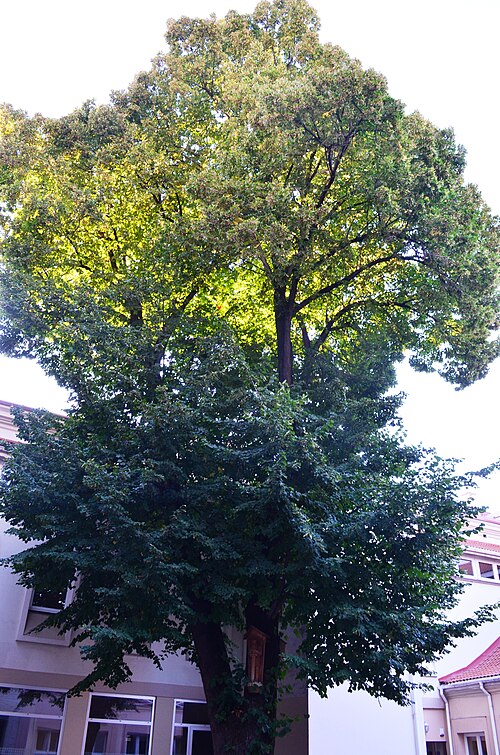
Small-leaved Lime (Tilia cordata) · Old Town / Vilnius University
Somebody has carved a chapel into this tree. It is a small niche cut into the trunk with a two-pitched roof above it, and inside stands a wooden figure of an old warrior holding a sword. No source names the carver. Lithuania has a long tradition of little roofed wooden shrines by roads and in yards, but putting one inside a living lime in a university courtyard is not the usual practice.
The tree holds the M. Daukša Courtyard of Vilnius University's central buildings together. History Faculty students meet under it, alumni come back to it at reunions, and the student corporation Korp! Tilia is said to have taken its name from it. Tilia is the linden's own genus, which makes the name either a good joke or a flat description.
Vilnius has protected it as a municipal heritage object since 29 May 1996. What nobody has written down is how old it is. There is no year in the register, none in the literature, and no published girth to reason back from. If you have measured it, or know when it went in, tell us and it goes on the page.
European Ash (Fraxinus excelsior) · Old Town / Vilnius University
Vilnius has protected this ash since 1996 and nobody has recorded a single measurement of it. No height, no girth, no age. The register gives the name and the coordinates and stops there, which is unusual for a tree a city considers worth protecting.
It stands in the Adomas Mickevičius Courtyard of the university's central buildings, named for the Romantic poet who studied here. The courtyard's name is not evidence about the tree: no source connects Mickiewicz to this particular ash, and it would be easy and wrong to imply he ever stood under it.
What is worth knowing is the species. European ash has had a hard thirty years across the continent as dieback thinned it out of woodland from Poland to Ireland, which makes a mature, protected ash in a city courtyard a better thing to stand under than it was a generation ago. This one has old university walls on four sides and a slot of sky above it, and it has grown up through the slot.
How much of the university's history it has actually stood through, nobody can say, because nobody has dated it. If anyone has put a tape around this trunk, we would like the number.
Large-leaved Lime (Tilia platyphyllos) · Užupis / Old Town
Four trunks leave the ground here as one tree, and Vilnius has protected the result since 1996 without ever writing down how old it is.
It is a large-leaved lime, didžialapė liepa, and the two sources that list it cannot even agree on the adjective: keturkamienė in the municipal register, keturliemenė in the garden's own inventory. Both mean four-stemmed. Neither carries an age, a height or a girth, which for a designated heritage object is a striking amount of blank paper.
Large-leaved lime flowers ahead of the small-leaved kind, in June, when the bees find it before you do. The rest of the year it is a shape: four heavy stems rising together, which is not how a lime looks in a textbook and is exactly how they often look in old gardens that have been cut back and left to recover more than once.
The garden around it has been rebuilt repeatedly, most recently in a full restoration finished in 2012, so the ground at its feet is a good deal newer than the tree standing in it. If you know when it was planted, or have a tape measure and five minutes, we would like the numbers.
European Ash (Fraxinus excelsior) · Užupis / Old Town
Two official sources have counted this tree's trunks and come to different numbers. The municipal register, which supplies the coordinates on this page, calls it Trikamienis paprastasis uosis, the three-trunked common ash. The encyclopedia entry for Bernardinai Garden lists a four-trunked ash among the same 1996 protected inventory, plus a second, plainer Sereikiškės Park ash besides.
It gets muddier. The register itself carries another ash about thirty metres away with no trunk count at all, which might be that second entry or might be this same tree written down twice under another name.
This page goes with the register's count and the register's pin. If you count four when you get there, tell us, because a reader with working eyes settles it faster than any amount of desk research.
No age has ever been recorded for it, and neither source gives a girth. What it does have is position. It stands in the lower part of Bernardinai Garden, a short walk from the pedestrian bridge over the Vilnia and about ten minutes from Cathedral Square, on the same loop as the four-trunked lime and the four-hundred-year-old oak at the southern end.
Small-leaved Lime (Tilia cordata) · 300-350 years · Antakalnis
On 18 July 2023 a storm took the top off the oldest lime in Vilnius. The arborist who examined the wreck found the trunk completely rotten inside, and a crown that earlier bad pruning had left top-heavy, which in a gale works as a lever. The tree had stood 28 metres. Roughly 11 to 12 metres of it are left.
It survived. Enough of the lower trunk is sound that dormant buds were expected to break and rebuild something of a crown, and the arborist's own verdict was that it will not live another 300 years, but that our grandchildren might see new growth. Weeks after the break it was entered as a candidate in Lithuania's Tree of the Year competition, damage and all.
Two trunks, 4.40 metres round measured before the storm, and an age the register puts at 300 to 350 years. Vilnius has protected it as a botanical heritage object since 29 May 1996, listed as Seniausia liepa, the oldest lime. It stands in Sapiegos parkas in Antakalnis, by the gates of the palace.
This is a single stop rather than part of a walk, 2.2 km from the trees in the Old Town. The most recent detailed report on its condition is from 2023, so you may find it further gone or well on the way back. Tell us which.
Scots Pine (Pinus sylvestris) · Old Town / Kalnai Park
Vilnius protects this pine by name and has written down almost nothing else about it. The register carries Kalnų parko pušis, the pine of Kalnai Park, a designation and a coordinate, and then stops: no age, no girth, no height.
Scots pine is the commonest tree in Lithuania and grows on every sandy hill in the country, which is what makes one singled out for protection worth the climb. It stands on the southwestern slope of Dainų slėnis, the Song Valley, behind the spectator stands of the amphitheatre, on a wooded hillside in Kalnų parkas that gives back a view over the Old Town on the way up.
The pin is honest rather than exact. The register rounds its coordinates, and no survey position or photograph exists to sharpen them, so expect to walk the slope and look rather than arrive at a trunk. The park is small enough that this costs a few minutes.
Nobody has dated it. No core, no published girth, no planting record, and nothing to reason back from. If you know the age, or have put a tape around this trunk, tell us and it goes on the page.
Kalnų parkas is free and open at all hours, about 1.3 km from Bernardinų sodas, which makes this the tree that extends the Old Town walk rather than sitting inside it.
Amur Cork Tree (Phellodendron amurense) and Crimean Linden (Tilia x euchlora) · Old Town / Bernardinai Garden
You can press a thumb into the bark of an Amur cork tree. It is thick, spongy and cut with deep fissures, closer to a layer of insulation than to a skin, and it is the reason to come and put a hand on it. Two of them stand in Bernardinų sodas beside a Crimean linden, and Vilnius designated the three together in 1996 as one heritage object, a group rather than three trees.
Phellodendron amurense comes from the Amur river basin, Manchuria and Korea, where the winters are harder than anything Vilnius produces, which is why it is comfortable in a Baltic park. It carries clusters of small black fruit in autumn. The Crimean linden beside them, Tilia x euchlora, is a hybrid lime with glossy dark leaves that European cities have planted along streets for well over a century.
The group sits inside the same short loop as the rest of the garden's protected trees: the nine-trunked willow, the four-trunked lime, the multi-stemmed ash, and the oldest oak in the city at the southern end.
The documentation is thin, and worth saying plainly. No age, girth or height has ever been published for any of the three, and the only real record is the city's own designation, which is what the later listings repeat. The pin puts you in the right part of the garden rather than at a particular trunk, so use the bark: nothing else growing here feels like it.
Birch (Betula sp.) · Old Town / Vilnius University
Every spring for decades, this birch had a festival named after it, more or less. Poezijos pavasaris, Lithuania's national Poetry Spring festival, closed its evenings under this tree until 2021, when the readings moved to the Town Hall. Vilnius University still calls it locally the Poezijos pavasario beržas, the Poetry Spring Birch, and its own page for the courtyard says the verses of famous poets have echoed under its crown for many years and will keep doing so.
The courtyard itself has a name and a face: M. K. Sarbievijaus kiemas, after Motiejus Kazimieras Sarbievijus, the 17th century Jesuit poet the university still calls its own Horace, whose memorial plaque hangs on the western wall beside a small fountain. The birch stands a few steps from three other protected trees in the same complex of university courtyards, an oak, a linden and an ash, none of them dated either.
Vilnius has listed it as a natural heritage object since 1996, the same year as its neighbours, and given it a name, Filologų beržas, the Philologists' Birch, rather than a description. Nobody has recorded which birch this actually is, down to species, or how old it has grown. If you know either, tell us.
Oak (Quercus sp.) · Dvarcionys
Dvarcionys is the part of Vilnius people go to for the lake, not the history, a spot on the eastern edge of the city known for its beach, its forest paths and a natural spring the city also lists as its own protected object a short walk from here. This oak is the other kind of protected thing in the same neighbourhood: not water, wood.
Vilnius's registry names it plainly, the Dvarcionys Oak, and gives it no further description, no measurement, no story attached. An independent natural-heritage catalogue lists it too, under the same municipality, confirming it as a real, standing, designated tree rather than a paperwork ghost, but adds nothing past that. Even the species stops at genus: this is an oak, pedunculate or sessile nobody has recorded which.
That is the whole file on it, which is unusual for a tree old enough to be listed alongside a spring that has presumably been running since before anyone thought to protect either. If you know this corner of Antakalnis and have stood under it, its species, its girth and roughly how old it looks would each answer something the register never bothered to ask.
Swiss Pine (Pinus cembra) · Antakalnis
Swiss pine belongs to the Alps and the Carpathians, a high-altitude species that grows where most trees give up. This one stands at street level in Antakalnis, three kilometres northeast of the centre of Vilnius.
Pinus cembra carries edible seeds, and its foliage is denser and its needles longer than the Siberian pine it usually gets mistaken for. It is an odd thing to meet in Lithuania, and it did not arrive alone: two dwarf cultivars of the same species, Compacta Glauca and Pygmaea, grow beside it, which makes this corner somebody's deliberate collection rather than a chance seedling.
The ground is the old Antakalnis manor park, laid out in the late 18th century. It is a small park, not the larger Antakalnio parkas further along the same street, and confusing the two is the easiest mistake to make here. The tree itself measures 15 metres tall and 1.86 metres round at chest height. Vilnius listed it as a protected nature heritage object on 29 May 1996 and it has held that status for thirty years.
Its age is the one number nobody has written down. The park's date settles nothing about the pine, and no source gives a planting year. If you know when it went in, tell us.