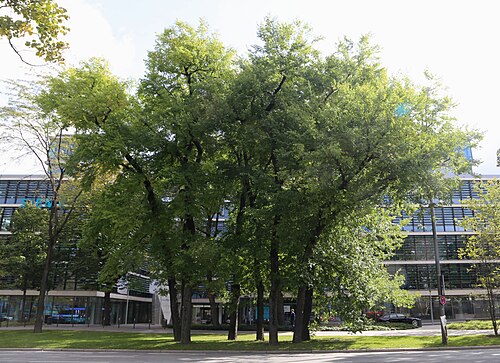
Eight Mediterranean trees grow on a green strip beside one of Munich's busiest ring roads, in a city more than 500 kilometres north of where the species grows wild.
Photo: Rufus46 (CC BY-SA 3.0)
Celtis australis
Italians call this tree spaccasassi, the stone splitter, because its roots get into paving and open it, and cities across southern Europe plant it in their squares regardless, because little else gives that much shade on that little water. We map 32 of them, in 21 cities.
Celtis australis is deep rooted, drought hardy and indifferent to heat, with a smooth grey trunk closer to a beech than an oak and small dark berries that taste faintly of dates. Mostly it is treated as background, which is why the exceptions stand out. Istanbul protects one by name. Munich registers a group of eight as an extremely rare species, five hundred kilometres north of where the tree grows wild. Varedo's, near Milan, is five metres round and 27 metres tall. And a hackberry in Zaragoza came third in Spain's national tree of the year vote in December 2025, put forward by five neighbourhood associations.
Eight Mediterranean trees grow on a green strip beside one of Munich's busiest ring roads, in a city more than 500 kilometres north of where the species grows wild.
Photo: Rufus46 (CC BY-SA 3.0)
The hill in this park is what was left of Munich after 1945.
Not every tree on this list needed royal patronage or a foreign pedigree to earn its place.
Barcelona protected twelve trees across the city in one sitting in May 2024, and this hackberry in the Jardins dels Drets Humans was one of them, cited for size rather than age: a 2.9 metre girth a...
One tree remembers the farms that used to be here.
Five metres round the trunk and twenty-seven metres tall, and it is only the largest of four.
Three trees on Italy's national monumental register stand on one ordinary town square in Pioltello.
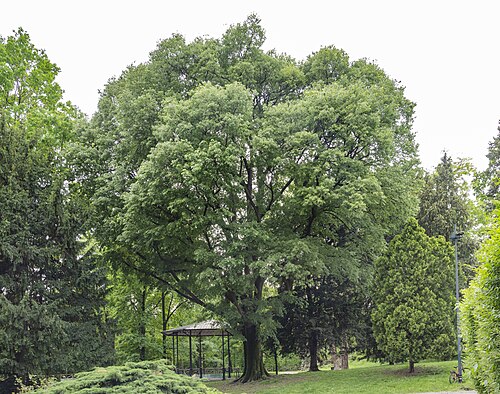
Milan calls this species spaccasassi, the stone-splitter, for roots strong enough to crack paving, and this hackberry has had over a century and a half to test the claim against the paths of the ci...
Photo: Sordelli (CC BY-SA 4.0)
The comune's own page for this hackberry calls it arcidiavolo, the archdevil, after a folk tale that blamed its hooked leaves on Lucifer, said to have carried the species down from heaven clutched...
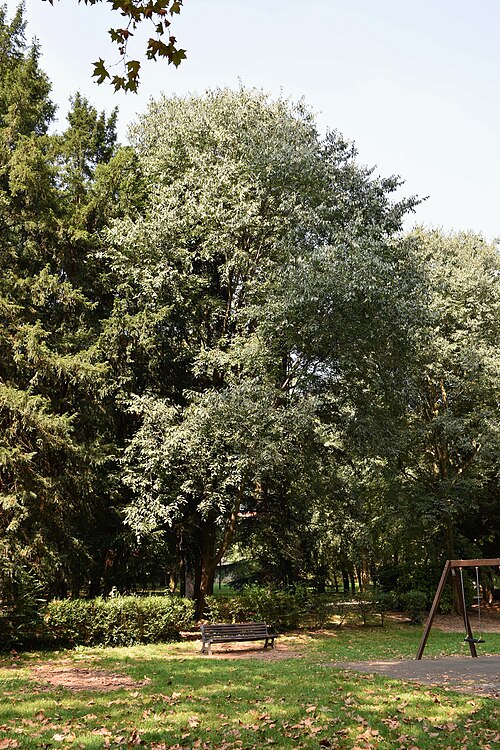
Ercole Silva wrote the book on English-style gardens in Italy, literally: his 1801 treatise Dell'arte dei giardini inglesi helped introduce the naturalistic parkland look to the country, and he tri...
Photo: Mauro Molinaro (CC BY-SA 4.0)
Two hackberries, the species Milan nicknames spaccasassi, the stone-splitter, for roots strong enough to crack paving, line the path toward a small theatre that has outlived every building that onc...
A hackberry in the holm oak wood behind the Museo Carlo Bilotti carries a nickname rather than a certificate: locals call it il bagolaro del Seicento, the hackberry of the 1600s, though nobody has...
Two official surveys measured this hackberry and agreed on its waist to within a centimetre: four metres around.
Rome's register carries two Mediterranean hackberries and they stand a hundred and twenty metres apart.
The Plaza de Murillo, the small formal square between the Prado's south door and the gate of the Royal Botanic Garden, holds four catalogued conifers and one broadleaf that outgrew every one of them.
In November 2025 Italy's state railway announced it would fell twenty one trees in this small square to rebuild the nearby Ponte al Pino bridge: fifteen hackberries, two maples, two planes, two hol...
Hackberry wood was cheap and ordinary enough that for centuries nobody thought to plant it for looks: it went into barrel staves, walking sticks, fishing rods and farm tools, and children used its...
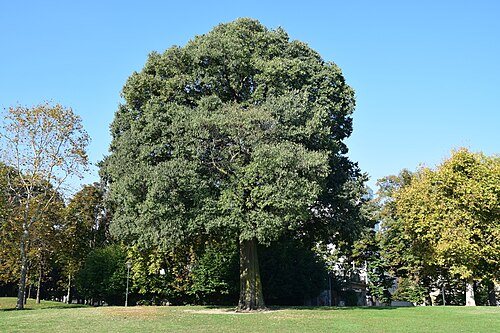
This one stands by itself on open grass, which is why it looks the way it does.
Photo: Emmanuelbaltasar (CC BY-SA 4.0)
For over 180 years this hackberry has stood in what is now Piazza Hortis, and for most of that time nobody thought about what people were doing to its roots.
Hundreds of schoolchildren carried this tree up the hill.
Istanbul protects this tree by name, which is unusual for a species most cities treat as background.
A fungus is eating these three from the inside, and the city said so itself.
In December 2025 this tree came third in Spain, with 1,799 votes, in a national poll for tree of the year.
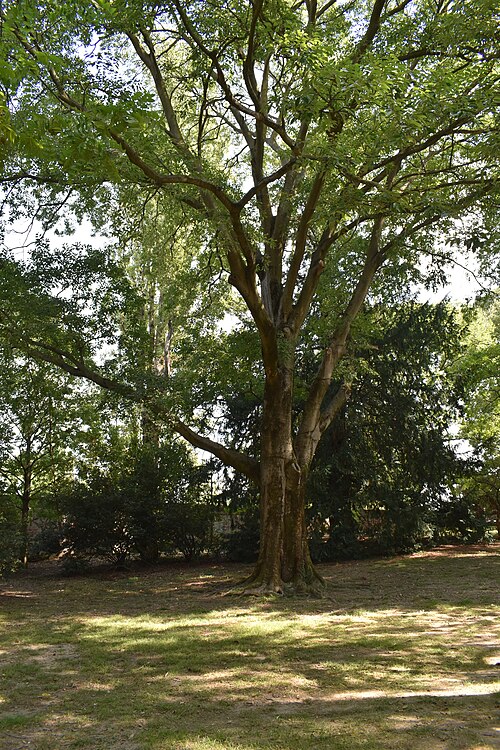
Parco Massari has changed hands three times since architect Luigi Bertelli laid it out in 1780 for the Marchese Camillo Bevilacqua: to the Massari counts in the mid-19th century, who remade it as a...
Photo: Nicola Quirico (CC BY-SA 4.0)
Ancient writers put this tree forward as the lotus that made Odysseus's crew forget the way home.
Photographs from a century ago already show this hackberry at roughly the size it is today, which is why the Balearic register will only put its age somewhere between 150 and 350 years.
In Montuiri, anar al Lledoner, going to the Lledoner, is local shorthand for dying.
Italians call this species spaccasassi, the rock splitter, because its roots get into stone and open it.
The small dark berries on this tree are edible, and they taste faintly of dates.
This tree came up between two gravestones and neither of them has moved.
Toulouse's tree inventory files this one as libre, free grown, and that word is worth more than it looks.
Most hackberries with a trunk this thick are twice as tall.
Explore by city: Munich · Seville · Barcelona · Lisbon · Milan · Venice · Rome · Madrid · Florence · Malaga · Turin · Trieste · Istanbul · Geneva · Ferrara · Caserta · Perugia · Toulouse · Trento · every city · or browse all species.