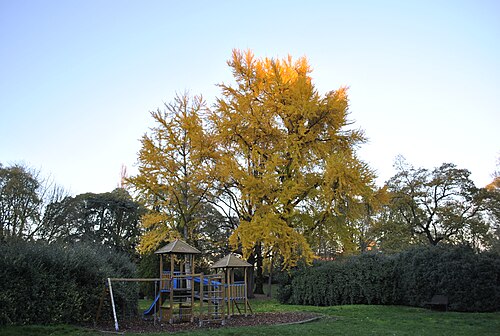
The Bagolaro of Parco Massari
Parco Massari has changed hands three times since architect Luigi Bertelli laid it out in 1780 for the Marchese Camillo Bevilacqua: to the Massari counts in the mid-19th century, who remade it as an English-style landscape park, and in 1936 to the city of Ferrara, which still owns it. This hackberry, about 150 years old, was already growing when that last transfer happened. Its trunk runs 3.76 metres round, straight and fluted under gray bark, holding up a dense, rounded crown on branches wide enough in diameter to have earned it individual protection on Italy's first monumental tree list alongside the park's three cedars of Lebanon. Celtis australis takes its Italian name, bagolaro, from a Lombard word for a tool handle, a nod to timber once prized for exactly that; a second nickname, spaccasassi, rock-breaker, describes its willingness to root in poor, stony ground where softer species fail. The species can live 600 years by some accounts, which makes a century and a half look like the opening chapter rather than the whole story.
The line is our estimate of how much there is to see, not a measurement. Typical for this species where this tree stands; exact weeks shift with the year.
Parco Massari, Corso Porta Mare, 44121 FerraraThe rounded, dense-crowned hackberry on the park's north side facing Via Guarini, its straight, fluted trunk covered in ash-gray bark.
Free, public park, open daily
About a 15 minute walk north-east of Ferrara railway station
Sources
Where the facts on this page come from.
- In the official register: Elenco degli alberi monumentali d'Italia (MASAF), no. 11/D548/FE/08
- masaf.gov.it
- museoferrara.it
- storiedipianura.it
- MASAF, Elenco degli alberi monumentali d'Italia (Italy's national register of monumental trees), no. 11/D548/FE/08