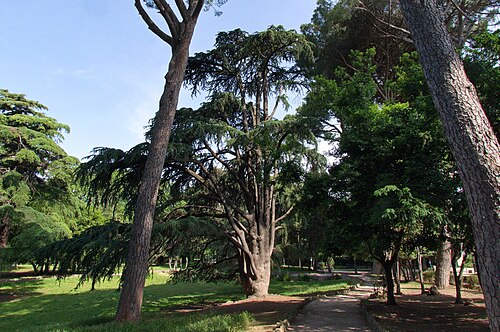
Rome's register carries two Mediterranean hackberries and they stand a hundred and twenty metres apart. The one inside the Parco degli Scipioni has a park authority's catalogue entry, a health rating and an age estimate. This one, thirteen centimetres thicker at 4.14 metres round, has a line in a spreadsheet. It grows at the corner of Viale delle Mura Latine and Via Latina, along the Aurelian Walls. Italians call the species bagolaro, and also spaccasassi, stone splitter, after its habit of rooting into walls and rock and refusing to be shifted. The wall beside it went up between 271 and 275, nineteen kilometres of brick faced concrete thrown around the city in four years by an emperor who had stopped assuming Rome was safe. The Porta Latina is a few steps south. The register puts the tree at twenty metres and records what earned it the designation: its size, and its form and bearing. It gives no age, and hackberries thicken quickly on good ground, so four metres round here does not mean the two centuries the same measurement would suggest in an oak. One source only, the national register through the Lazio list. The Appia Antica park's own catalogue of notable trees describes its neighbour in detail and does not mention this one.
The line is our estimate of how much there is to see, not a measurement. Typical for this species where this tree stands; exact weeks shift with the year.
Viale delle Mura Latine at the corner of Via Latina, by Porta Latina, 00179 RomaAt the corner of Viale delle Mura Latine and Via Latina, hard against the Aurelian wall, 4.14 metres round and a few steps from the Porta Latina.
Free, on a public street beside the Aurelian Walls
By Porta Latina, about 100 metres from the Parco degli Scipioni entrance at Via di Porta Latina 16; roughly 20 to 25 minutes' walk from Circo Massimo (Metro B)
Sources
Where the facts on this page come from.
- In the official register: Elenco degli alberi monumentali d'Italia (MASAF), no. 65/H501/RM/12
- masaf.gov.it
- regione.lazio.it