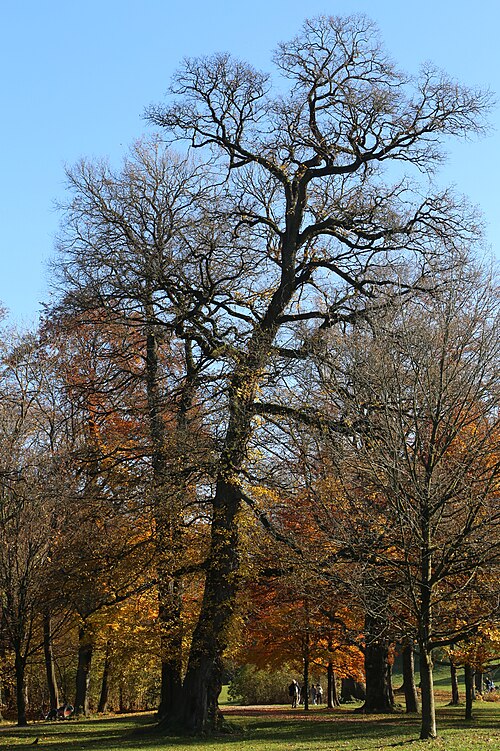
The Hackberry of the Luitpoldpark
The hill in this park is what was left of Munich after 1945. From 1946 onward the rubble of the bombed city was carted up to Schwabing and piled into the Luitpoldhügel, roughly 37 metres of broken masonry now buried under grass and footpaths, with a view across to the Olympic Park from the top. The park underneath it is older. It was laid out in 1911, when 90 lime trees went in for the ninetieth birthday of Prince Regent Luitpold. The hackberry is not one of them. Celtis australis belongs to southern Europe, Asia Minor and North Africa, its natural range stopping well south of the Alps, and Munich's 2021 natural monument ordinance calls it an extremely rare species in the city, protected here for being beautiful and for an interesting growth form rather than for any size. It was the timber of whip handles, pitchforks and walking sticks, chosen because it bends a long way before it breaks. The quickest way to be sure you have found one is the leaf: lopsided at the base, one half running further down the stalk than the other, with a hard toothed edge. The fruit is a small dark drupe, sweet and almost entirely stone. The ordinance records why the tree is protected, never when it was planted, and no age exists for it anywhere.
The line is our estimate of how much there is to see, not a measurement. Typical for this species where this tree stands; exact weeks shift with the year.
Luitpoldpark, 80804 MünchenYou can recognise it by a lopsided leaf base, one half running further down the stalk than the other, standing apart from the park's 1911 lime plantings. It stands in the Luitpoldpark.
Free, public land, no restrictions
3 min walk from Scheidplatz station
Sources
Where the facts on this page come from.
- In the official register: Naturdenkmal (Bayern LfU), no. ND-07188
- Munich Naturdenkmalverordnung 2021, Schwabing-West 1
- lfu.bayern.de