Assisi's monumental trees climb the town's own geography. Near the walls: a yew whose 4.5-metre girth is a cluster of shoots rather than one trunk, and a downy oak in the hamlet of Valecchie, added to Italy's register in July 2026 as Umbria's tallest. Four kilometres up Monte Subasio, two holm oaks flank the path to the Eremo delle Carceri, where Francis withdrew to pray; a sign calls the older one nine centuries old, tradition rather than measurement. Furthest of all, a wind-shaped hawthorn waits on the open mountaintop, a real climb past the hermitage.
0 of 6 visited in Assisi
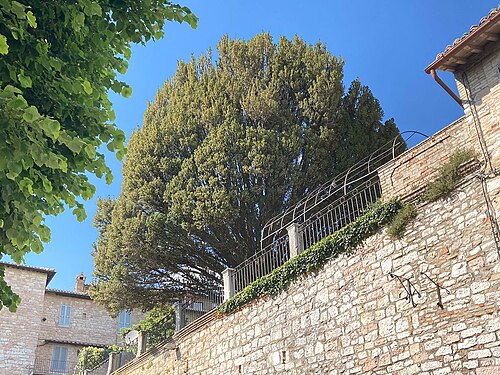
European Yew (Taxus baccata) · centuries old · Historic centre, near Porta Santa Chiara / Porta Nuova
The 450 centimetres in this yew's register entry is not a trunk. The tree has thrown up a ring of shoots from the base of the mother plant, so a tape at chest height goes around a cluster rather than a stem, which is why the sources that record the figure call it insignificant as a measurement. Nobody has dated the tree either. The only evidence is photographic: pictures from the early 1900s already show a yew of this size on this terrace, so it was a substantial old tree before the First World War, and that is where the record stops.
It sits in a raised garden above Via Borgo Aretino, inside the walls near Porta Santa Chiara, a few minutes downhill from Piazza del Comune, and stands 12.5 metres of dark evergreen over a street that has carried pilgrims for eight centuries. The name belongs to the Pucci family, whose house adjoined the garden; the spot is still known locally as the Portella dei Pucci. Italy's national register lists it under three criteria at once, age and size, form and bearing, and landscape value.
Yews hollow out from the inside as they age, which defeats ring counting. You can see this one from the street. Whether the garden is open to walk into we have not been able to confirm, so plan on the pavement. If you know either answer, tell us.
Photo: Jynjyn (CC BY-SA 4.0)
Downy Oak (Quercus pubescens) · Just outside the walls, on the old road to the Eremo delle Carceri
Assisi stops at this oak. Walk out through Porta Cappuccini, the highest of the town's medieval gates, and the paving gives way to a dirt track toward Fontemaggio and the Eremo delle Carceri. The downy oak stands at that fork, marking the line where the walled town ends and Monte Subasio begins, which is why the town calls it simply la cerqua di Porta Cappuccini, the oak of the Capuchin gate.
Italy's national register measures it at 4.8 metres round and 21 metres tall. Two other surveys give 5 metres and 25 metres, which is what happens when a living tree is measured years apart rather than a sign that anyone got it wrong. Downy oak is the dry-hillside oak of central Italy and it is usually cut for firewood long before it reaches anything like this size. This one was left, standing over the old walking route that pilgrims still take up to the hermitage where Francis withdrew to pray.
The tree sits inside a private orchard, so the view is from the path rather than from under the crown. For a tree this wide that is the better vantage anyway, and the path is public.
Nobody has recorded an age for it. Italy's register does not carry one and neither do the local sources. If you know, tell us.
Downy Oak (Quercus pubescens) · Valecchie, a hamlet (frazione) of Assisi, lower and west of the walled historic centre
Italy added this oak to its national register of monumental trees on 24 July 2026, and it went straight in as the tallest tree Umbria has on that list. Thirty metres tall, 5.2 metres round. For a downy oak that is unusual: the species is the drought-tolerant hillside oak of central Italy and it normally stops well short of thirty, so this one has spent its life on deep soil with water and nothing crowding it for light.
The address explains part of that. Valecchie is a hamlet below Assisi's walls, on the plain rather than the hill, at 273 metres against the old town's 420, where the ground is farmland instead of limestone. Every visitor to Assisi climbs; the tallest monumental tree in the region has been standing down the hill from them the whole time. It is on or beside Via di Valecchie, a public road, though whether you get to the trunk or only to the verge is not something we can promise yet.
The freshness of the listing is itself worth something. A ministerial decree in the tenth national update named it this July, which means surveyors measured this tree standing and healthy weeks ago rather than decades ago. Most register entries anywhere cannot say that.
No age is recorded. Italy's national list has never carried an age field and no local source fills the gap. If somebody has dated this oak, tell us.
Holm Oak (Quercus ilex) · 850-1,000 years · Eremo delle Carceri, a Franciscan hermitage on the wooded slope of Monte Subasio, about 4km from Assisi's centre
This was the first tree Italy ever entered on its national register of monumental trees. Entry number one is a holm oak at the Eremo delle Carceri, standing beside the path to the cave where Francis of Assisi withdrew to pray.
A sign at the site calls it the Albero del tempo di San Francesco, the tree of St Francis's time, and gives it 850 to 1,000 years, which would put it here before he was. Read that as the hermitage's claim rather than as a measurement: it is a devotional attribution, not a growth-rate estimate, and two metres of girth is modest for a holm oak of nine centuries. What is not in doubt is why the register wanted it. Its sheet carries criterion g, historic and religious value, alongside age and size, which is the state saying out loud that this tree matters for what happened next to it.
It is a small, hard-worn tree, nine metres tall with a crown of four, which for a species that can spread twenty says everything about 800 metres of altitude and thin limestone soil. It stands inside a holm oak wood of roughly fifty hectares, described locally as one of the most important in central Italy. The hermitage is open daily and entry is free.
Nobody has dated the tree by measurement. If someone has, tell us.
Holm Oak (Quercus ilex) · Eremo delle Carceri, a Franciscan hermitage on the wooded slope of Monte Subasio, about 4km from Assisi's centre
The famous holm oak at the Eremo delle Carceri is the small one. Two hundred metres along the same path stands its neighbour: three metres round, 23 metres tall, a crown spreading sixteen, and second place in Umbria's regional register of monumental trees. It has no sign, no name of its own and no legend attached, which is most of the reason people walk past it.
It grows on a scarp beside the path down to the sanctuary, on ground held in place by a dry-stone retaining wall. Look at the wall as well as the tree. A holm oak this size on a slope at 795 metres needs its root plate to stay where it was put, and somebody at some point decided this one was worth the masonry.
The rest of the story is the wood: fifty-odd hectares of holm oak covering this side of Monte Subasio, the forest the first Franciscans built their cells into, and the reason the hermitage sits where it does. Two of its trees are on the national register by name and this is the larger of them. The Eremo is open daily and entry is free.
Nobody has dated it. Its neighbour got a sign and a tradition; this one got a tape measure. If you know how old it is, tell us.
Common Hawthorn (Crataegus monogyna) · High on Monte Subasio (1,075m altitude), well beyond the Eremo delle Carceri
Hawthorn is a hedge plant. This one is on Italy's national register of monumental trees, standing at 1,075 metres on the open top of Monte Subasio, and reaching it is a climb rather than a stroll.
The register credits it with 480 centimetres of girth, which is a figure that needs explaining rather than repeating. The ministry measures every tree at a standard 1.3 metres from the ground, and by that height this hawthorn has already split into several stems, so 480 is the girth of a fork. Drop to 50 centimetres and the trunk below the split measures 260. That is still enormous for the species and it describes the tree far better: low, broad and many-limbed, six metres tall with a crown spreading eight and a half, the shape of something that grew up in wind.
The walk is the honest part. From Porta Cappuccini it runs about five kilometres on the CAI 350 and 351 trails, past the Eremo delle Carceri and on up to the old Rifugio di Vallonica, climbing roughly 600 metres. No road, no bus, several hours there and back, on open park land the whole way. Time it for May, when the crown turns white and scented and the top of the mountain smells of it.
Nobody has dated the tree. If you know, tell us.