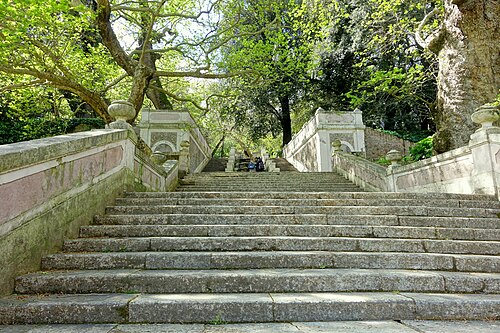
The Cedar of the Garibaldi Mausoleum
This cedar shares its hillside with the dead of a revolution. It grows between the Fontana dell'Acqua Paola and the Mausoleo Ossario Garibaldino, the 1941 monument holding the remains of those killed defending Rome's short-lived Republic in 1849 and fighting to make the city Italy's capital between 1860 and 1870. Officially measured for the national monumental tree registry, it stands about 20 meters tall with a trunk 5.74 meters around, and its documented age of roughly 146 years puts its planting in the 1870s, soon after Rome became the capital of a unified Italy in 1871 and this hillside turned from battlefield into a place of civic memory. Cedars of Lebanon are not native anywhere near the Gianicolo; Roman nobility, and later the new Italian state, planted them across the city's hilltop gardens as a shorthand for permanence and old-world grandeur, the same reasoning that put cedars in half the noble villas on this list. This one has outlasted the reasoning: nobody plants status symbols on a war memorial today, but the tree stayed, and it is now the memorial's oldest living feature.
In fruit
upright barrel cones that sit on the branches like eggs
The line is our estimate of how much there is to see, not a measurement. Typical for this species where this tree stands; exact weeks shift with the year.
Via Giuseppe Garibaldi 29, Gianicolo, 00153 RomaBetween the Acqua Paola fountain and the Garibaldi ossuary, a cedar 5.74 metres round and about 20 metres tall, the oldest living thing on the memorial ground.
Free, open access, Gianicolo
Bus 115 or 870 to Gianicolo, short walk
Sources
Where the facts on this page come from.
- In the official register: Elenco degli alberi monumentali d'Italia (MASAF), no. 03/H501/RM/12
- ilregistrodeglialberi.it
- comune.roma.it