Fara in Sabina's one mapped tree is an olive so old that its own sources cannot agree by how much: the national tree register's own dendrological reading puts it near two thousand years, other experts settle nearer a thousand and tie it to an eleventh-century land reclamation, and a university field study suggests it may be younger still. It stands alone in a grove at Casale Bertini, on the Via di Francesco pilgrim route, still cropping, still hollow enough to have hidden supplies during the Second World War.
0 of 1 visited in Fara in Sabina
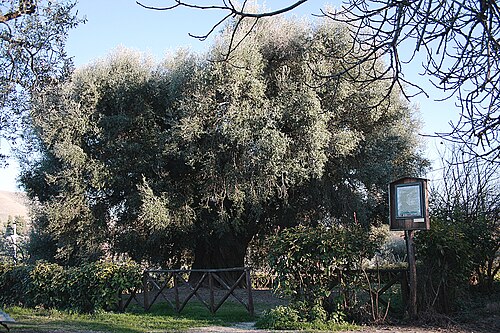
Olive (Olea europaea) · 700-2000 years · Casale Bertini, Canneto Sabino
Four estimates of this olive's age are on the record and they span more than a thousand years.
Italy's tree register credits it with roughly 2,005 years from its own dendrological assessment. Local legend goes further and hands the planting to Numa Pompilius, Rome's second king, in the seventh century BC, a story the sources that repeat it also dismiss as legend. Others settle near a thousand years and tie the tree to the Benedictine reclamation of this land in the eleventh century. The University of Tuscia's field analysis comes in lowest of all, at perhaps seven or eight hundred. Nobody has closed the gap, and the tree is no help: like most ancient olives it is hollow, so there are no rings left to count.
The measurements are firmer, if not identical. The register puts it at 6.40 metres round at 130 centimetres up and 10 metres tall. Taken elsewhere on the trunk it reads anywhere from 5.60 metres at its narrowest to 7.20 at its widest, because an olive this old is less a trunk than a bundle of fused stems.
During the Second World War the hollow was used to hide supplies. It still crops. It stands by itself in the middle of a grove at Casale Bertini, on the Via di Francesco pilgrim route, and festivals are still held underneath it.
Photo: Edoardo Berionni Berna (CC BY-SA 4.0)