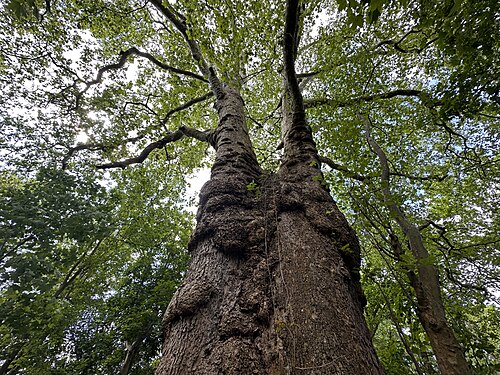
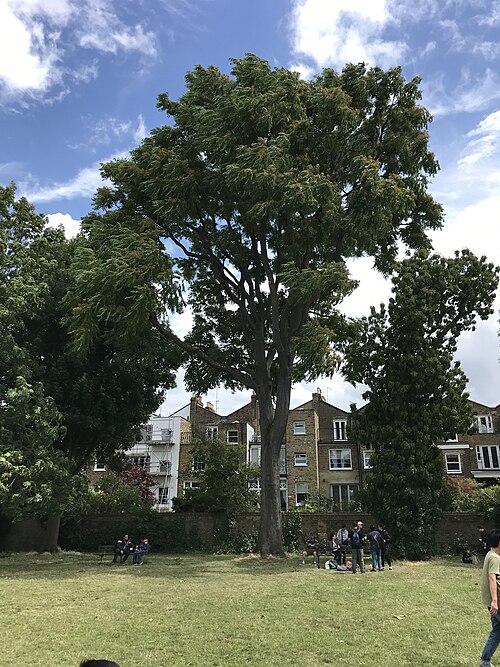
This oak survived five centuries partly because people kept attacking it. It was coppiced long ago, cut back hard to its base, a brutal-looking practice that paradoxically resets a tree's age clock and can add centuries to its life rather than shorten it. What grew back is a Holm Oak, an evergreen Mediterranean species that has no business thriving this far north, and quite possibly the oldest specimen of its kind anywhere in Britain. It grows in the grounds of Fulham Palace, for centuries the working home of the Bishop of London rather than a royal estate, and the two bishops most often credited with planting it, Edmund Grindal and John Aylmer, both lived here in the second half of the 16th century, among the first people in England to try growing the species at all. The oak was named among the original 41 trees given Great Tree status in 1988, and a later record corrected an old misidentification of the tree as a common Pedunculate Oak rather than the rarer Mediterranean evergreen it actually is. Fulham Palace Gardens are free to enter daily, which means reaching London's likely oldest holm oak costs nothing but the walk from Putney Bridge station.
The line is our estimate of how much there is to see, not a measurement. Typical for this species where this tree stands; exact weeks shift with the year.
Fulham Palace Gardens, Bishop's Avenue, London SW6 6EAYou can recognise it by its evergreen leaves, a Mediterranean holm oak still in leaf when its neighbours are bare, and by the low base it was once coppiced to. It stands in Fulham Palace Gardens, free and open daily.
Free. Fulham Palace describes itself as open daily with free admission; its opening-times page lists the botanic garden as 07.00 to 18.00. Parts of the garden can close for private events. The oak stands at the south-east corner of the main lawn, near the Tudor wall of the walled garden.
Putney Bridge tube, 10 min walk
Sources
Where the facts on this page come from.