A mulberry tree possibly older than Belgium itself grows in a garden that predates the country by four years.
Black Mulberry
Morus nigra
Britain's silk industry failed on a species error and left the trees behind. We map 13 of them, in 10 cities.
In 1608 James I ordered mulberries planted across the country to feed silkworms, but silkworms eat white mulberry and mostly refuse black, and black was what went into the ground. Charlton House got one of them and it is still fruiting four centuries later. Christ's College in Cambridge planted another in 1608 or 1609, the year after John Milton was born. The oldest here is older than the scheme: Adam Winthrop planted the Groton mulberry in Suffolk around 1550, on the ground where his grandson grew up before leading the Puritan fleet to Massachusetts. Its trunk collapsed decades ago and the fallen wood rooted again, which is how old mulberries keep going. Breda's public library was designed around three of them rather than the other way round.
Brussels
Cambridge
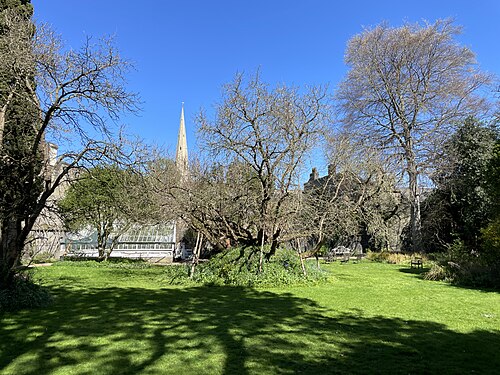
James I wanted England to have a silk industry to rival France and Italy, and in the early 1600s ordered mulberry trees planted nationwide to feed silkworms.
Photo: Mr Ignavy, via Geograph/Wikimedia Commons (CC BY-SA 2.0)
London
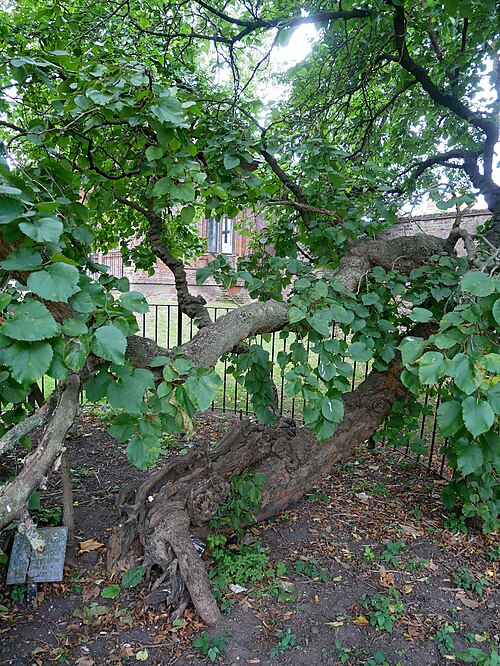
James I wanted Britain to grow its own silk, and in 1608 he ordered mulberry trees planted across the country to feed the silkworms that would spin it.
Photo: Ethan Doyle White (CC BY-SA 4.0)
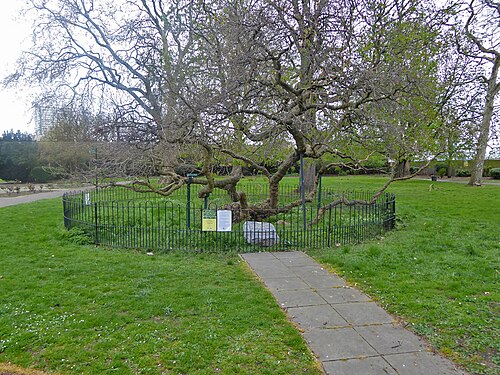
John Evelyn's garden at Sayes Court was one of the most celebrated in 17th century England, laid out by a writer and diarist who helped define English ideas about forestry and planting, and it last...
Photo: Robin Webster, via Geograph Britain and Ireland / Wikimedia Commons (CC BY-SA 2.0)
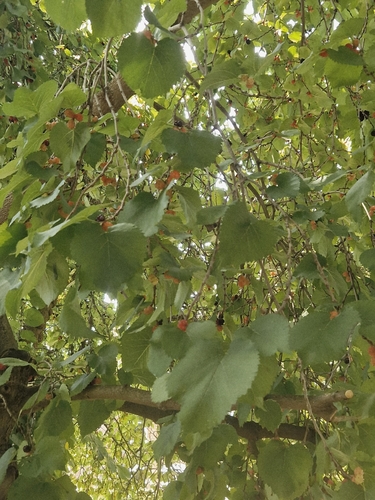
Two black mulberries lean on wooden crutches either side of a fountain that has been running since 1681.
Photo: Clive Freedman (CC BY)
The Inner Temple's garden opens to the public for two and a half hours on weekday afternoons, and this tree is a fair reason to time the visit.
Breda
A library was built around these trees rather than the other way round.
Copenhagen
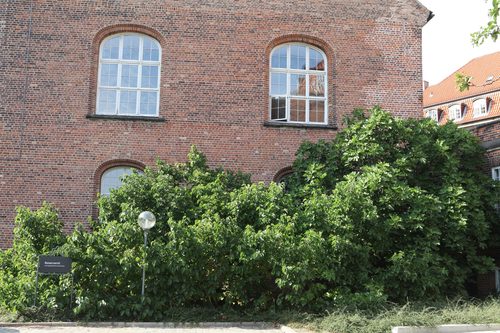
King Christian IV tried to build a Danish silk industry the way his contemporaries elsewhere in Europe were doing it, by planting mulberry trees to feed silkworms, and Copenhagen has pointed at thi...
Photo: Hans Erik Lund
Delft
The black mulberry in the courtyard of Hofje van Pauw has been fruiting since before the Dutch East India Company's Delft chamber was a century old.
Antwerp
Sharing Hertoghepark with Belgium's thickest black locust is a much smaller record holder: a black mulberry measured at 1.28 metres around in 1989, listed as the national champion of its species re...
Cesky Krumlov
Zlatá Koruna's last abbot went into silk.
Groton
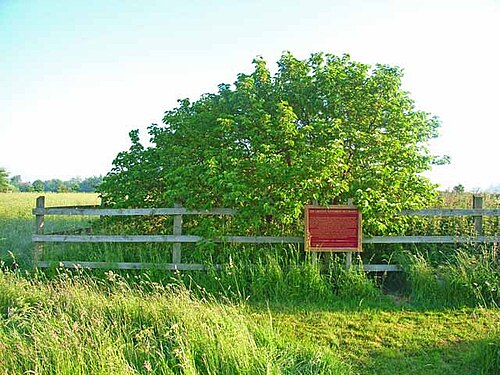
A black mulberry in a Suffolk village helped put the first governor on Massachusetts Bay.
Photo: Oliver Dixon (CC BY-SA 2.0)
Leuven
Belgium protects this mulberry the way it protects a building.
Explore by city: Brussels · Cambridge · London · Breda · Copenhagen · Delft · Antwerp · Cesky Krumlov · Leuven · every city · or browse all species.