Runnymede is famous for a meadow where King John sealed Magna Carta in 1215, and across the Thames at Ankerwycke stands the tree old enough to have watched it happen. The Ankerwycke Yew is somewhere between 2,000 and 2,500 years old, hollow enough to step inside, and 7.98 metres round at its base. It grows in the grounds of a ruined priory on open National Trust parkland, no ticket needed, reached on foot from Magna Carta Lane.
0 of 1 visited in Runnymede
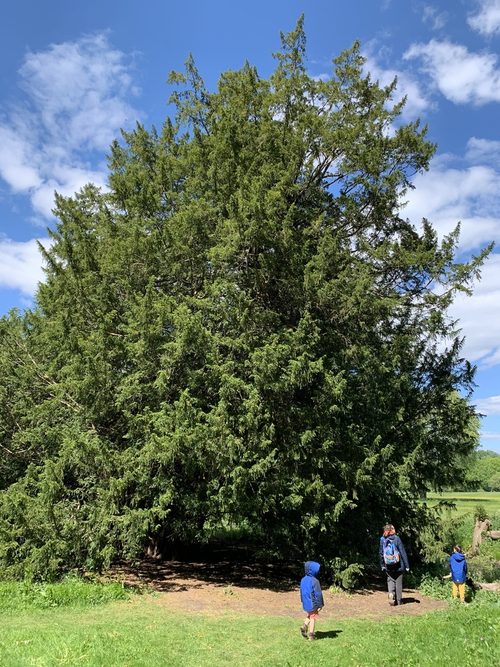
European Yew (Taxus baccata) · 2,000-2,500 years · Runnymede and Ankerwycke (National Trust)
Two national bodies that both know their trees cannot agree on this one's age to within five hundred years. The Woodland Trust says approximately 2,000. The National Trust says as much as 2,500. Neither can settle it, because an old yew rots from the middle outwards and takes its rings with it. What can be measured is the trunk: 7.98 metres round, and taken low, at thirty centimetres off the ground, because a base this hollowed and buttressed offers no clean line higher up.
Either figure leaves it standing here in June 1215, when King John sealed Magna Carta somewhere on this stretch of the Thames. Tradition puts the sealing under this tree, and some historians do argue the ceremony happened on this bank rather than in the meadow opposite. That is an argument, not a record. The same applies to the story that Henry VIII courted Anne Boleyn beneath it in the 1530s. Said to, thought to, never written down at the time.
The certainties are quieter. It grows in the grounds of St Mary's Priory, a ruined Benedictine house on open National Trust land, reached on foot from Magna Carta Lane. The 2020 survey recorded holes, water pockets, decaying wood in the crown and a trunk hollow enough to step into, all of it ordinary for a yew of this age. Visitors still tie strips of cloth to the boards beside it, which is an old habit for an old tree.
Photo: Liam Maguire (CC BY)