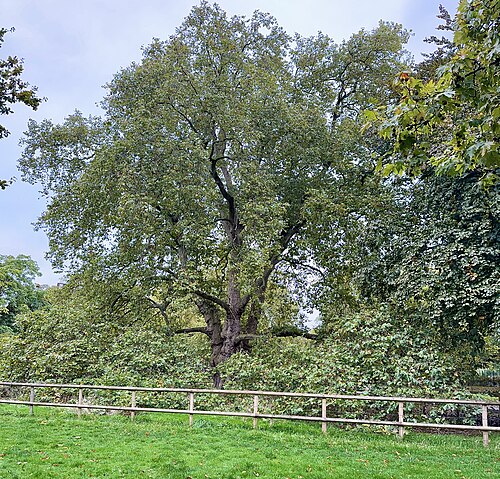
The oldest living thing in London stands in a churchyard most people drive straight past. This yew was already ancient when the Romans built Londinium two thousand years ago, and the church beside it is the newcomer: St Andrew's dates only to the 13th century, a good thousand years younger than the tree growing at its edge. A 2008 survey by the Conservation Foundation, the Ancient Yew Group and Barnet Council named it possibly the oldest tree in the city, though ring counting is useless here. Yew heartwood rots away long before it can be counted, which is why the estimate spans a thousand years, 1,000 to 2,000, rather than a single number. What survives is a hollow, propped trunk with a girth of nearly eight metres, kept alive the way most ancient yews are kept alive: repeated pollarding, cutting the tree back hard and often enough to reset its own clock rather than let it grow toward collapse. Totteridge was a village long before London reached it, and its Hundred Court, the local medieval assembly that settled disputes and collected dues, once met in the yew's shade, using the tree as a landmark centuries before anyone thought to measure its age.
In fruit
September to November: red arils on female trees, the only part that is not poisonous
The line is our estimate of how much there is to see, not a measurement. Typical for this species where this tree stands; exact weeks shift with the year.
St Andrew's Churchyard, Totteridge Village, London N20 8PRYou can recognise it by the hollow trunk, propped up and nearly eight metres round, cut back hard by repeated pollarding. It stands in St Andrew's churchyard at Totteridge, older by a thousand years than the church beside it.
Free, open access, churchyard
15 min walk from Totteridge & Whetstone station (Northern Line)
Sources
Where the facts on this page come from.