Brighton holds the National Elm Collection, the largest surviving population of mature elms in Europe. Dutch elm disease emptied Britain of its big elms from the 1960s on. Here the Downs to the north and the sea to the south slowed the beetle down, and the council has cut infected wood out of the city's trees since the early 1970s. Four of the six trees below are elms, among them one planted around 1613 and its twin, felled in 2019 and carved into a sculpture that stands beside it.
- KKerry PickettBrighton ambassador
0 of 6 visited in Brighton
English Elm (Ulmus procera) · 410 years · Preston Park
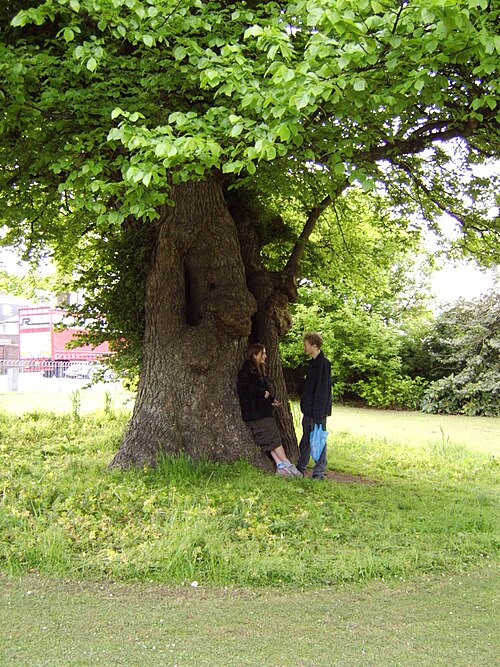
Two elms were planted here around 1613, almost certainly as part of a hedgerow, on land local accounts put under the Bishop of Chichester at the time, and grew into what Brighton and Hove City Council calls the largest and oldest surviving English elms in Europe. They had no name until Peter Bourne, the volunteer curator of the National Elm Collection, which Brighton hosts, measured them in the late 1980s and called them the Preston Twins. The eastern twin was damaged in a storm in 2017, caught Dutch elm disease the following year, and was felled in December 2019 to keep the infection off its neighbour. Its wood was carved, gilded and raised again on the same ground in spring 2023. So the north end of Preston Park holds one living elm of about 410 years and the worked remains of its twin.
The survivor is 6.38 metres round and was dedicated to Queen Elizabeth II under the Queen's Green Canopy in May 2022. It holds a colony of White-letter Hairstreak butterflies, which lay only on elm.
Dutch elm disease took the mature English elm almost everywhere else. Brighton has cut infected wood out of its elms since the early 1970s, and since 2023 it has also inoculated them against the disease, the first council in the UK to run such a programme by local account: 200 elms the first year, around 1,400 in 2025. This pair is what that buys: one still growing, one still standing, carved.
English Elm (Ulmus procera) · 250 years · Royal Pavilion Garden
The Royal Pavilion's garden holds an elm older than the Pavilion. It was planted in 1776 and is now kept in one piece by a pair of forged iron braces clamped around a hollow stem, which is where the name comes from. Visitors have hooked padlocks onto them, the way people do to bridges, so the tree carries both the ironwork that saved it and the ironmongery it attracted.
Brighton and Hove Museums call it their oldest elm and describe it as hollow but healthy, which is the normal condition of an old elm that has got this far. The heartwood goes; the outer sleeve keeps working. The only measurements anyone has published come from a 1968 survey: 20 metres tall, 4.6 metres round, two large cavities recorded at the time and nothing since.
It is still being looked after. In March 2025 the museums took out a dead sycamore nearby, partly so that this tree would get more light.
One thing to know before you go. The sources put it on different lawns. The museums place it near the Indian Gate at the south entrance, another of their own articles calls it the West Lawn tree, and a Brighton elm resource says the southern edge. It is one tree, and the garden is small enough to settle the question on foot.
European Yew (Taxus baccata) · 500 years · Stanmer Park
In a city known for its elms, the oldest tree is a yew, and there are two of them. They grow together on the north side of Stanmer parish church, at the far end of Stanmer Park, and Brighton and Hove City Council names the larger one as the oldest tree in Brighton: 5.94 metres round, classed ancient, estimated at over 500 years. The Ancient Yew Group, who survey these trees for a living, record the same girth and put the companion at 5.64 metres.
Local tradition claims a great deal more, calling this one Saxon and a thousand years old or better. Neither the council nor the yew specialists repeat that, and nobody has dated the tree directly, because ancient yews hollow out and take their rings with them.
What is documented is how long the pair have been worth remarking on. A drawing in the Burrell Collection from around 1780 shows them, and in 1833 J.D. Parry put two curious old yew-trees in this churchyard into print, which puts them on the record while Stanmer was still a private estate rather than a public park. The churchyard is open, free and quiet, and the two trees are the first thing you meet on the north side of the church.
Cedar of Lebanon (Cedrus libani) · 250-300 years · Stanmer Park
Three cedars of Lebanon stand behind Stanmer House, and one of them is the tallest of its species in East Sussex on the council's own reckoning. They were planted in the eighteenth century, and the tradition here attaches them to Thomas Pelham, who built the house in the 1720s.
Cedrus libani was a status planting in English parkland: brought from the mountains of the Levant and set out in front of new country houses precisely because it did not look English. Flat-topped, dark, built in horizontal plates rather than a rounded crown. Three centuries on that is still what marks this group out from the parkland trees around them.
There used to be more. One of the original cedars came down in a storm at over 150 years old, and its timber was carved into badger sculptures that are still on the site, which is a better end than firewood.
Which of the three carries the height record is not something the sources settle. They describe the cedars as a group, and no girth or height figure has ever been published for any of them, only the designation. So the honest version is this: the tallest cedar in the county is one of these three, and if you know which, tell us.
Wych Elm (Ulmus glabra) · 200 years · Queen's Park
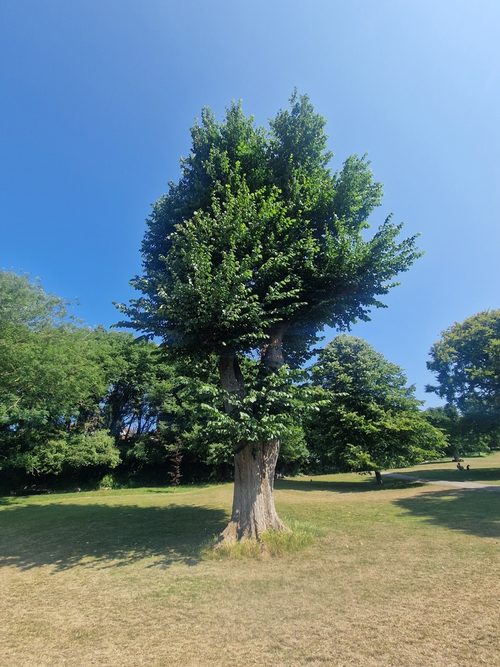
The widest wych elm recorded in Sussex stands in a dog exercise area above a children's playground. The Tree Register of the British Isles holds it as the county champion for its species on girth, 389 centimetres when it was measured in June 2020, at a height of 23 metres.
Wych elm is the only elm truly native to Britain, which is part of why a champion specimen matters here beyond the size of it. Friends of Queen's Park, the group that surveys and writes up the park's trees, put it at about 200 years old and note what it has come through: Dutch elm disease, two world wars, and the Great Storm of 1987.
It is not alone. The same group describes several more elms in this corner of the park at 100 to 150 years and older, which is ordinary in Brighton and close to unheard of in the rest of England, where the mature elm population went in a single generation.
The champion measurement comes from that one group rather than from two independent surveys, so read 389 centimetres as their figure rather than a settled one. Anyone with a tape and four minutes can check it, and we would be glad of the number.
Elm, listed as Lombarts' Elm (Ulmus 'Lombartsii'), identification disputed · Bevendean / Hartington Road
It may be the last of its kind anywhere, and nobody is certain it is that kind at all. Brighton and Hove City Council listed this tree in 2022 as Ulmus 'Lombartsii', a cultivar raised at the Lombarts nursery in Zundert in the Netherlands around 1910 and now so rare in Europe that this one is described as possibly the only survivor. Wikipedia's page on the cultivar then undercuts the claim from the other side: the leaves match herbarium specimens closely enough, but the tree lacks the drooping branch habit that defines 'Lombartsii', so it may be some other corky-barked field elm instead. Both the rarity and the doubt rest on the same identification, which is why they arrive together.
What is not in dispute is the tree. It stands at the entrance to Brighton and Preston Cemetery on Hartington Road, beside a gothic terracotta gateway, with the thick corky ridging on its twigs and branches that gives this kind of elm its name. A matching elm once stood on the other side of the gate until Dutch elm disease took it, so the pair is now one.
Nobody has recorded an age, a girth or a height for it. If you can settle the name, we would like to hear it.