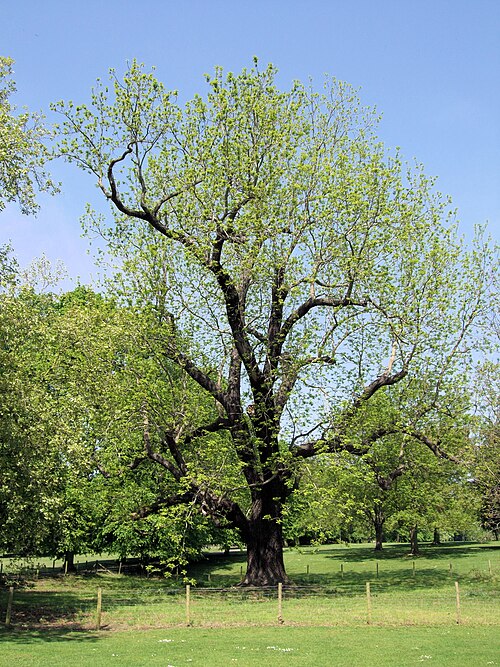
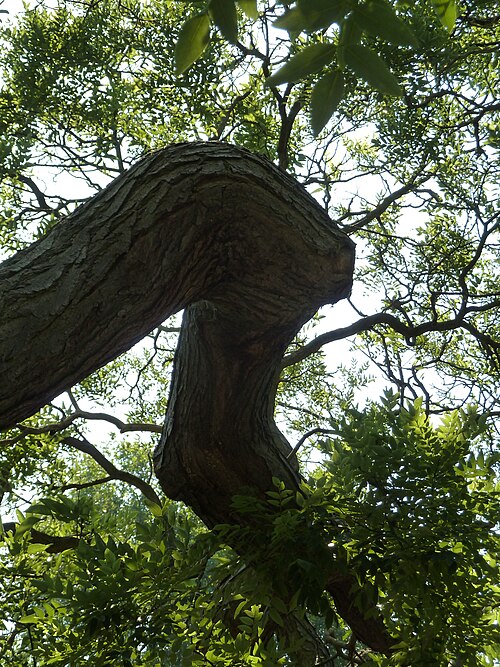
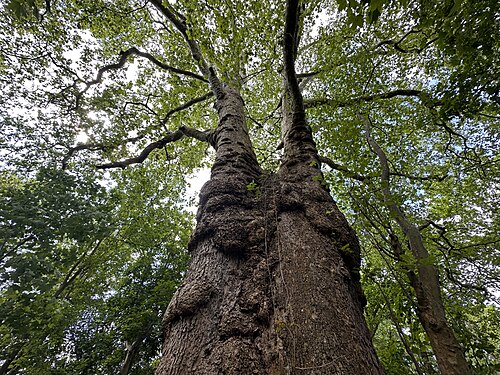
The wall came second: this oak was already centuries old when Charles I enclosed Richmond Park around it in 1637, walling off common land for his own deer rather than planting anything new. It has lived behind royal fences ever since. The tree is a massive hollow pollard now, its trunk split and gnarled into a shape wide enough to shelter a small football team, kept alive by the same repeated cutting-back that saves most ancient oaks from their own weight. Richmond Park holds one of the largest collections of ancient oaks in Europe, and the Royal Oak is treated as its figurehead: Sir David Attenborough chose it as the symbol of a conservation campaign for the park's veteran trees, and it carries its own entry in the Woodland Trust's national Ancient Tree Inventory, a formally surveyed and registered specimen rather than a folk legend. Fallow deer, descendants of the herd Charles I first enclosed the park to hunt, still graze in its shadow, close enough on a quiet afternoon that the oak and the animals read as one scene rather than two separate facts.
In fruit
September to October: acorns drop, and a good mast year buries the ground in them
The line is our estimate of how much there is to see, not a measurement. Typical for this species where this tree stands; exact weeks shift with the year.
Near Pen Ponds, Richmond Park, Richmond, LondonYou can recognise it by the huge hollow pollard trunk, split and gnarled and wide enough to shelter a small football team. It stands near Pen Ponds in Richmond Park, usually with fallow deer grazing around it.
Free. Richmond Park's pedestrian gates are open 24 hours a day, so the oak near Pen Ponds can be reached on foot at any time; vehicle gates 7am to 6:30pm.
Bus or car to Richmond Park, then on foot near Pen Ponds
Sources
Where the facts on this page come from.