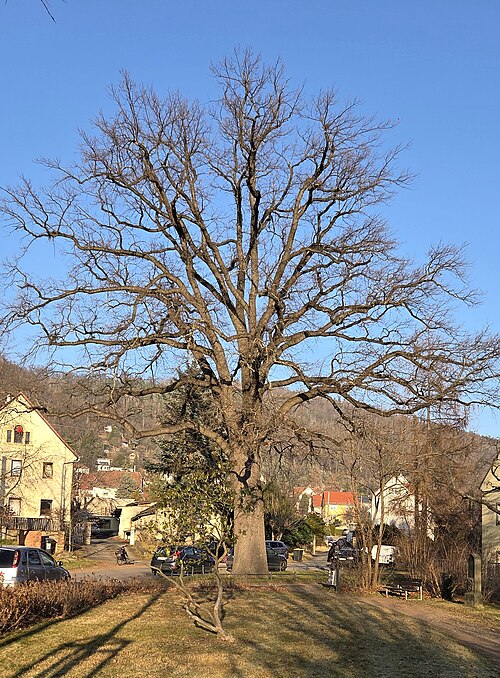
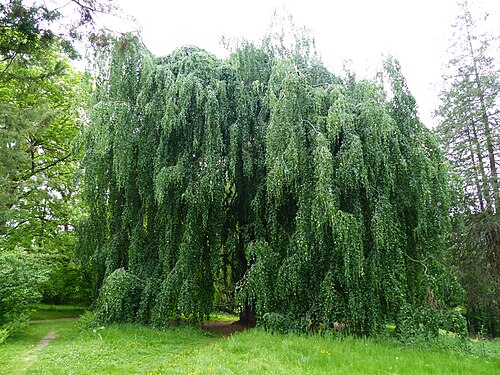
In January 1905 this camellia's winter house burned down at about minus 20 degrees, and the water from the fire hoses froze around the plant in a shell of ice. It survived, and sprouted again that spring. It has stood on this spot since 1801, when the court gardener Carl Adolph Terscheck planted it. The camellia reached the Dresden court somewhere between 1770 and 1790, so 225 years at Pillnitz are documented; the palace's owners, the Saxon state palaces administration, put it at over 250. A favourite story says it is one of four plants the botanist Carl Peter Thunberg brought back from Japan in the 1770s. Kew has no record of that, and the claim is increasingly doubted. A 2015 study at TU Dresden found it almost genetically identical to the old camellias of Caserta, Campobello in Portugal and Greifswald, which points to cuttings from one shared stock. Strictly it is a shrub grown into a tree: almost nine metres high, with a crown nearly eleven metres across. In 2025 it became the first camellia in Germany to be named a Historic Camellia by the International Camellia Society. From October to May it lives inside a heated 13-metre glass house that weighs 54 tonnes and runs on rails. In summer the house rolls aside and the tree stands in the open park. The owners call it the largest and oldest of its kind north of the Alps. Come in March, when up to 35,000 crimson flowers are open.
From people who stood here
No notes yet
Did you visit the tree? Leave a note for the next visitor.
Getting there
Kamelienhaus, Schloss und Park Pillnitz, August-Böckstiegel-Straße 2, 01326 Dresden
You can recognise it by the 13-metre glass house on rails that covers it from October to May. In summer the house is rolled aside and it stands in the open park beside its tracks, a dark evergreen dome almost nine metres high.
Inside Schloss & Park Pillnitz (owner Staatliche Schloesser, Burgen und Gaerten Sachsen). The camellia stands in its own glass house, open to visitors only in the bloom season, 28 Feb to 12 Apr 2026, daily 10:00-17:00; EUR 5 until 27 March (camellia and palm house), then included in the EUR 8 Schloss & Park Pillnitz ticket. From May to the autumn the glass house is rolled aside and the tree stands in the park; October to May it is inside the heated house.
In bloom
March, when the glass house opens and up to 35,000 crimson flowers are out
The line is our estimate of how much there is to see, not a measurement. Typical for this species where this tree stands; exact weeks shift with the year.
Sources
Where the facts on this page come from. The story was written with AI from these sources, and readers who know the tree correct it.