The Moreau Oaks
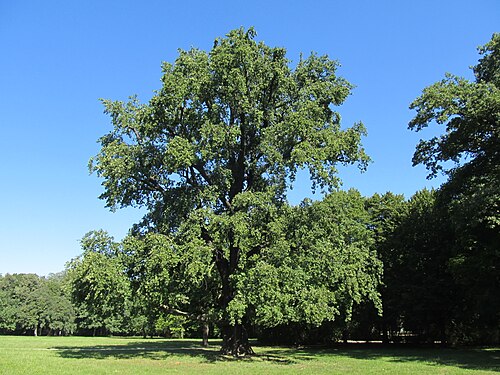
Beneath these three oaks lie a general's legs. On 27 August 1813, in the Battle of Dresden, the French general Jean-Victor Moreau was fighting on the allied side, next to Tsar Alexander, when a cannonball shattered both his legs. He died six days later. A monument went up on the spot in 1814, commissioned by the Russian governor-general Repnin-Wolkonski, and on 4 November that year the amputated legs were buried beneath it in an urn. That same November three pedunculate oaks were planted around the stone, one for each ally: Russia, Prussia and Austria. They did not start well. In 1836 the writer Ferdinand Stolle reported that the oaks looked sickly and had given no shade even in 1830, on ground judged poor for them. They stand today regardless, carrying the scars: broken branches, pruned crowns, and a cavity in one trunk that has been surgically closed. Their crowns have grown together into one, and their stems now press against the monument's stone border. Nor did they grow evenly. One trunk is 4.75 metres round, the other two 3.00 and 2.55. The meadow, called the Franzosenhöhe, is protected together with the monument as a heritage site, which is why the oaks carry no natural-monument status of their own. The inscription still reads: Moreau, the hero, fell here at Alexander's side.
catkins hang before the leaves are fully outacorns drop, and a good mast year buries the ground in themAutumn colour
The line is our estimate of how much there is to see, not a measurement. Typical for this species where this tree stands; exact weeks shift with the year.
Moreau-Denkmal, Moreauweg / Raecknitzhoehe, on the meadow 'Franzosenhoehe'You can recognise them as three oaks with crowns grown together, ringed close around a stone monument whose inscription names Moreau; the thickest trunk is 4.75 metres round. They stand on the Franzosenhöhe meadow off Moreauweg.
Free, open meadow with the monument; the whole meadow ('Franzosenhoehe') and monument are a listed Kulturdenkmal. Slope, no ticket, no gate described in the sources.
On the Räcknitzhöhe south of the Altstadt, across the street from Räcknitz Park. We have not checked the nearest bus or tram stop.
Sources
Where the facts on this page come from.