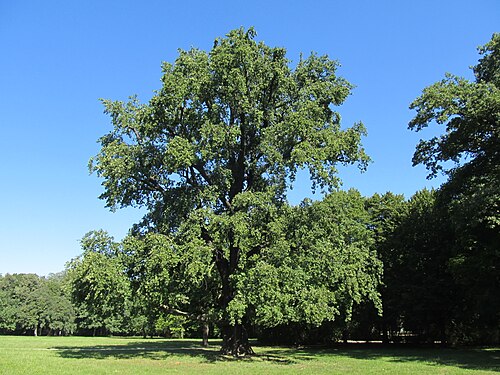
Legend says that when this poplar blooms, a war is about to end. People reported it in 1870, in 1918 and in 1943, when Victor Klemperer noted it in his diary on 23 May. What appears is not really a bloom but the fluffy white seed of the ripe fruit, and it does not come every year. The landowner Johann Gottlieb Becke planted the black poplar in 1808 to mark the edge of his property. By 1884 it drew so many visitors that a farmer wanted it felled to keep them off his land, and the local mountain club bought the tree for 300 marks to save it. A viewing frame went up beside it the following year and has been rebuilt in 1922, 1963 and 1999. In the war of 1866 it served as a lookout, and surveyors used it as a sighting mark. The weather has been harder on it than people were. A thunderstorm on 20 July 1967 took a third of the crown, storms in 1996 took most of the rest, and the main stems were later topped. The 2025 survey gives 15 metres of height where 2004 recorded 26, a trunk 5.50 metres round, and only a few side branches still in leaf. A clone grown from its cuttings was planted a few metres away in 2006, in case. It stands alone on an open plateau outside the city, and the platform looks over the Elbe valley to Saxon Switzerland and the Ore Mountains.
catkins on bare branches, red on the male treesfemale trees release their seed in cottony tuftsyellow
The line is our estimate of how much there is to see, not a measurement. Typical for this species where this tree stands; exact weeks shift with the year.
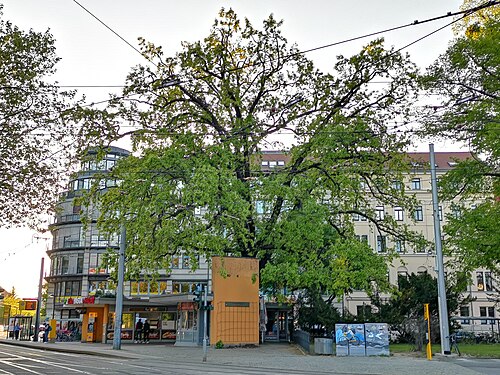
Zughuebel, about 800 m west of Babisnau, Kreischa (on the Babisnau/Golberode boundary), south of DresdenYou can recognise it by its cut-down crown: topped main stems and only a few leafy side branches. The fuller tree about 10 metres away is the Bismarck oak of 1890, and the young poplar nearby is its 2006 clone.
Free, open-air. Stands alone on an open field plateau with a steel viewing platform beside it; reached by field and hiking paths (about 800 m from Babisnau village). Land owned by the Landesverein Saechsischer Heimatschutz since 1996. Not in the city: label as a day trip to Kreischa/Babisnau outside Dresden.
About 9 km south of the Altstadt, outside the city in Kreischa, and 800 m on foot from Babisnau village along field paths. We have not checked the bus connection to Babisnau; use the VVO journey planner.
Sources
Where the facts on this page come from.