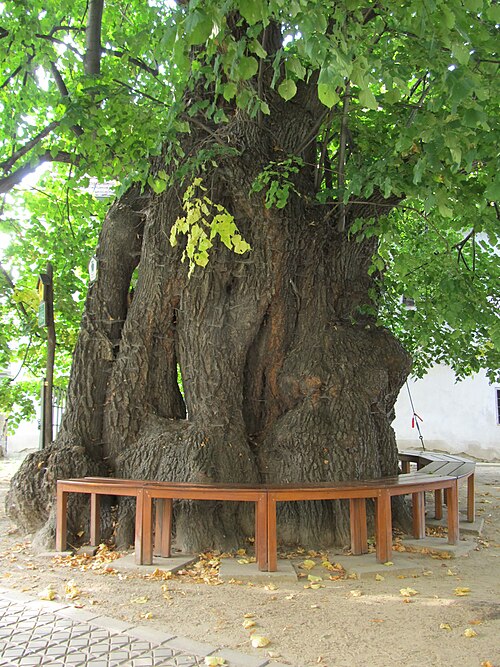
The Five Brothers of Oberwartha
Nobody agrees why there are five. One legend has a girl carried off by a dragon and her five brothers dying in the search for her, with the trees planted in their memory. Another has six monks from Altzella monastery planting six chestnuts before a crusade: five grew, and five monks came home. A third has five brothers who went out into the world, came back rich and planted a tree each. Dresden's city wiki adds that they replaced five limes at a spring once sacred to the Slavic Nisani, which is folklore too. What the sources do agree on is the date, the first half of the 17th century, which makes these sweet chestnuts roughly 400 years old. They stand along a lane at the edge of Oberwartha, on the far western rim of Dresden, where it runs down into the Tännichtgrund valley. The lane is the Fünf-Brüder-Weg and the stream below is the Fünf-Brüder-Bach, both named after the trees, which tells you how long they have been the landmark here. They run from 12 to 25 metres tall, with crowns 10 to 20 metres across, and their trunks measure between 4.15 and 6.20 metres round at chest height. The group is a protected natural monument, signposted beside the lane. Come in October, when the chestnuts drop.
long cream catkins cover the whole crown at midsummer, with a heavy sweet smell that people either like or very much do notchestnuts in spiny burs, ripe and gatherable in OctoberAutumn colour
October, when the chestnuts drop along the lane
The line is our estimate of how much there is to see, not a measurement. Typical for this species where this tree stands; exact weeks shift with the year.
Fuenf-Brueder-Weg at the entrance to the Taennichtgrund, 01156 Oberwartha, DresdenYou can recognise them as the five old chestnut trunks lining the Fünf-Brüder-Weg where it leaves the village for the Tännichtgrund, beside the natural monument sign. The thickest is 6.20 metres round.
Free. Beside a public lane and footpath, the Fünf-Brüder-Weg, at the edge of the village on the way into the Tännichtgrund valley. A signposted natural monument, open-air, no entry needed.
In the far west of Dresden, about 13 km from the Altstadt. The nearest rail stop is Niederwartha, on the line from Dresden Hbf towards Elsterwerda-Biehla; we have not timed the walk from there.
Sources
Where the facts on this page come from.