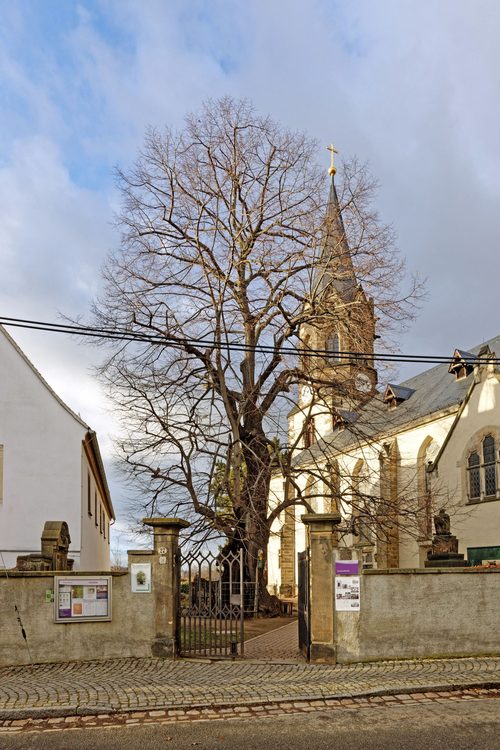
Half of this tree burned in 1818 and what holds the other half up is its own roots. A fire that year took eighteen farms, thirty barns and the parsonage of Kaditz, and the lime beside the church went with them. The side facing the parsonage died outright. What survived is a half shell of trunk, and the city's sign on it explains the trick that kept the thing alive: the stems standing inside the hollow are former roots that turned into supports. Dresden calls it the oldest tree in the city and will not put a number on it. The sign says many centuries old, then adds a thousand years with a question mark after it. Nothing can be counted, because the trunk has been damaged too often for rings to survive. A parish account of 1909 put the circumference at twelve and a half metres. A measurement at chest height in 2007 gave 9.6. Both figures are in the record and nobody has reconciled them. Since 1829 its heaviest limbs have been held up, first on timber, now on steel anchors and cables. The smaller of its two stems stopped leafing out in 2021 and died. The larger one did not. A bench runs in a ring around the base.
In bloom
June, when the lime flowers and the churchyard hums with bees
The line is our estimate of how much there is to see, not a measurement. Typical for this species where this tree stands; exact weeks shift with the year.
Emmauskirchhof, Altkaditz 27, 01139 DresdenNot a trunk but a standing half shell, wide open on one side, with a curved wooden bench built around its foot and steel cables running up into the crown. A war memorial with a stone eagle stands a few metres away.
Free. In the churchyard of the Emmauskirche, open in daylight. A wooden bench rings the trunk.
Tram 9 to its terminus at Kaditz, Riegelplatz, then about ten minutes on foot into Altkaditz. About 6 km northwest of the old town.
Sources
Where the facts on this page come from.