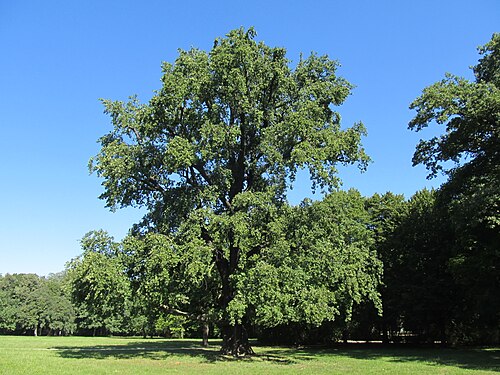
This oak was planted as a birthday present for a king, and has spent most of its life negotiating with traffic. It went into the ground on Wasaplatz in Strehlen in April 1898, on the 23rd or the 24th depending on which record you trust, for King Albert of Saxony's 70th birthday and his 25th year on the throne. Several Albert oaks went in around Dresden for that double jubilee. This one got a fenced decorative plot ringed with birches. The square did not stay quiet. A tram line has run through Wasaplatz since 1928, a main road now presses hard against one side of the tree, and its crown is pruned back regularly so that traffic clears it. In 1991 a cable was laid through its root zone and the roots were cut. It kept growing anyway. The most recent measurements put it at about 21 metres tall, with a crown some 24 metres across and a trunk 3.85 metres round; the city's older designation figures give 20 metres and 3.65. Dresden made it a natural monument in 1999. At under 130 years it is not an ancient tree and does not pretend to be. It is a royal anniversary that kept its leaves, holding the middle of a busy junction while the city works around it.
catkins hang before the leaves are fully outacorns drop, and a good mast year buries the ground in themAutumn colour
The line is our estimate of how much there is to see, not a measurement. Typical for this species where this tree stands; exact weeks shift with the year.
Wasaplatz, Strehlen, DresdenYou can recognise it as the single large oak in the middle of the star-shaped Wasaplatz, its trunk 3.85 metres round, with tram tracks curving past. A main road runs hard against one side of it.
Free. Stands on the public Wasaplatz square in the middle of a busy junction; a footpath runs right up to the trunk. Street traffic on the other side.
A tram line runs through Wasaplatz (per de.wikipedia, since 1928); stop name and timetable not verified, check before quoting.
Sources
Where the facts on this page come from.