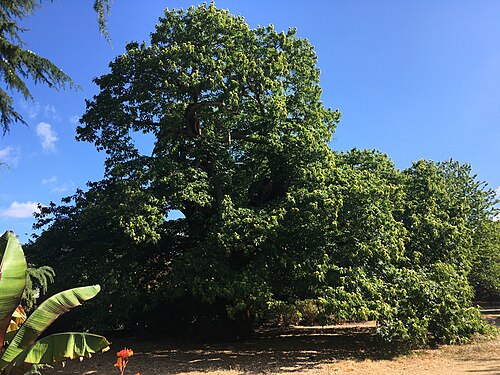
Charles II wanted Versailles and settled for Greenwich instead.
Photo: Hopefully Acceptable Username (CC BY-SA 4.0)
Castanea sativa
On the slope of Etna above Sant'Alfio, what looks like three enormous chestnuts is one tree: the Hundred-Horse Chestnut, named for a queen said to have sheltered under it with a hundred mounted knights, and put at about 2,200 years by Italy's agricultural research council in 2022. We map 31 of them, in 26 cities.
Sweet chestnut collects stories because it stays around long enough. Corsica's Bread Tree at Pianello is so called because for centuries its nuts were the bread. In January 1949 a runaway bus above Trento was stopped by a chestnut, and local accounts still argue about which one. The trunk gives the age away better than any plaque, because as a chestnut ages its bark starts to spiral around the stem, and on the oldest the whole trunk looks wrung out like a towel. Charles II is behind the Greenwich Park tree, planted for the formal avenues he ordered after 1660.
Charles II wanted Versailles and settled for Greenwich instead.
Photo: Hopefully Acceptable Username (CC BY-SA 4.0)
Two registers place this chestnut within eighty centimetres of each other and disagree about its age by fifty years.
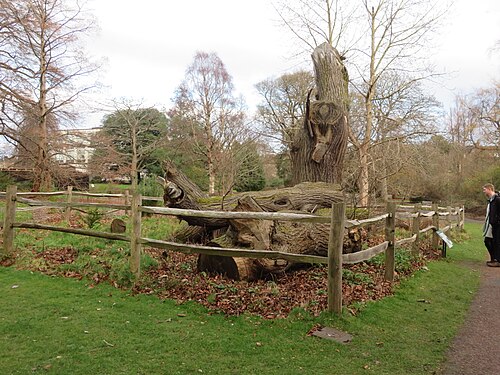
The oldest tree in Edinburgh's Royal Botanic Garden was already growing here before the garden was.
Photo: M J Richardson, via Geograph Britain and Ireland / Wikimedia Commons (CC BY-SA 2.0)
There are two Spanish chestnuts on West 20th Avenue, and the heritage-listed one is the smaller.
Nine metres and seventy centimetres round, standing behind a hermitage on a plateau in the Rocacorba hills.
Nobody can say exactly when this tree was planted, and the people who study it are refreshingly honest about that.
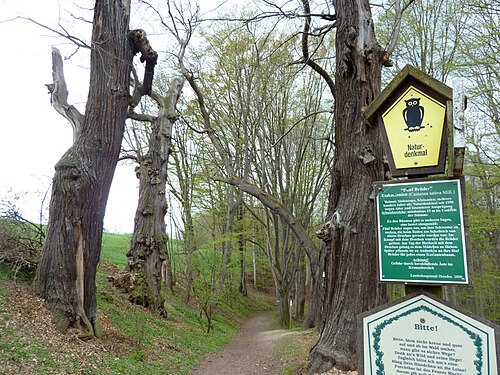
Nobody agrees why there are five.
Photo: Derbrauni (CC BY-SA 4.0)
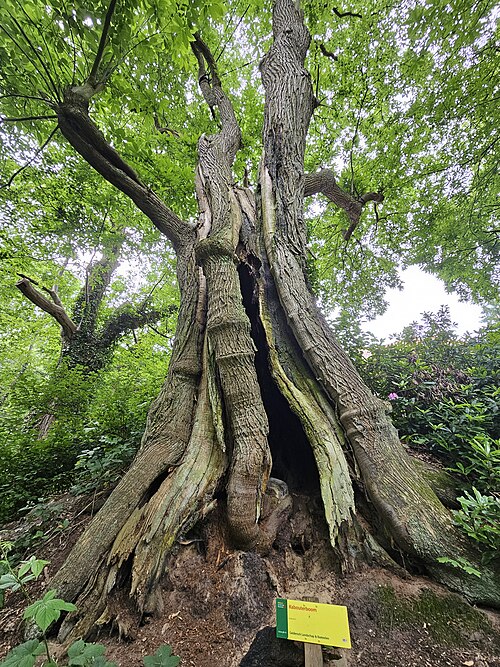
Children in Beek have been told for generations that gnomes live inside this tree, which is how a sweet chestnut came to be called the Gnome Tree.
Photo: MPhernambucq (CC BY-SA 3.0)
Four Catholic parishes petitioned Nijmegen's city council in 1884 for permission to open a shared cemetery on the Daalseweg, and the bishop of 's-Hertogenbosch consecrated it the following June.
Sweet Chestnuts spiral as they age, their bark twisting around the trunk in a pattern that gets more pronounced with every passing century, and Ashton Park's oldest is a dramatic example: an estima...
This sweet chestnut grows on what the register itself calls former barracks ground, on the Leusderweg side of what is now Juliana van Stolberg park.
The farm is nearly four centuries old and the tree is only two, which is the correct order for once.
The national register of monumental trees contains, for this tree, the testimony of an old man who walked past.
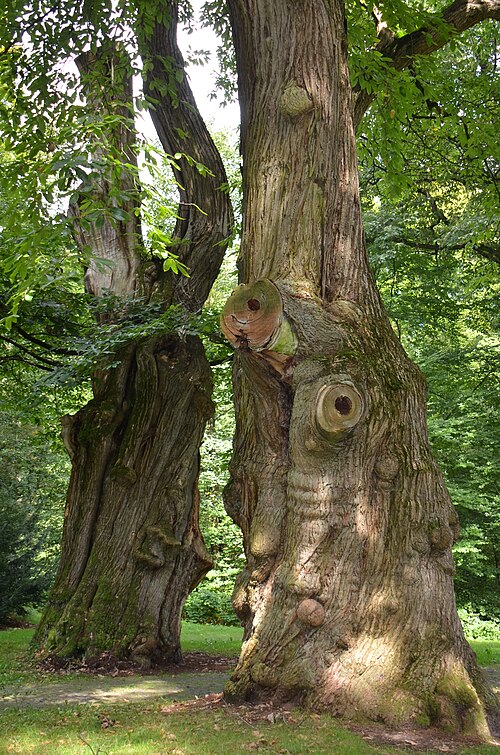
Locals call them Hans, Gretel and the Witch, and Arnhem's storytellers like to credit Karel van Egmond, the last independent Duke of Guelders, with planting these three sweet chestnuts by hand.
Photo: Henk Monster (CC BY 3.0)
This is the one tree on Arnhem's list you have to go looking for.
Christian troops heard mass at the foot of this chestnut before going to fight, and that is where the name comes from: the holy chestnut.
Nobody walking the Camino del Molino Real gets past this one without stopping.
Bute Park holds more than 3,000 catalogued trees and 50 British champions, and it took until 2023 for anyone to formally record this sweet chestnut as a veteran.
Slovakia's largest sweet chestnut does not grow in a park or an arboretum.
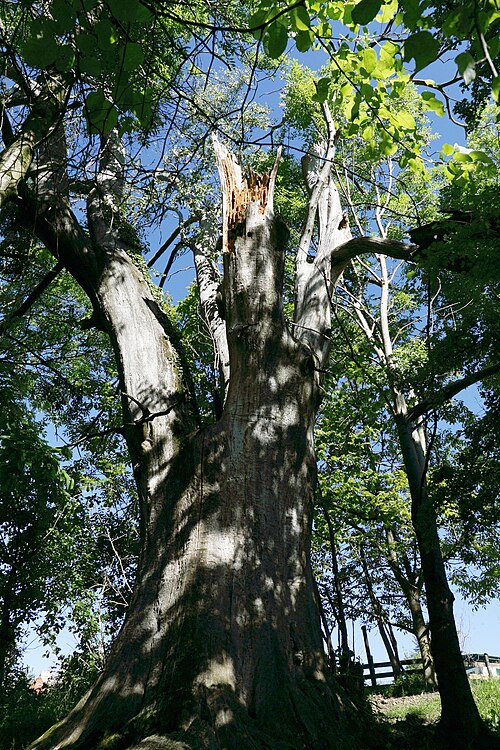
A storm once snapped the top off this chestnut, and it carried on regardless.
Photo: Christian Pirkl (CC BY-SA 3.0 at)
The age of this sweet chestnut comes from a division sum.
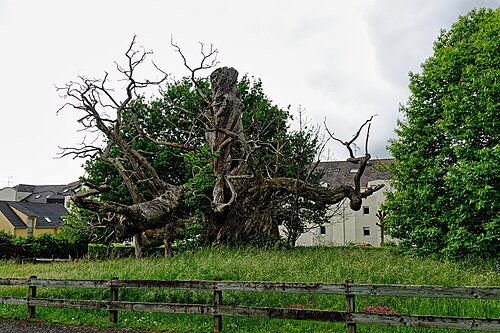
Local tradition puts this chestnut in the ground in the year 756.
Photo: François de Dijon (CC BY-SA 4.0)
In Corsica this chestnut is called the Bread Tree, because for centuries its nuts were the bread.
What looks like three enormous chestnuts on the slope above Sant'Alfio is one tree.
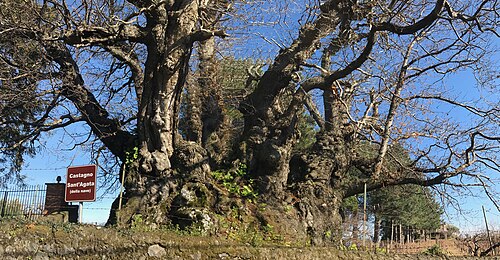
One source dates this chestnut to roughly 1,800 years old; a second confirms only that it is over a thousand, without putting a number on it.
Photo: AusTitz (CC BY-SA 4.0)
The people who planted this tree lived in a forester's house at the Rond de Condé.
Somewhere in this chestnut grove above Trento stands a tree that stopped a runaway bus in January 1949.
Portugal's thickest chestnut stands on private farmland, and its owner wants you to come in.
This chestnut's shape was cut into it by winegrowers.
In the hard years after the Second World War, Acton Park was stripped for firewood.
This chestnut was cut to a stump by shelling in the First World War, and what grew back from the surviving roots was not one trunk but four.
Explore by city: London · Eindhoven · Edinburgh · Vancouver · Girona · Maastricht · Dresden · Nijmegen · Bristol · Amersfoort · Venlo · Arnhem · Ronda · Cardiff · Graz · Liverpool · Sant'Alfio · Senonches · Trento · every city · or browse all species.