The mountains behind Ronda hold a fir that grows nowhere else on earth. Abies pinsapo survives in three small patches of the Serrania de Ronda and Grazalema, a relic left behind when the ice went and the climate dried, and Andalusia's register of singular trees names half a dozen individual pinsapos in these hills, each with its own measured sheet. Alongside them are sweet chestnuts of a size that stops walkers on the track, and a yew whose girth puts it at five centuries. Most of it lies inside the Sierra de las Nieves.
0 of 6 visited in Ronda
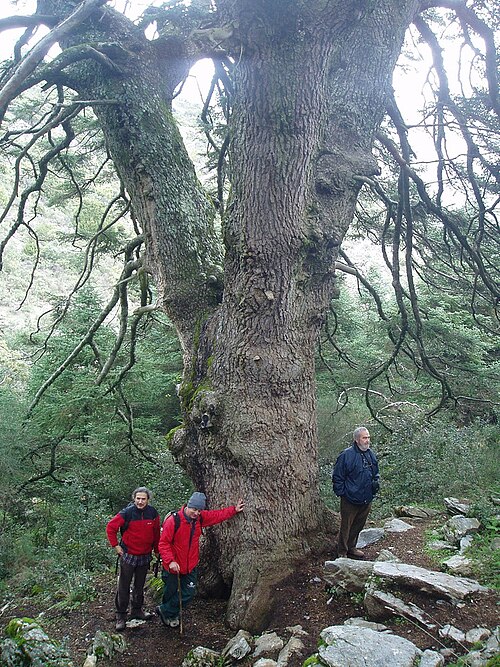
Spanish Fir (Abies pinsapo) · 350-550 years · Parauta
This tree has a natural monument to itself. Andalusia protects whole landscapes as natural monuments and it has declared one for a single fir, the Monumento Natural Pinsapo de las Escaleretas, inside the Sierra de las Nieves. It is 26 metres tall, 5.10 metres round at chest height and 9 at the base, where roots near the trunk come up out of the ground, and the register puts it between 350 and 550 years old. Closed scars where limbs were cut make it look older than that. The place is named for the way the flat stones of the path lie like steps, and the fir grows at the bottom of a bank beside streams, so from the access track all you see is the top of the crown; you have to go down to it. The view from where it stands takes in the Torrecilla peak and the Alcazaba hill. There is a story that it grew on the grave of a woman known for helping travellers and mountain people, whom she treated with plant remedies. The land is public.
Photo: Por los caminos de Málaga (CC BY 2.0)
Spanish Fir (Abies pinsapo) · Tolox
It grows like a candelabrum, which a fir is not supposed to do. The trunk of this pinsapo is only 60 centimetres long before it forks in two, and one of those two then splits again into three, so what stands on the hillside above the Puerto de La Perra is a twisted branching thing rather than the single straight spire the species normally makes. The register measures 5.10 metres round below the fork and nearly 8 at the base, on a tree 22 metres high. Firs are pruned into that shape by damage, wind or snow load or a lost leader, and the result is a specimen worth the walk precisely because it is wrong. It stands near a path and a mountain stream cutting the northeast slope of the Chaparral hill, with other pinsapos around it and, in the understorey, quejigos of Quercus alpestris, an oak endemic to this range and nowhere else. The land is public and inside the natural park. Nobody has published an age for it, which for a tree of this shape is a real gap: if you know one, tell us.
European Yew (Taxus baccata) · 300-600 years · Tolox
This is the one tree on this page whose age comes with its arithmetic attached. The register's sheet does not simply assert a number: it says that dendrological work on yews puts a five-metre girth at somewhere between 500 and 600 years, notes that this tree measures 4.50 metres and grows in conditions poor enough to slow it further, and concludes that it may go back five centuries. That is an estimate with a method, which is rarer than it should be. The yew is 19 metres tall, on a broken northeast-facing slope so steep and so thin-soiled that almost no shrub layer grows, which is ideal ground for the Spanish ibex and hard on everything else. It is hidden among pinsapos and bare rock and takes finding. On a clear day you can see the Sierra Nevada from where it stands, 150 kilometres east. Yew is the slowest thing on this mountain and it gets slower with age, which is the whole reason the arithmetic works.
Sweet Chestnut (Castanea sativa) · 400-800 years · Istan
Christian troops heard mass at the foot of this chestnut before going to fight, and that is where the name comes from: the holy chestnut. The mass was said in the sixteenth century, before a battle with the Moriscos, the Muslims of these mountains who had been forced to convert and who rose against Spain twice. The tree is the largest on this page by a wide margin. Its trunk measures 14.65 metres round at chest height and 21.5 metres at the base, it stands 24.5 metres tall, and the two enormous main limbs carry a crown covering 510 square metres. The register puts the age at possibly around 800 years and has proposed the tree as a Natural Monument of Andalusia. It sits on a ledge on an east-facing slope in dense woodland of cork oaks and Algerian oaks with other chestnuts scattered through it, on land where pigs are still run out to feed on acorns, and somebody has built a low stone wall behind it to stop erosion undercutting the roots. The land is private, but the tree stands a few metres from a public bridle path.
Sweet Chestnut (Castanea sativa) · Cartajima
Nobody walking the Camino del Molino Real gets past this one without stopping. The Castano Arena stands at the side of the track that runs down toward the valley of the river Genal, right where a medium slope begins to fall away toward one of the streams that feed it, and the register's own sheet says as much: it does not go unnoticed by the walker. The trunk is 7.20 metres round at chest height and 10.20 at the base, on a tree 17 metres tall, and the register attributes that thickness plainly to advanced age without putting a number on it. It stands out from everything around it, and what is around it is the point. The Genal valley is one continuous chestnut wood, tens of thousands of trees running across the whole basin and on into Pujerra and Igualeja, and in late October the entire valley turns copper at once. It is the reason people drive this road in autumn. The land is private and the track is public. No age has been published: if you know one, tell us.
Spanish Fir (Abies pinsapo) · Ronda
It is the only tree in sight, which is the entire point of it. The Solitary Pinsapo grows on a crag of bare rock near the Puerto del Pinsapo in a stretch of mountain with no woodland at all, so it reads at a distance as a single dark shape on grey stone. It is 17 metres tall and 3.50 metres round at chest height, and the base measures double that, 7 metres, because the trunk has spread sideways to get over and around the rocks it emerged on, some of which it is slowly swallowing. The register calls it a silent witness to the distribution the species once had, which is the honest way to put it: pinsapo forest covered far more of these mountains before the climate dried and people cut and grazed the rest, and an isolated fir on a bare crag is what is left of a wood. The only plants near it are what those soils allow, terebinth, kermes oak and hawthorn. The land is private and there is no path to the foot of it, so this is a tree to look at from the pass rather than to stand under.