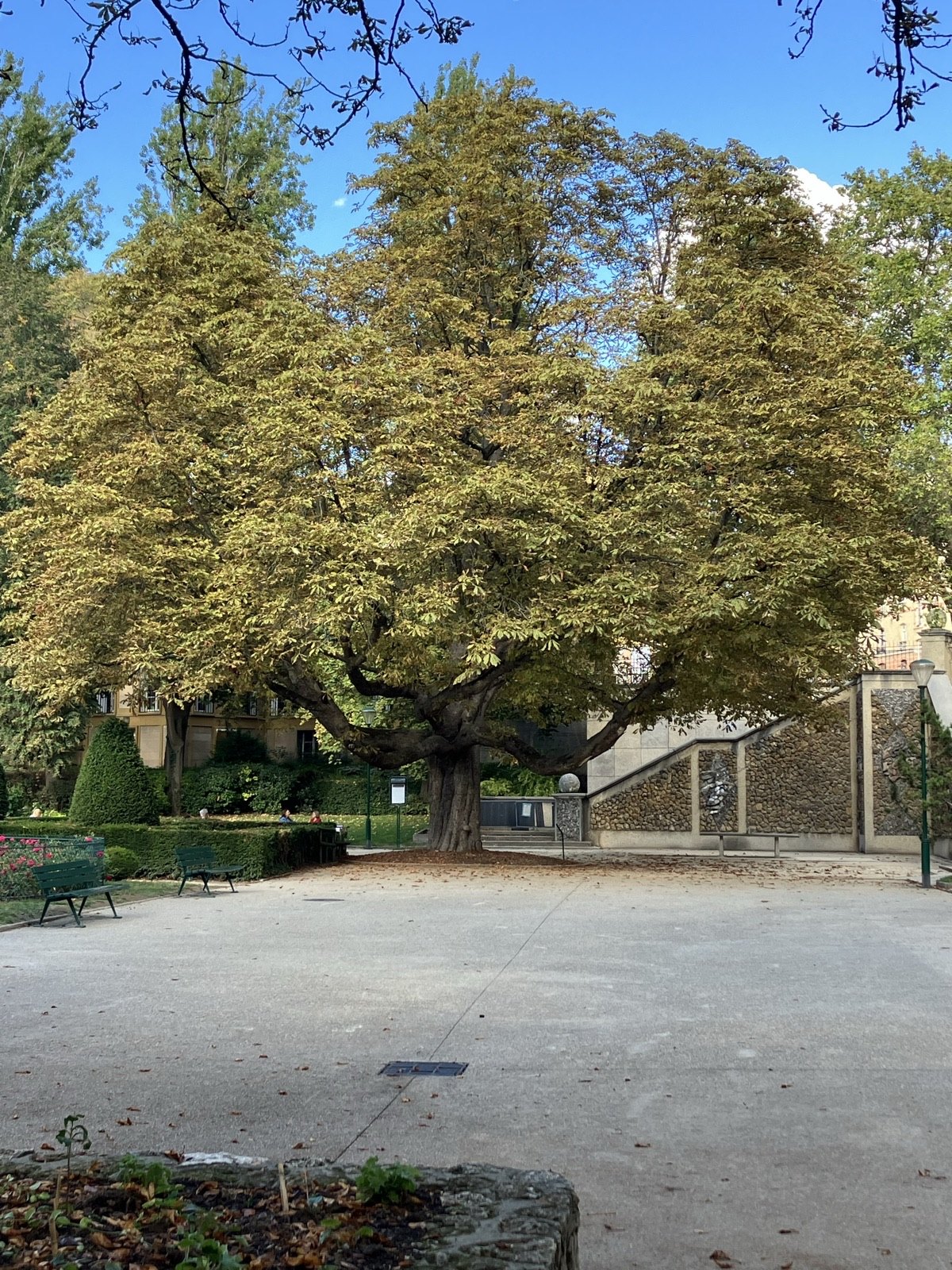
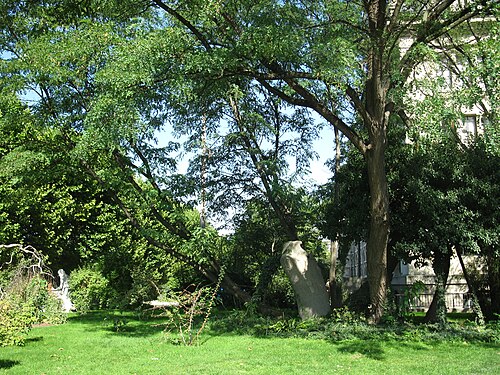
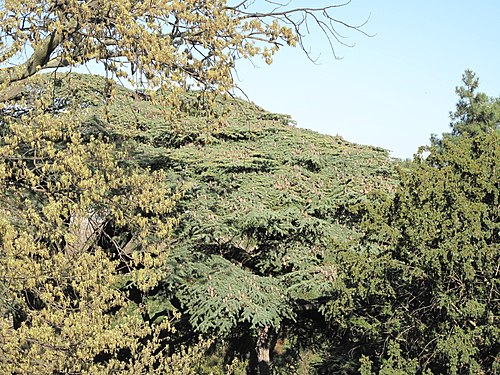
Three hundred metres from Square Rene-Le Gall's horse chestnut, on the same buried river, stands a Turkey oak the city's own register lists at 190 centimetres round and 18 metres tall. It shares the garden's history without sharing its fame: the horse chestnut has a planting date, an obelisk nearby and a published story, while this oak has only its two register measurements and a spot in the same 1930s park laid out over the vanished Bievre. Quercus cerris is a fast grower for an oak, native to southern Europe and Asia Minor, distinguishable from more familiar oaks by acorns wrapped in a shaggy, moss-like cup that gives the species its French name, chene chevelu, the hairy oak. Paris plants it as a street and park tree precisely because it tolerates drought and poor soil better than the native pedunculate oak, useful for a garden built on reclaimed, once-marshy ground. No second source beyond the city's own tree register has been found for this specific tree, so it ships flagged. If you know more, the garden's obelisk is a five minute walk and the two trees make an easy stop on the same visit.
1 Rue Emile DeslandresYou can recognise it by the acorns wrapped in shaggy, moss-like cups, on a trunk 190 centimetres round and 18 metres tall. It stands in Square Rene-Le Gall, 300 metres from the horse chestnut near the obelisk.
Free, public municipal square (Square Rene-Le Gall, also known as Jardin des Gobelins), open standard Paris park hours and closed at night
Corvisart or Les Gobelins (Metro 6/7), 8-10 min walk
Sources
Where the facts on this page come from.
- In the official register: Ville de Paris, Direction des Espaces Verts et de l'Environnement, remarkable t…
- Ville de Paris, Direction des Espaces Verts et de l'Environnement, remarkable trees of Paris (register_id 104840, girth 190cm, height 18m, Ville de…