Seasons1 of 4
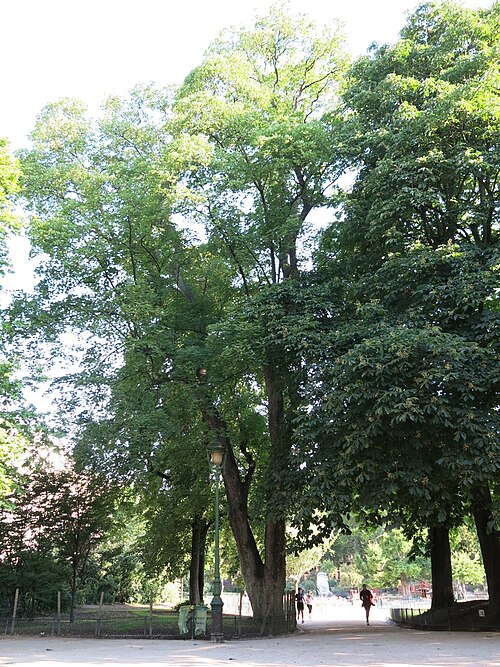
This oriental plane has a waistline of six and a half metres. Planted in 1814, the year Napoleon abdicated and the allied armies camped in the city, it grew up in what was then the private pleasure garden of the Orleans family. Parc Monceau had been laid out as an aristocratic fantasy of ruins and follies, and the plane outgrew all of them. It is now 31 metres tall with a crown to match, among the largest of its species in the city. The park around it became public under Haussmann in 1861, and the tree has since shaded Proust, who walked here as a boy, and several generations of the best dressed joggers in Paris. Its bark peels in grey and cream patches and its lower branches are thicker than most full grown street trees. The city lists it among its officially remarkable trees. Stand at the trunk and look up, and the first branch is higher than the surrounding lampposts.
From people who stood here
No notes yet
Did you visit the tree? Leave a note for the next visitor.
Getting there
Parc Monceau, 35 Boulevard de Courcelles, 75008 Paris
You can recognise it by the trunk, 6.45 metres round, and by a first branch that starts higher than the park lampposts. It stands in Parc Monceau, the thickest tree in Paris and the largest oriental plane in the city.
Monceau (Metro 2), at the park gates
The line is our estimate of how much there is to see, not a measurement. Typical for this species where this tree stands; exact weeks shift with the year.
Sources
Where the facts on this page come from. The story was written with AI from these sources, and readers who know the tree correct it.
- In the official register: Arbres remarquables de Paris (Ville de Paris), no. 313940
- unjourdeplusaparis.com
- bonjourparis.com
- opendata.paris.fr