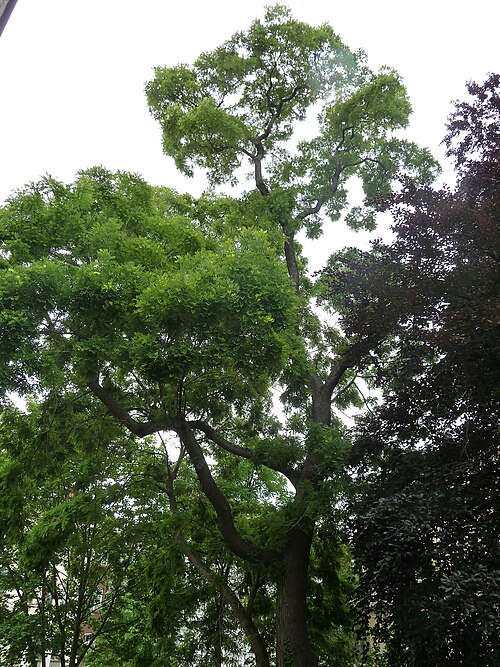
Lebanon oak belongs on the slopes of the Levant and the Taurus mountains, not on the western edge of Leipzig. Yet here it is, a natural monument in Schoenau, standing in a green corridor beside a footpath, and an unusual name to find on a German city's list of protected trees. Up close it does not look like the oaks you know, and the leaves are why. Instead of the rounded lobes of a pedunculate oak, Quercus libani carries long, narrow leaves edged with small bristle-tipped teeth, closer at first glance to a sweet chestnut than to anything a German child would draw as an oak. Its acorns take two summers to ripen rather than one. Leipzig protects it as Naturdenkmal number 91, with a protected zone 18 metres across. The city's list says nothing about who planted a Levantine oak on this spot, or when, and it gives no girth or height either. A photograph taken in May 2024 shows it in full leaf, which makes it the most recently confirmed tree of this group. It is also the outlier: out on the city's western edge, kilometres from the Plagwitz villa trees, so this is a separate trip rather than part of the walk. Look at the leaves first, then at any oak you pass on the way back, and the difference is obvious. If you know how this tree got here, tell us.
Ludwigsburger Strasse 2, 04209 LeipzigYou can recognise it by its long, narrow, chestnut-like leaves with bristle-tipped teeth, unlike any native oak. It stands beside the footpath in the green strip at Ludwigsburger Strasse 2 in Schoenau.
Free; the Commons photo shows the tree beside an open footpath in public green (no fence). Access not documented by a source: flagged.
Schoenau, about 7 km west of the centre; stops not verified
Sources
Where the facts on this page come from.