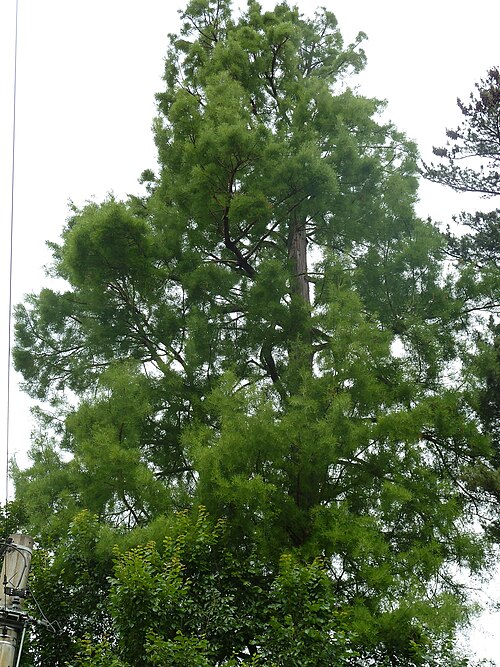
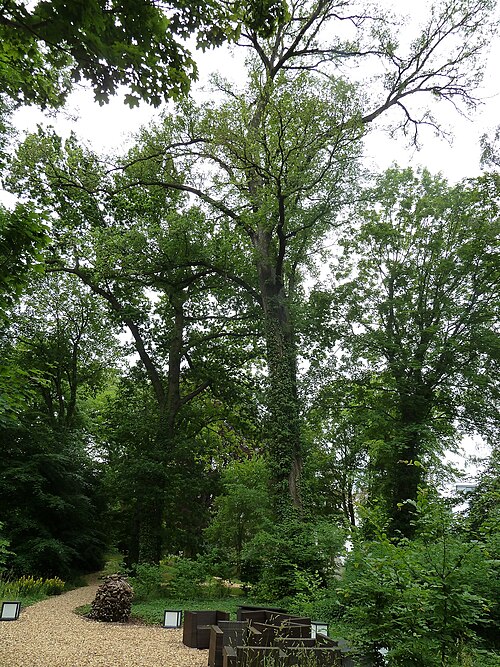
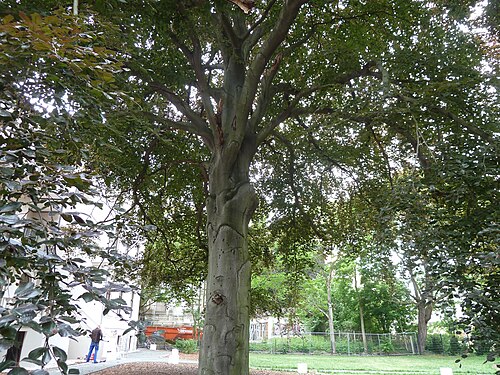
A female ginkgo stands at the corner of Karl-Heine-Strasse in Plagwitz, one of 148 trees Leipzig protects as a Naturdenkmal, Saxon law's strongest individual-tree designation. The city's own record gives it a number, ND 30, a protected root radius of 18 metres, and the resolution that made it official in 1996. It gives no age and no planting date, which is typical of the German Naturdenkmal system: protection does not require a documented history, only a tree worth keeping. Ginkgo biloba survives as a single species from a lineage otherwise known only from fossils, and female trees like this one carry a reputation the male trees down the street do not: come autumn, the fallen seed coats smell distinctly of rancid butter, which is why most street plantings today are male clones. This one was left as it grew. It shares its stretch of Karl-Heine-Strasse with four more protected trees within about 150 metres, an elm, a bald cypress, a copper beech and a pagoda tree, all named on this page.
Autumn colour
November: the whole crown turns butter gold, then drops in a day or two
The line is our estimate of how much there is to see, not a measurement. Typical for this species where this tree stands; exact weeks shift with the year.
Karl-Heine-Strasse 1, 04229 LeipzigYou can recognise it as the female ginkgo, seed coats smelling of rancid butter in autumn where street plantings are usually male. It stands at the corner of Karl-Heine-Strasse.
Free, stands at the edge of the pavement
Karl-Heine-Strasse tram (lines 3/N3) or S-Bahn Leipzig MDR, then a short walk
Sources
Where the facts on this page come from.
- In the official register: Naturdenkmale der Stadt Leipzig (Verordnung 601/96), no. ND 30
- de.wikipedia.org
- wikidata.org