Ede sits on sand at the western edge of the Veluwe, which is poor ground, and poor ground is why the oldest tree here is not a tree in the usual sense. It is an oak stool: a stump cut to the ground over and over for centuries, sending up a new ring of stems every time, so what survives is the base, broad and low and older than any trunk on it. Around it are a castle with a pair of oaks, a named beech in the town wood, and one oak inside a national park.
0 of 7 visited in Ede
Sessile Oak (Quercus petraea) · 225-275 years · Ederbos
This is not a trunk. It is a base, broad and low, with a ring of stems standing up out of it, and it is the oldest living thing in Ede.
Coppicing is what people did with oak on poor sandy ground for a thousand years, because it turns a slow tree into a repeating crop. Cut an oak to the ground and it does not die; it sends up a dense ring of new shoots from the stump, which are harvested again a decade or two later for firewood, fencing, charcoal and tan bark. Repeat that for centuries and the stump widens into a low circular platform of old wood, sometimes two or three metres across, with a hollow middle where the original stem rotted out.
So the age is on the base. The stems you see are young. The thing they are standing on has been cut and has regrown perhaps twenty times.
This wood shows on topographic maps from 1830 to 1850. In the 1920s and 1930s it was planted through with conifers, and on some plots and along some paths the old oak stools were spared. This is the largest of them, in a row along a path.
Come in winter, when you can see the shape of the base.
Pedunculate Oak (Quercus robur) · 185-195 years · Hoekelum
There are two oaks here of the same age and they are worth seeing together, because between them they show what open ground does to a tree.
This is the one standing beside the house. It grew up close to buildings, with structures and other planting on at least one side, so it has done what a hemmed tree does: gone up rather than out, kept a narrower crown, and lost its lower branches early. The other one, out in the meadow in front, had nothing near it at all and spread instead.
Same species, same planting band of 1830 to 1840, almost certainly the same original scheme. Different shapes entirely, and the only variable is how much room each one had.
That is a more useful thing to notice than it sounds, because it is how you read any old tree. A wide low crown with heavy horizontal limbs means the tree grew in the open, even if a wood has since grown up around it. A tall clean trunk means competition.
Kasteel Hoekelum is on the Edeseweg between Ede and Bennekom, and the grounds are recorded as visitable in the national register.
Pedunculate Oak (Quercus robur) · 185-195 years · Hoekelum
A single oak standing alone in a field is one of the most reliable pleasures this country offers, and it is almost always deliberate.
Solitary field trees were left or planted for reasons that had nothing to do with looks. Shade for livestock, a marker on a boundary, a fixed point in a landscape without many. What they produce is a shape no woodland tree ever gets: heavy limbs leaving the trunk low down and running out horizontally as far as the wood will bear, a crown far wider than the tree is tall, and clear ground beneath.
This one has had that room since about 1830 to 1840, in the meadow in front of Kasteel Hoekelum, with its twin standing close to the house and looking completely different for it.
A free-standing oak of nearly two hundred years is also a small ecosystem on its own. Old oaks carry more dependent species than any other tree in northern Europe, several hundred of them, most in the dead wood and the crevices, so the value is in the parts that look neglected.
Go in low winter sun, when the whole frame of it is visible from the road.
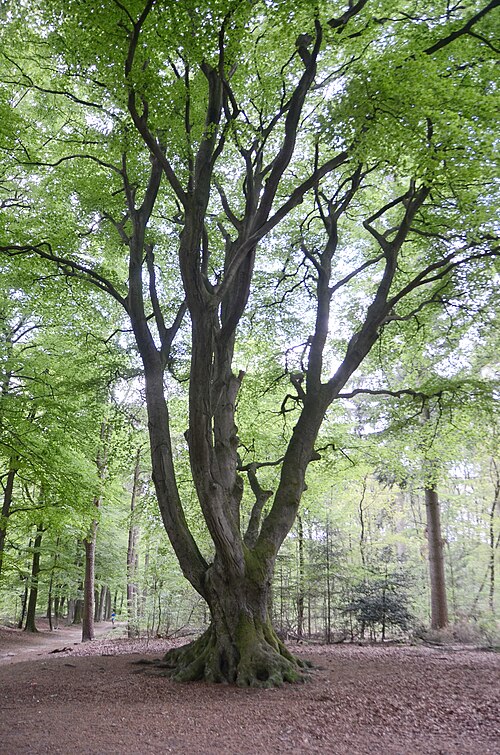
European Beech (Fagus sylvatica) · 195-205 years · Edese bos
Somebody called this tree Marjan and the name went into the national register.
That is a small thing and it is not nothing. Almost every entry in that register is a species and an address. A handful carry a name, and a name means a person: somebody local knew this beech well enough to call it something, used the name often enough that other people used it too, and it eventually turned up on an official form.
The tree itself is a beech of about two hundred years in the Edese bos, north of the N224, and its age is the interesting part in this landscape. Two hundred years ago much of the Veluwe was open drifting sand, and the woods around Ede are largely a nineteenth and twentieth century creation, planted to fix the ground and grow timber. A beech from the 1820s is from the very beginning of that effort.
Beech is also the wrong tree for this soil on paper. It wants moisture and does badly on dry sand, so a big old one out here has found itself a better pocket of ground than its neighbours.
Bring your hand. That bark is the smoothest thing in the wood.
Photo: Henk Monster (CC BY 3.0)
Giant Sequoia (Sequoiadendron giganteum) · 135-145 years · Centrum
A tree from the Sierra Nevada, planted in a Gelderland village in the 1880s, now standing next to a fire station.
The sequoia was the status tree of its moment. Introduced to Europe in 1853, still expensive thirty years later, and unmistakably foreign in a landscape of oak and pine, which was the entire attraction. Whoever put this one in was making a point about the ground it stood on, and that ground was not a municipal square at the time.
Everything around it has since been replaced. The tree stayed, because a sequoia in the 1880s becomes a sequoia you cannot casually remove by the 1950s, and now it is the oldest thing on the Burgemeester van Dijkeplein by a wide margin.
Go and push the bark. That is the single best thing about the species and almost nobody does it. It is thick, soft and fibrous, and your fist sinks into it, which is an adaptation to forest fire: the outer layer chars and insulates while the living tissue underneath survives. Nothing else you can touch in a Dutch town centre behaves like that.
It will still be here in a thousand years if we leave it alone.
Pedunculate Oak (Quercus robur) · 155-165 years · Lunteren
A village street with an oak on it that is older than most of the houses.
Lunteren is a Veluwe village a few kilometres northwest of Ede, and this oak has been on the Dorpstraat since somewhere between 1860 and 1870. That places it before the railway came through, before the tourist trade, and before most of the building that turned a farming settlement into a commuter village.
An oak on a village street lives a harder life than an oak in a wood, and it usually looks it: pruned back from the road and the wires, roots under paving, and a lopsided crown leaning toward whatever open space there is. That is not damage so much as negotiation, carried out over a century and a half, one branch at a time.
It is also the sort of tree a village argues about. Every generation there is a reason to take it out, and so far every generation has decided not to.
Stand across the road rather than under it. From the far pavement you can see the whole shape and read where the street has pushed it about, which is the interesting part.
A day trip away
Hoge Veluwe, 12 km north-east
Pedunculate Oak (Quercus robur) · 165-175 years · Hoge Veluwe
It stands inside a fenced national park where you have to pay to walk, and both of those facts are the reason it is in good condition.
De Hoge Veluwe is 55 square kilometres of sand, heath, drift dunes and planted wood, bought up in the 1910s by Anton and Helene Kroller-Muller and later given to the state. It is enclosed, it is managed, and it is one of the few landscapes in the Netherlands where you can walk for an hour without leaving it. The Pampel is a spot in the northwest of it, off the Houtkampweg.
The oak is banded 1850 to 1860, which puts it well before the Kroller-Mullers and inside whatever estate or farm woodland was here first. On the Veluwe that usually means it grew up on land that was heath within living memory, since much of this sand was open and drifting into the nineteenth century and was only planted up afterwards.
An oak that establishes itself on poor sand grows slowly and puts on dense timber, so the girth understates the age.
Go in October, and let the acorns be the reason. Wild boar and deer here live off them.