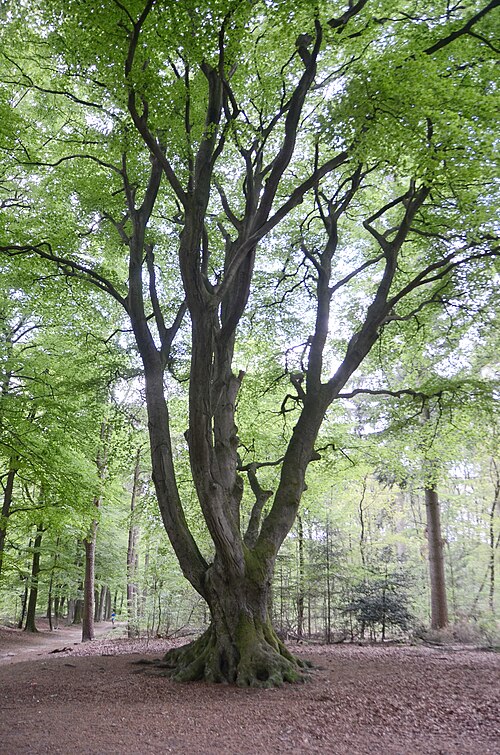
This is not a trunk. It is a base, broad and low, with a ring of stems standing up out of it, and it is the oldest living thing in Ede. Coppicing is what people did with oak on poor sandy ground for a thousand years, because it turns a slow tree into a repeating crop. Cut an oak to the ground and it does not die; it sends up a dense ring of new shoots from the stump, which are harvested again a decade or two later for firewood, fencing, charcoal and tan bark. Repeat that for centuries and the stump widens into a low circular platform of old wood, sometimes two or three metres across, with a hollow middle where the original stem rotted out. So the age is on the base. The stems you see are young. The thing they are standing on has been cut and has regrown perhaps twenty times. This wood shows on topographic maps from 1830 to 1850. In the 1920s and 1930s it was planted through with conifers, and on some plots and along some paths the old oak stools were spared. This is the largest of them, in a row along a path. Come in winter, when you can see the shape of the base.
Winter shapeIn fruit
January, when the bare stems show the shape of the old stool
The line is our estimate of how much there is to see, not a measurement. Typical for this species where this tree stands; exact weeks shift with the year.
East of the Apeldoornseweg, near the Immenweg sand trackA broad low ring of ancient wood with several stems rising from it, the biggest of a line of stools along the path.
Free. Woodland with public paths, east of the Apeldoornseweg.
About 6 km northeast of Ede-Wageningen station, off the Apeldoornseweg near the Immenweg.
Sources
Where the facts on this page come from.
- In the official register: Landelijk Register Monumentale Bomen (Bomenstichting), no. 1694799
- monumentalebomen.nl
- services-eu1.arcgis.com