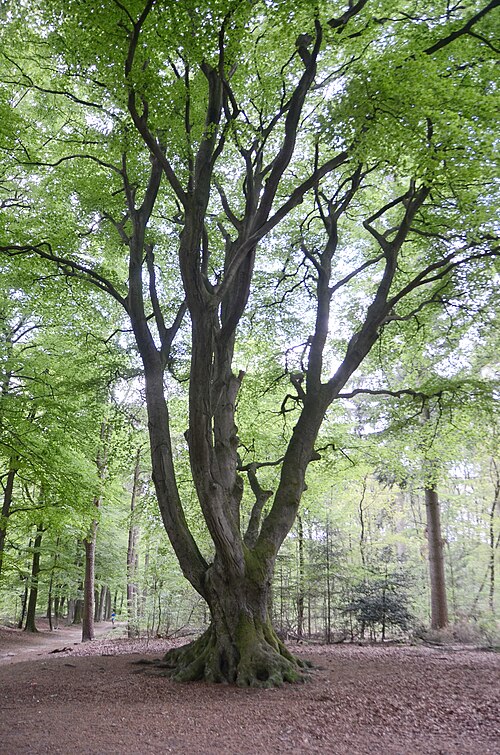
The Oak in the Hoekelum Meadow
NetherlandsEdeHoekelum
A single oak standing alone in a field is one of the most reliable pleasures this country offers, and it is almost always deliberate. Solitary field trees were left or planted for reasons that had nothing to do with looks. Shade for livestock, a marker on a boundary, a fixed point in a landscape without many. What they produce is a shape no woodland tree ever gets: heavy limbs leaving the trunk low down and running out horizontally as far as the wood will bear, a crown far wider than the tree is tall, and clear ground beneath. This one has had that room since about 1830 to 1840, in the meadow in front of Kasteel Hoekelum, with its twin standing close to the house and looking completely different for it. A free-standing oak of nearly two hundred years is also a small ecosystem on its own. Old oaks carry more dependent species than any other tree in northern Europe, several hundred of them, most in the dead wood and the crevices, so the value is in the parts that look neglected. Go in low winter sun, when the whole frame of it is visible from the road.
Winter shapeIn fruit
January, when the bare frame shows against the field
The line is our estimate of how much there is to see, not a measurement. Typical for this species where this tree stands; exact weeks shift with the year.
In the meadow in front of Kasteel Hoekelum, Edeseweg, BennekomThe lone spreading oak in the open field in front of the castle, wider than it is tall.
Castle grounds on the Edeseweg, recorded as visitable in the national register. The tree is visible from the road.
About 3 km southwest of Ede-Wageningen station, on the Edeseweg toward Bennekom.
Sources
Where the facts on this page come from.
- In the official register: Landelijk Register Monumentale Bomen (Bomenstichting), no. 1684854
- monumentalebomen.nl
- services-eu1.arcgis.com