The Giant Sequoia of the Fire Station
NetherlandsEdeCentrum
A tree from the Sierra Nevada, planted in a Gelderland village in the 1880s, now standing next to a fire station. The sequoia was the status tree of its moment. Introduced to Europe in 1853, still expensive thirty years later, and unmistakably foreign in a landscape of oak and pine, which was the entire attraction. Whoever put this one in was making a point about the ground it stood on, and that ground was not a municipal square at the time. Everything around it has since been replaced. The tree stayed, because a sequoia in the 1880s becomes a sequoia you cannot casually remove by the 1950s, and now it is the oldest thing on the Burgemeester van Dijkeplein by a wide margin. Go and push the bark. That is the single best thing about the species and almost nobody does it. It is thick, soft and fibrous, and your fist sinks into it, which is an adaptation to forest fire: the outer layer chars and insulates while the living tissue underneath survives. Nothing else you can touch in a Dutch town centre behaves like that. It will still be here in a thousand years if we leave it alone.
This tree looks much the same in every month of the year, so there is no season to chart.
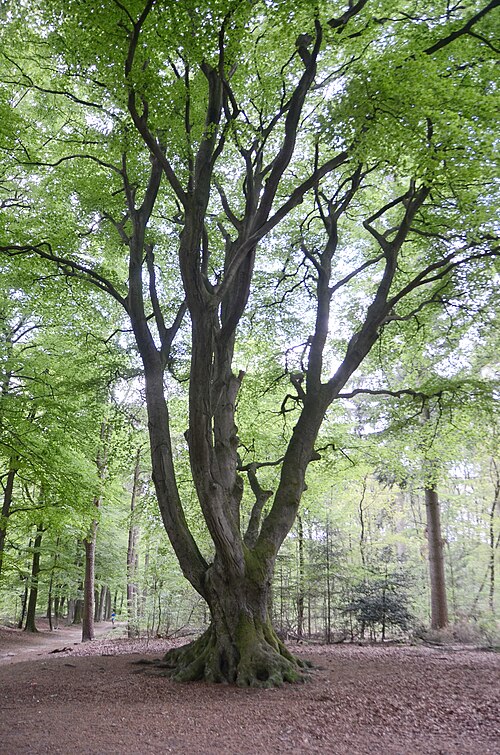
By the fire station, Burgemeester van DijkepleinThe one enormous conical conifer on the square, with thick spongy red-brown bark.
Free. Public square, reachable at any time.
About 2 km north of Ede-Wageningen station, on the Burgemeester van Dijkeplein.
Sources
Where the facts on this page come from.
- In the official register: Landelijk Register Monumentale Bomen (Bomenstichting), no. 1683100
- monumentalebomen.nl
- services-eu1.arcgis.com