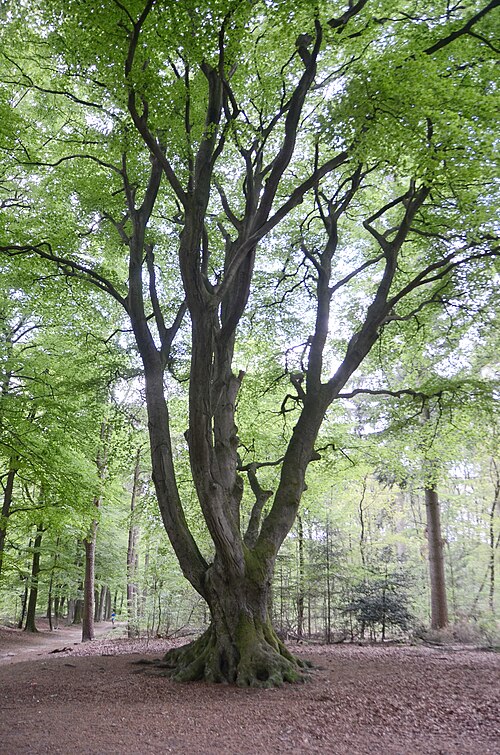
A village street with an oak on it that is older than most of the houses. Lunteren is a Veluwe village a few kilometres northwest of Ede, and this oak has been on the Dorpstraat since somewhere between 1860 and 1870. That places it before the railway came through, before the tourist trade, and before most of the building that turned a farming settlement into a commuter village. An oak on a village street lives a harder life than an oak in a wood, and it usually looks it: pruned back from the road and the wires, roots under paving, and a lopsided crown leaning toward whatever open space there is. That is not damage so much as negotiation, carried out over a century and a half, one branch at a time. It is also the sort of tree a village argues about. Every generation there is a reason to take it out, and so far every generation has decided not to. Stand across the road rather than under it. From the far pavement you can see the whole shape and read where the street has pushed it about, which is the interesting part.
In fruit
September to October: acorns drop, and a good mast year buries the ground in them
The line is our estimate of how much there is to see, not a measurement. Typical for this species where this tree stands; exact weeks shift with the year.
Dorpstraat 25, LunterenThe large oak on the Dorpstraat by number 25, with a crown leaning away from the buildings.
Free. Street tree in the village, reachable at any time.
About 8 km northwest of Ede-Wageningen station, in Lunteren.
Sources
Where the facts on this page come from.
- In the official register: Landelijk Register Monumentale Bomen (Bomenstichting), no. 1683090
- monumentalebomen.nl
- services-eu1.arcgis.com