Walter Hill planted most of what's on this page. Appointed first curator of Brisbane's City Botanic Gardens in 1855, he spent three decades filling it with trees that were experiments as much as ornament, among them the tree that started Australia's macadamia industry. Thirteen of these twenty stand inside that garden; the rest scatter across a CBD traffic island, Newstead Park, a Toowong corner, a Milton street corner and a Manly West road reserve. All twenty are free and unfenced.
0 of 20 visited in Brisbane
Moreton Bay Fig (Ficus macrophylla) · 150 years · City Botanic Gardens
Moreton Bay figs do not so much grow as advance. This one holds a 23 metre crown on buttress roots that leave the trunk above knee height and run into the ground like low walls, with two metres of trunk standing behind them.
It sits on the path to Old Government House, the oldest public building in Queensland and now part of a university campus, so the tree is what you look at while walking between two versions of the same city. The record comes from the National Trust of Australia's significant tree database, which dates the planting to somewhere between 1864 and 1884, during the curatorship of Walter Hill. Hill was appointed the gardens' first curator in 1855 and spent decades planting the ground out. A twenty year window is as precise as the paperwork gets, and nobody has narrowed it since.
That one record is also the whole of the evidence. We have not found a second write-up dealing with this specimen rather than with the gardens' figs in general, so read the date and the age as the Trust's account rather than as a settled fact. The tree itself needs no defending. Good condition, no fence, no ticket, and buttresses you can put a flat hand against.
Macadamia (Macadamia integrifolia) · 165 years · City Botanic Gardens
Nobody farmed macadamias until someone in Brisbane planted this tree. Walter Hill, first curator of the City Botanic Gardens, began trialling the nut here in 1858 from seed brought down from Gympie, and the tree those trials produced is still standing at the southern end of the rainforest section: 17 metres tall, a metre through the trunk.
The National Trust's significant tree database and the State Library of Queensland both record it as the first macadamia brought into cultivation anywhere. Popular accounts go further and call it the oldest cultivated macadamia alive and the starting point of Australia's macadamia export industry, which is now a crop grown commercially across four continents. Those accounts are not what the entry rests on, but they do not contradict it either.
The scale is the thing worth carrying home. Every macadamia in every jar of mixed nuts descends from a wild rainforest species that no one had thought to plant deliberately until a colonial gardener put some seed in the ground here and waited. The founding specimen of a global crop is usually long gone, ploughed out when an orchard was replanted or a road went through. This one ended up inside a public park in the middle of a state capital, unfenced, with a path running past it.
Indian Banyan (Ficus benghalensis) · 150 years · City Botanic Gardens
Forty-nine metres around. That is the National Trust's figure for this banyan's trunk, and it is only possible because a banyan refuses to keep to one. The tree drops aerial roots from its limbs, they thicken into props where they land, and the props fuse back into the mass. Measure the result and you are measuring something that has been walking outward since the 1870s.
It went in during Walter Hill's curatorship and now stands 29 metres tall with a crown 20 metres across. The National Trust record calls it the best known example of its species in Australia and gives it the finest aerial root structure in these gardens. The State Library of Queensland's account arrives at the same 49 metre circumference independently, which is worth knowing about a number that reads like a typing error.
Ficus benghalensis is the fig of Indian village squares, the species whose old specimens end up roofing markets and meetings rather than merely shading them. Brisbane's subtropics suit it well enough that this one has behaved exactly as it would at home. Stand under it and the height is not the interesting part. The floor is: root, prop and trunk have become genuinely hard to tell apart, which is the whole point the measurement is trying to make.
Cook Pine (Araucaria columnaris) · 158 years · City Botanic Gardens
An avenue of six Cook Pines was proposed for the ground in front of the old Parliament House in 1868. Two went in, planted by Prince Albert, Duke of Edinburgh, Queen Victoria's second son, during his visit that year. The other four were never planted, one of the two is gone, and the survivor is now the tallest tree in the gardens at roughly 45 metres.
One correction to the record, because it circulates: the State Library of Queensland's write-up calls the prince the later King Edward VII. He was not. That was his elder brother, and the Duke of Edinburgh never took the throne. The National Trust record names him correctly.
The species comes from New Caledonia and grows as a narrow column rather than a spreading conifer, which is why a single one reads as deliberate where a lone fig would read as an accident. Cook Pines also lean, and they lean consistently: a 2017 survey of the species worldwide found them tilting toward the equator, which in Brisbane means north.
Its lower branches have been removed to stop people climbing, which tells you what 45 metres of straight trunk does to the human imagination. The trunk is 0.9 metres through, narrow for the height, and from the George Street side the tree is visible well before you reach the gardens.
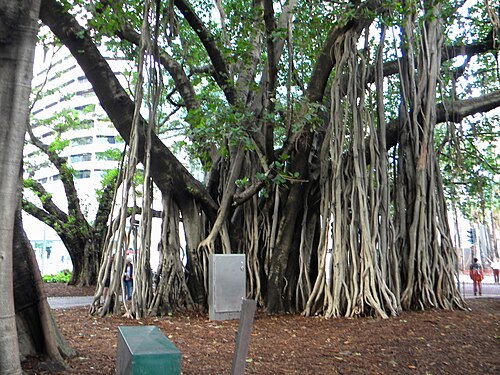
White Fig and Banyan Fig (Ficus virens and Ficus benghalensis) · 135 years · Brisbane CBD (Eagle Street)
A triangle of central Brisbane was granted in Queen Victoria's name so that wharf labourers and carriers would have somewhere shaded to sit down. Governor Sir Henry Wylie Norman signed it on 16 May 1889, and Walter Hill, first curator of the city's botanic gardens, planted the reserve with three figs: two White Figs and one Banyan.
They are still on the island where Eagle, Elizabeth and Creek Streets meet, carrying 29 metres of combined height in the middle of Brisbane's financial district. The wharves have gone. The carriers have gone. The shade does the job it was planted to do, now for office workers eating lunch on a bench instead of carters resting a horse.
Queensland added the site to its heritage register on 13 May 2004, Brisbane City Council keeps its own local citation, and the National Trust records the trees individually, which is an unusual amount of paperwork for three trees on a traffic island. Four independent records describe the same planting and none of them disagree.
It is the one stop on this list outside the gardens, about a kilometre north and an easy walk, three minutes up from the Riverside ferry terminal. One small bounded reserve, three trees, and a single obvious place to stand and look up into all of them at once.
Photo: Lobster1 (CC BY-SA 3.0)
Crows Ash / Australian Teak (Flindersia australis) · 140 years · City Botanic Gardens
The first recorded act of gardening on this ground was a felling. In 1826 an older crows ash was cut down here to mark the spot where the Moreton Bay penal settlement would put its government garden, and the ground has been a garden ever since.
The tree standing there now is not that tree, and no record suggests any descent between them. It was planted in 1884, is 21 metres tall and a metre through the trunk, and belongs to a genus named for Matthew Flinders, who charted this coast three decades before the settlement that cleared its predecessor.
Crows ash is a rainforest hardwood, sold as Australian teak, and its seed capsules are the detail worth looking down for: woody, covered in short spines, and splitting open into five parts like a carved wooden flower. They end up on the grass under the tree, which stands between the formal flower garden and the river.
One caution about the dating. A single record carries this tree, the National Trust of Australia's significant tree database, and we found no second source naming this individual, although the gardens are separately documented as holding native Flindersia of the same era. So 1884 is the Trust's date rather than a corroborated one, and the age here is stated on one authority.
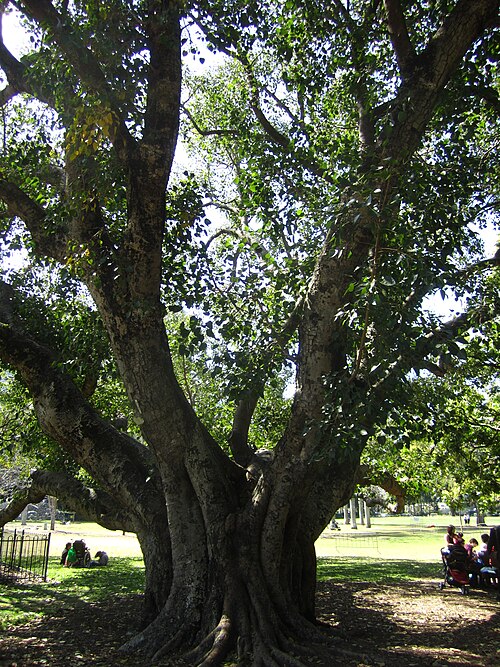
Bodhi Tree (Ficus religiosa) · 145 years · City Botanic Gardens
The record for this fig traces it, cutting by cutting, back to the tree the Buddha is said to have sat under. The line runs from Bodh Gaya in India to an ancient tree in Sri Lanka grown from it, and from there to this one, planted in the early 1880s. That is what the National Trust's entry states, and it is a claim that cannot be checked at either end. No second source adds anything independent to it: the audio guides and walking tours repeat the same paragraph. Treat the pedigree as tradition rather than as documented fact.
The tree can be checked. Twenty five metres tall, three metres through the trunk, and one of the widest canopies in the gardens, which in a garden this full of figs is a real distinction. Its leaves are heart shaped with a drawn out tip and they move in air still enough to leave everything around them alone.
One piece of the story is documented and it runs the other way. In 1983 the fourteenth Dalai Lama blessed this tree, during the same visit on which he attended the planting of a cutting taken from it at the University of Queensland. Whatever the ancestry behind it, there is a verified descendant of it growing across the city.
Photo: Craig Franklin (CC BY-SA 3.0 AU)
Weeping Fig (Ficus benjamina) · 155 years · City Botanic Gardens
Walter Hill delivered his verdict on these two trees in 1872, and it is not a boast. The figs, he wrote, 'tended greatly to diminish the appearance of bareness'. They are 40 metres tall now, two metres through, standing either side of the Alice Street gate, and bareness is no longer the difficulty.
Weeping figs are the species sold by the thousand as pot plants for office lobbies. Given open ground, subtropical rain and roughly a century and a half, this is what they do instead: a matched pair holding up the main entrance the way a gatehouse would, which is how the National Trust describes them, as a landmark denoting the way in.
The dating is not clean, and the framing is not either. The National Trust puts the planting at 1868 and treats these two as a deliberate pair marking the entrance. Wikipedia's account of the gardens describes an avenue of weeping figs planted in the 1870s and does not single them out. Species and rough decade are agreed between the two; whether this pair was planted as a pair, or is what remains of a longer line, rests on the Trust's record alone, as does the earlier date.
Either way they are the first thing the gardens show you, and the last thing you walk through on the way back out to Alice Street.
Mahogany (Swietenia mahagoni) · 165 years · City Botanic Gardens
Nothing would grow under this tree, and that turned out to be useful. Walter Hill planted it in 1861, testing whether West Indian mahogany could take root as a colonial timber crop the way it had elsewhere in the empire. The tree took, growing into what the National Trust's significant tree database calls probably the first mahogany planted in Queensland and among the oldest of its species anywhere in Australia: 41 metres tall, its trunk two metres through.
The bare ground under its canopy shaped part of the garden decades later. A later curator, Harry Oakman, turned the empty soil beneath and around the mahogany into what became the gardens' rainforest section, so a tree brought in to test a colonial industry ended up dictating the layout of an entirely different corner of the park.
The timber trade Hill hoped for never really arrived. Mahogany stayed a curiosity in Australia rather than a crop, unlike the macadamia planted a few decades later just 35 metres away. The most recent recorded inspection, from February 2014, found the tree in good condition. What is left of the experiment is one very tall, two-metre-thick specimen and the ground it cleared for something else entirely.
Tamarind (Tamarindus indica) · 165-200 years · City Botanic Gardens
The National Trust's own record puts this tamarind older than the garden around it: 'thought to predate the formation of the Botanic Gardens', which were declared in 1855, with an estimated age near 190 years. That would set its planting in the mid-1830s, two decades before Walter Hill ever picked up a spade here. It rests on one source and reads better as an estimate than as a settled fact.
What is not in doubt is that it is a real, fruiting tamarind. A Rare Fruit Council Australia trip report from May 1994 describes visiting it two years earlier: 'a large multi-stemmed tamarind, about forty foot tall with a forty six foot spread', starting to fruit for the season. The National Trust's current entry gives it 18 metres and makes no mention of multiple stems, a gap of three decades and one that measurement alone does not resolve; the two accounts may describe the same tree at different points in its growth, or there may be more to the difference than growth explains.
It stands in the older, southern reach of the gardens, on the path toward Old Government House, still producing the sour brown pods that turn up in curries and chutneys across a tropics it was never native to. Whatever its real age, it is fruiting now, which most of Brisbane's founding-era trees no longer bother to do.
Silky Oak (Grevillea robusta) · 110 years · City Botanic Gardens
Most grevilleas are shrubs you can see over the top of. This one is 32 metres tall.
Silky oak is the largest of Australia's grevilleas, and it is not an oak at all. It sits in the protea family beside the banksias, and it took its name from the timber, which cuts with a fine silky figure that cabinetmakers chased for a century. This tree stands in the north east part of the City Botanic Gardens, between the pond and the Morning Star sculpture, its trunk 0.7 metres through and a little over two metres around.
In spring it does at 32 metres what the rest of the genus does at knee height: dense one sided combs of orange flower held out along the branches, until the whole crown changes colour.
The National Trust of Australia put it at roughly a hundred years old when it was measured in February 2014, an approximation rather than a ring count, which places it somewhere near 110 now. That makes it a seedling around the time of the First World War, and the gardens around it have twice gone under the river since, in 1974 and again in 2011.
One record carries this tree, the Trust's significant tree register, and its last inspection is that 2014 one, which found it in good condition. We found no second source naming it. If you know more, tell us.
Hoop Pine (Araucaria cunninghamii) · 70-75 years · City Botanic Gardens
The hoops are real. Run your eye up the trunk and you find it ringed at intervals with raised bands, stacked like the hoops on a barrel, which is where the tree got its name.
It stands on raised ground just inside the George Street fence, about halfway along, where the gardens meet the QUT campus. Thirty three metres tall, its trunk a metre through and a shade over three metres around, it carries the stiff dark prickly foliage that gives every araucaria its slightly prehistoric look. That look is not a trick of the light. This is an old lineage of conifer, and its close relatives are the monkey puzzle and the Norfolk Island pine.
Araucaria cunninghamii takes its name from Allan Cunningham, the botanist who came up the Brisbane River in the 1820s while the place was still a penal settlement. The species went on to build the city he was looking at: hoop pine was the softwood Queensland's sawmills ran on for generations, and it remains the state's main plantation conifer.
The National Trust of Australia's significant tree register put its age at roughly sixty years when it was measured in January 2014, an approximation rather than a planting date, which puts it somewhere in its seventies now. The Trust went back to the listing in February 2023. That register is the only source we could find naming this particular tree.
Big-leaf Mahogany (Swietenia macrophylla) · 157 years · City Botanic Gardens
It was planted in 1869 to be looked at, and the staging still works. Walk in from Alice Street and it is there on your left, positioned so that arriving visitors would meet it, which is what Walter Hill intended when he put it in during his curatorship of the gardens.
This is big-leaf mahogany, the species behind most of what the world sells as mahogany. Across its native range in Central and South America it has been logged hard enough to sit under CITES protection. Here nobody has ever come for the timber, and 157 years have produced a tree 22 metres tall, a metre through the trunk and a little over three metres around.
Worth knowing before you go looking, because these gardens hold two mahoganies planted eight years apart. The other is Swietenia mahagoni, a different species, planted in 1861 and standing about 400 metres away in the middle of the rainforest section. This one is the Alice Street tree, the big-leaf, near the entrance rather than deep in the planting.
Queensland had been a colony in its own right for ten years when it went into the ground, and Brisbane was still a small colonial town rather than a city.
The planting date, like everything else here, comes from the National Trust of Australia's significant tree register, which recorded the tree in good condition in 2014 and is the only source we found naming it.
Black Bean (Castanospermum australe) · 80 years · City Botanic Gardens
The seeds look like chestnuts and will make you seriously ill. Black bean drops heavy pods holding two or three glossy brown seeds the size of a golf ball, and people ate them anyway: Aboriginal peoples along this coast sliced, leached and roasted them over several days to strip the toxins out. That is a great deal of work for a seed, which tells you what the return was worth.
The tree stands on the northern edge of the rainforest section, 22 metres tall, its trunk a metre through and a little over three metres around. It is a legume, despite growing into a rainforest hardwood, and in spring the pea flowers open in orange and yellow racemes on the older wood rather than out at the tips.
The species has one famous piece of joinery to its name. When the Speaker's Chair in the British House of Commons was destroyed in a 1941 air raid, the replacement Australia presented in 1951 was carved from black bean timber. Not from this tree. It went into the ground around 1944 and was roughly seven years old at the time, a decent sapling and no use whatsoever to a carver.
The National Trust of Australia's significant tree register put it at about seventy years old when it was measured in February 2014, in good condition. That register is the only source we found naming this tree.
Cunningham's Fig / White Fig (Ficus virens) · 200 years · Newstead Park, Newstead
A speaker hidden in the garden bed narrates Newstead House's history to whoever pauses under the giant fig growing on the driveway roundabout in front of it, which is where the tree earned its local name, the Talking Tree. The fig has the better claim to the story: Patrick Leslie built the house in 1846, and by the property's own account the fig was already a substantial tree when he did, older than everything else on the site.
It is a Cunningham's fig, Ficus virens, and it has hollowed out the way old figs do, described on Queensland's heritage register as a magnificent hollowed out Cunningham fig believed to be 200 years old, growing inside its own circular garden bed. Nobody has taped its girth, so 200 is a long-held estimate rather than a measurement, and one account puts it closer to 300.
The tree stands on the public entrance drive, open every day with no gate and no ticket. Newstead House itself, the museum building further up the drive, only opens Friday to Sunday, but the fig and its roundabout sit outside that line. If you know its real age, tell us.
Crows Ash / Australian Teak (Flindersia australis) · 160 years · Newstead Park, Newstead, in the grounds near Newstead House (about 160m from the Cunningham fig published as bne_016)
The house went up in 1846, and this tree was probably already standing. That is the entire basis for its age: Gardening Australia looked at the crows ash in the grounds of Newstead Park, judged that it predated the building, and put it at over 160 years. Nobody taped the trunk and nobody counted a ring, so read that number as a floor rather than a measurement.
Crows ash is a rainforest hardwood from the Queensland coast, milled and sold as Australian teak, hard enough that it went into floorboards and railway carriages. The detail worth looking down for is the seed capsule: woody, covered in short blunt spines, splitting into five boat-shaped parts that end up scattered on the grass under the crown.
It shares the park with the tree everybody comes for, the hollowed Cunningham's fig on the entrance roundabout with a loudspeaker in the garden bed beside it, about 160 metres away. This one has no speaker and no plaque, which is why it takes more looking for.
Two honesty notes. A single organisation carries this tree, an ABC gardening segment and its companion factsheet, and nothing else we searched names it, so both the age and the identification rest on that one account. And the pin marks the house rather than the trunk, because the source places the tree in the grounds without saying where in them. If you can put us on the exact spot, tell us.
Queen's Crepe Myrtle (Lagerstroemia speciosa) · 180 years · Newstead Park, Newstead, within the themed playground area behind the house
This tree has a door in its trunk and a painted White Rabbit at the foot of it. Fungal disease rotted the crepe myrtle out from the inside, the hollow was packed with concrete and finished with a small hinged door, and the playground built around it at Newstead Park took its Alice in Wonderland theme from a tree that was already there.
Gardening Australia calls it the largest tree of its kind in the southern hemisphere. That is their claim and we have found nobody who has checked it, but the size is real enough that the claim is worth repeating with its source attached.
The same segment says it was planted at about the time Newstead House was built, which was 1846, putting it around 180 years old. That is a planting claim made about this specimen rather than a date lifted off the building.
Lagerstroemia speciosa is the outsized member of a genus otherwise grown for suburban front gardens. Through the Brisbane summer it carries dense panicles of crinkled mauve and pink, then colours and drops its leaves before flushing again. A tree filled with concrete, wearing a rabbit and flowering anyway is a good reason to walk into a playground as an adult.
One organisation carries all of this, an ABC gardening segment and its factsheet, and no second source we searched names the tree at all. If you have stood in front of it recently, tell us how it is looking.
Crows Ash / Australian Teak (Flindersia australis) · 100 years · Toowong, on the Sylvan Road streetscape
The council that planted this tree was abolished thirteen months later. In September 1924 the Mayor of Toowong set a crows ash into a sandstone box on the corner of Milton and Sylvan Roads, under a marble plaque marking a hundred years since John Oxley landed on the Brisbane River. On 1 October 1925 the Toowong Town Council ceased to exist, absorbed into the new Greater Brisbane City Council, and a second inscription on the same planter records the forty years it lasted. The tree is a memorial to two things at once, and one of them is the body that did the memorialising.
A century on, the box has had the last word. Brisbane City Council's own heritage citation notes that the tree appears stunted, most likely because of the constraints of the planter it was ceremonially placed in. Crows ash lives around 200 years in a natural setting, and this is not one: it is a rainforest hardwood spending its life in a stone container beside the traffic on Milton Road. A Vegetation Protection Order covers it and it has been a Local Heritage Place since 2002.
That citation, written in 2006, is the only source we have found for the tree, and no photograph or sighting since has turned up to confirm it is still standing. The corner is public footpath, visible at any hour. If you pass it, tell us how it is doing.
Hill's Fig (Ficus microcarpa var. hillii) · 100-150 years · Milton
On a street corner in Milton, a Hill's fig has stood as physical evidence of Brisbane's push to plant its footpaths, more than a century after most of that program's other trees came down. Brisbane's own heritage register calls it a survivor of a citywide street tree planting drive from the late 1800s, which would put this fig somewhere between 100 and 150 years old today; the register's own paraphrases disagree on whether to call it 'at least 100' or 'at least 120', so we are carrying the wider range rather than picking a number that sounds more precise than the source is.
It shares its stretch of Milton with Milton State School, opened in 1889 next door, which has several large figs of its own inside the school grounds, not open to passers-by. This one is different: it stands on the road reserve itself, at the corner of Haig Road and Bayswater Road, free to walk up to any time, three or four minutes from Milton station.
Brisbane listed it as a Local Heritage Place in 2002. No second source has turned up yet describing this specific tree, unusual for something with its own heritage listing; if you know more about it, we would like to hear it.
A day trip away
Manly West, 13 km east
Bunya Pine (Araucaria bidwillii) · 135 years · Manly West
John Hargreaves planted a pair of Bunya pines in 1891 at the gate of his fruit farm and cannery in Manly West, a property called Woondall for the spring that watered it. Only one of the two trees is still standing, and it is now the sole marker on the ground of a business that once ran for over a century, canning peas, beans and preserves under what later became the Edgell-Birds Eye label, before closing in 1999 and giving way to housing. Brisbane's own heritage register lists the tree as a Local Heritage Place, dating the planting to 1891 and putting the tree at roughly 135 years old today. Queensland Places independently confirms Hargreaves and his cannery at Woondall, though without naming the tree itself, so the planting date and age rest on the one heritage citation. It stands free on the Manly Road reserve, no gate and no ticket. Manly West sits well outside the radius of this city's other old trees, about 35 to 40 minutes from the centre by train and bus rather than the short hop most of this list asks for, so treat it as a deliberate trip in its own right rather than a stop along the way.