Sydney's oldest trees are colonial garden plantings, and two of the most famous are not the original tree at all. The Camperdown Cemetery fig went in the year the cemetery opened, 1848. The Bidwill kauri in the Royal Botanic Garden grew from seed collected on New Year's Day 1849 by the Garden's first director. The jacaranda in the university Quadrangle and the Botanic Garden's Wishing Tree are both replacements for celebrated predecessors that died, which their pages say in the first line. At Carramar, an oak planted in 1842 was once called the largest tree in Australia.
0 of 7 visited in Sydney
Queensland Kauri (Agathis robusta) · 170 years · Royal Botanic Garden Sydney
The seed was picked on New Year's Day, 1849, at Maryborough in Queensland, by John Carne Bidwill, the first director of the Royal Botanic Garden Sydney. It went into the Palm Grove in 1853 and the tree that came up is still standing there, more than 170 years later, pushing well clear of the palm canopy around it as one of the tallest things in the garden.
It is the Garden's type specimen of Queensland kauri, the first of the species planted here, and other kauris in Sydney get measured against it. A 2015 heritage survey of the Domain does exactly that: a companion kauri on Central Avenue, 31 metres tall with a canopy 16 metres across, is described as approaching the size of the 1853 tree in the Palm Grove. It has not caught up.
Kauris are slow and can run past 300 years, so at 170 this one is barely middle-aged. What it has instead is priority.
Nobody has published a trunk measurement for it, so if you get a tape around it we would like the figure. And our pin marks a point in the Palm Grove rather than the trunk itself, so allow a minute of standing among the palms and looking up. You are looking for the one that overtops the palms.
Blue Jacaranda (Jacaranda mimosifolia) · Camperdown
The jacaranda in the Quadrangle is about nine years old. Say that first, because everything written about this tree is really about a different one: the jacaranda planted in the south-eastern corner in 1928 by Associate Professor Eben Gowrie Waterhouse, which toppled on 28 October 2016 after a root fungus ended 88 years of it. The BBC reported the death.
What stands there now was planted on 20 July 2017 and is a genetic clone of the tree that fell, propagated so the replacement would be the same jacaranda rather than merely another one. That is worth being clear about. You are not looking at a tree from 1928. You are looking at its cutting, growing into the same corner of the same sandstone quadrangle, with a flame tree put in beside it as a companion the same year.
The folklore transferred intact. Generations of Sydney students have held that if you have not started studying by the time the jacaranda flowers, you will fail your exams, which is a superstition that survives because the timing is genuinely cruel. The purple arrives in late October, just as the semester runs out.
The Quadrangle is open to visitors through daylight hours and the tree is easy to find. In flower it draws a crowd with phones. Out of flower it is a young tree with a great deal expected of it.
Port Jackson Fig (Ficus rubiginosa) · 170 years · Vaucluse
Two records date this fig and they land a few years apart. Museums of History NSW puts the giant Port Jackson fig at the eastern corner of Vaucluse House in the mid-1850s. The State Heritage Register listing for the property calls it a Port Jackson fig of about 1859. Neither is a planting receipt, so the honest answer is that it went in somewhere inside that window, roughly 170 years ago, and nobody has narrowed it since.
It was planted as part of a fashion. Sydney's villa gardens were being laid out in the Thomas Shepherd manner, with specimen trees placed for effect on lawns meant to be walked across, and this fig is one of the survivors of that generation of planting. The Port Jackson fig is the local species rather than the imported showpiece, and it grows into exactly the wide, dark, low-branching shape those gardens were designed around. A century and a half on, it is doing what it was placed there to do.
Be careful which fig you are told about. A separate Moreton Bay fig stood between the house and the tea rooms until 1996, when it was removed and replaced by a cutting. Different tree, other side of the house.
The pleasure garden is free and open Wednesday to Sunday, ten until four, with only the house interior ticketed. Our pin is good to the eastern side of the house rather than to the trunk.
Moreton Bay Fig (Ficus macrophylla) · 125 years · Woolwich
This fig was dated by photograph. Hunter's Hill Council's tree register found what appears to be a small fig near this spot in pictures from about 1913, then a full-grown specimen in 1943 aerial survey imagery, and concluded that it would support a planting date of around 1900. That is one council reading two photographs, and it is the only source we have found on this tree at all, so treat the age as a reasonable inference rather than a record. If somebody has a better one, we want it.
The rest of the assessment is easier to check by standing in front of it. Seventeen metres tall, a canopy eighteen metres across, and a health rating that calls it an excellent example of the species. It grows on the Gale Street verge in Woolwich, on council land beside the side entrance of Vailele, a sandstone Federation house of about 1892; the register describes the tree as an important remnant planting associated with the house. The verge is public, so this one can be reached from the footpath at any hour.
Most people will see it from the water first. The register notes how visible it is from the Lane Cove River, and the best way here is the F3 ferry from Circular Quay to Woolwich Wharf, twenty-three minutes, then a walk up from the foreshore.
Do not confuse it with the two forest red gums further along the same street.
Moreton Bay Fig (Ficus macrophylla) · 178 years · Newtown
The canopy spans more than thirty metres, in a walled cemetery of four acres. It shades a good share of the dead.
The tree went in in 1848, the same year the cemetery itself opened, and the date is carried by a 1962 local history of Camperdown, a 1997 landscape management plan and the cemetery's own tree survey, with a 2010 account written from a site visit giving the same year independently. The reason given for the planting is softer. It is believed to have marked the roofing of the Cemetery Lodge, which the sources report as tradition rather than record, so take the ceremony loosely and the date firmly.
With the oaks put in the same year, it is the oldest tree in the Marrickville district. Camperdown is the oldest surviving cemetery in Sydney, the walled remnant of a much larger burial ground that Newtown grew around, and the fig stands near the Lodge by the Church Street entrance, so it is the first thing you meet coming through the gate.
Nobody has published a trunk measurement, which for a fig of 178 years is a gap worth closing. If you tape it, send us the number.
The cemetery is free and open through daylight hours, fifteen to twenty minutes on foot from Newtown or Stanmore stations. Our pin sits on the cemetery rather than the tree, though at that size it will not cost you long.
Norfolk Island Pine (Araucaria heterophylla) · 90 years · Royal Botanic Garden Sydney
A plaque on the trunk explains that this tree will never reach the grandeur of the one it replaced, because a storm damaged its crown soon after it was planted. It is an unusually honest thing for a label to say, and it is accurate.
The original Wishing Tree was a Norfolk Island pine set out from a tub around 1816, under Elizabeth Macquarie's eye. By 1905 it was over thirty metres and the most popular tree in the Royal Botanic Garden, with a custom attached: three times around it forwards, three times backwards, and then make your wish. In the 1930s it was found to be dying of old age, and a replacement was bought with money raised by the Farmer's Children's Radio Birthday Club and planted nearby. The original came down in 1945 and its timber was turned into souvenirs, sold to raise funds for returned servicemen.
So the tree you will stand in front of, on the harbour side of the garden, is that 1930s replacement. Roughly ninety years old, shortened by one storm early in its life, and still being walked around: visitors were doing their six laps in 2018.
Two notes. The spot where the original stood now holds a Wollemi pine, a different tree with a different story. And our pin follows a map node named for the Wishing Tree rather than a surveyed position, so leave room for a short hunt.
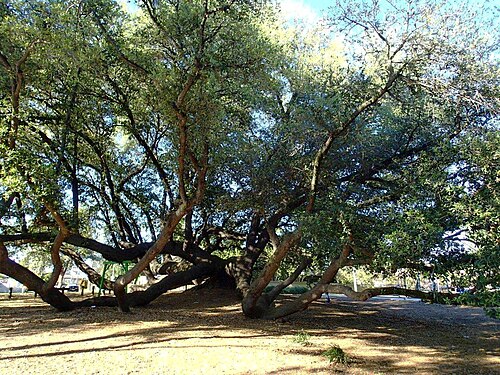
Southern Live Oak (Quercus virginiana) · 184 years · Carramar, City of Fairfield, Greater Western Sydney
On New Year's Day 1941 a storm split what was reported to be the largest tree in Australia into two pieces. The salvaged timber was carved into Fairfield's mayoral chair, now held at the city's museum, and the oak itself is still alive in Oakdene Park.
William Bland planted it in 1842. He arrived in New South Wales as a convict and became one of colonial Sydney's more prominent figures, a surgeon, a politician, a farmer and an inventor. What he put in the ground was a southern live oak, an American species, and 1842 is a documented planting date rather than an estimate, which gives this tree one of the few real birthdays in Sydney: 184 years.
It never recovered the size it lost in 1941 and it is still the largest oak of its kind in the city, about thirteen metres tall with a canopy spreading more than thirty metres across. Fairfield put it on the city's coat of arms. The National Trust added it to the National Register of Significant Trees in 2018, and in 2020 the council germinated acorns from it to raise about ten young Bland Oaks around the district, which is the most practical answer anyone has found to a tree that cannot last forever.
Oakdene Park is free and open at any hour. Carramar station is a short walk, 45 to 60 minutes by train from central Sydney.
Photo: Meganesia (CC BY-SA 4.0)