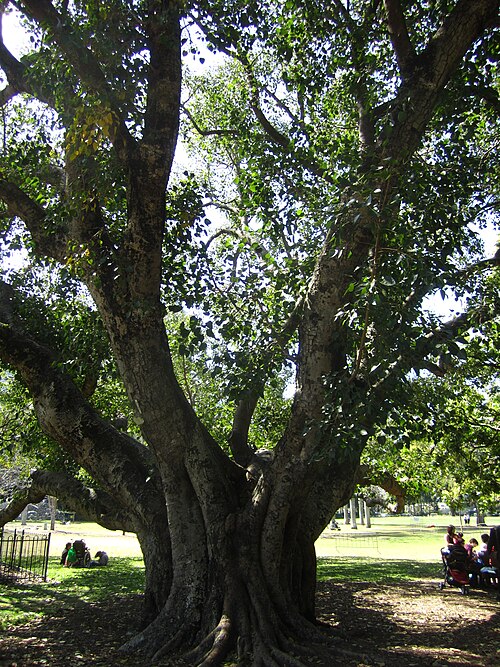
The Eagle Street Fig Trees
A triangle of central Brisbane was granted in Queen Victoria's name so that wharf labourers and carriers would have somewhere shaded to sit down. Governor Sir Henry Wylie Norman signed it on 16 May 1889, and Walter Hill, first curator of the city's botanic gardens, planted the reserve with three figs: two White Figs and one Banyan. They are still on the island where Eagle, Elizabeth and Creek Streets meet, carrying 29 metres of combined height in the middle of Brisbane's financial district. The wharves have gone. The carriers have gone. The shade does the job it was planted to do, now for office workers eating lunch on a bench instead of carters resting a horse. Queensland added the site to its heritage register on 13 May 2004, Brisbane City Council keeps its own local citation, and the National Trust records the trees individually, which is an unusual amount of paperwork for three trees on a traffic island. Four independent records describe the same planting and none of them disagree. It is the one stop on this list outside the gardens, about a kilometre north and an easy walk, three minutes up from the Riverside ferry terminal. One small bounded reserve, three trees, and a single obvious place to stand and look up into all of them at once.
118A Eagle Street, at the intersection of Eagle, Elizabeth and Creek Streets, Brisbane City QLD 4000You can recognise it as three figs, two White Figs and a Banyan, sharing a small triangular traffic island rather than a garden. It stands where Eagle, Elizabeth and Creek Streets meet, a kilometre north of the Botanic Gardens.
Free, a small public reserve (triangular traffic island / pocket park) open at all times
Short walk from Riverside ferry terminal (about 3 minutes) or Central Station (about 8 minutes)
Sources
Where the facts on this page come from.