Canberra's best-known tree is the Lone Pine at the Australian War Memorial, grown from a cone a soldier carried home from Gallipoli in 1915 and planted in 1934. Around it the ACT Tree Register protects a handful of older and bigger neighbours: a blue Atlas cedar and an Arizona cypress on a Braddon verge, the Corroboree Tree in Ainslie, and red gums, apple boxes and yellow boxes left standing in the suburbs.
0 of 8 visited in CanberraSee your full collection
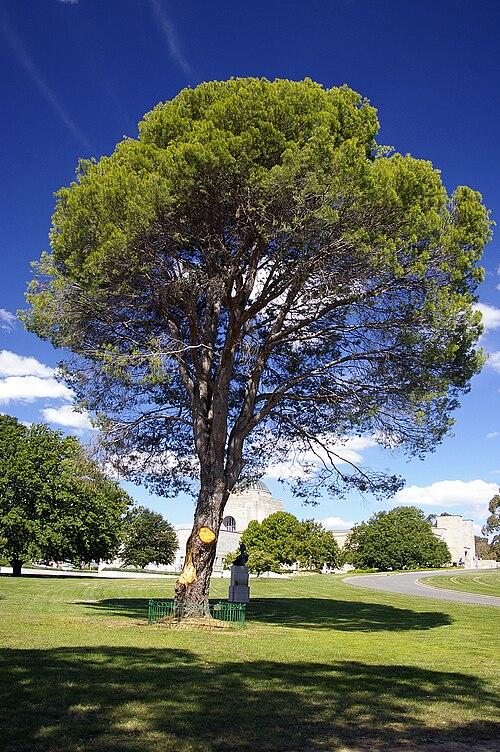
Aleppo Pine (Pinus halepensis) · 90 years · Australian War Memorial grounds, Campbell
The most famous pine in Australia was born from a soldier's pocket. In 1915 at Gallipoli, the ridge above a lone Aleppo pine gave its name to one of the bloodiest battles the Anzac forces fought, and the original tree did not survive it. Sergeant Benjamin Smith picked up two cones from the wreckage and carried them home. Nineteen years later, on 24 October 1934, Prince Henry, Duke of Gloucester, planted a seedling grown from one of them on the grounds of the new Australian War Memorial in Canberra.
That seedling is this tree, and it has since become the most visited of every Lone Pine descendant planted around Australia and New Zealand from the same handful of cones. Every ANZAC Day it stands at the centre of the national ceremony; in 2014 the Duke and Duchess of Cambridge planted a cutting propagated directly from it during that same service, an unbroken graft back to Gallipoli that most of the country's other Lone Pines cannot claim. It lost a large limb in a storm in December 2008 and kept growing.
Ninety-two years old this year, and still doing the one job asked of it: standing where people can find it every year on the day that matters.
Photo: Bidgee (CC BY-SA 3.0)
Blue Atlas Cedar (Cedrus atlantica f. glauca) · Braddon
A street tree on a Braddon road verge stands 29 metres tall, about the height of a nine-storey building. It is a blue atlas cedar at the corner of Ainslie Avenue and Currong Street, and the ACT Tree Register puts its trunk at 3.5 metres round.
The territory added it to the register on 10 August 2010, for its natural and cultural heritage value. That entry is the only written account of this cedar we have found.
What nobody has recorded is its age. There is no planting date in any source, and the street around it does not date the tree. If you know when this corner of Ainslie Avenue got its cedar, or have an old photograph of it, tell us.
The blue in the name is literal. This is the glaucous form of the Atlas cedar from the mountains of North Africa, its needles a silvery blue-green rather than the darker green of the wild trees, which is what separates it from most conifers on a city street.
It makes a short walk with its neighbours. About 40 metres along the avenue, in front of Gorman House, the register lists an Arizona cypress and two more Atlas cedars as a group, so one stop covers four registered trees. Civic is about a kilometre away, roughly twelve minutes on foot. The pin is the middle of the register's outline of the crown, so it lands close rather than on the trunk.
Arizona Cypress (Cupressus arizonica) · Braddon
In front of Gorman House in Braddon, three conifers from two continents share a single entry in the ACT Tree Register. The largest is an Arizona cypress, a tree of the dry mountains of the American Southwest, standing 20 metres tall on the road verge at Ainslie Avenue and Doonkuna Street.
The territory registered the group on 16 September 2011 for its natural and cultural heritage value. Beside the cypress the register lists two Atlas cedars, one 22 metres tall and 3 metres round, the other 19 metres and 2.95 metres round. The city's own notes on the species say an Arizona cypress reaches about 20 metres, so this one has gone the full distance.
The register also gives the cypress a girth of 537 centimetres. That is a great deal of trunk for this species, and the record does not say whether the tape went around several stems, a flared base, or whether the figure is simply a slip. Take it as a number to check rather than one to quote, and if you have measured it, tell us.
Gorman House is on the ACT Heritage Register, but nothing we have found says when these three trees went in or who planted them, so their age is undocumented too.
Pair it with the blue atlas cedar 40 metres away at the corner of Currong Street and the stop covers four registered trees. Civic is about a kilometre off, twelve to fifteen minutes on foot.
Yellow Box (Eucalyptus melliodora) · Ainslie
Ainslie built a park around this tree, and named the park after what may once have happened beneath it. Corroboree Park was laid out in about 1925 with the yellow box at its heart, on ground believed to have been a corroboree site, where Aboriginal people gathered for ceremony and dance. The same patch is said to have been the first campsite of James Ainslie, the overseer of the Duntroon estate.
Both stories arrive with care attached. The ACT Tree Register, which listed the tree in March 2013 for its Aboriginal heritage and its place in the landscape, says plainly that the Aboriginal history is not well documented. The ABC, writing about Canberra's exceptional trees in 2015, went no further than saying it is claimed the tree was a focal point for the local Aboriginal community. That is the honest edge of the record, and it is still a lot to ask of a eucalypt in a suburban park.
The register measured it at 19.2 metres tall with a crown 26 metres across, and gives its girth only as more than three metres. Nobody has published an age. If you know how old it is, tell us, and since the newest written sources date from 2013 and 2015, tell us too that it still stands.
Blakely's Red Gum (Eucalyptus blakelyi) · Bruce
This red gum is far wider than it is tall. It stands 15 metres high, but its crown spreads 25.4 metres, and it does it on four trunks whose girths, measured together by the ACT Tree Register, come to 10.28 metres.
It is a remnant, the register's word for a tree that was growing here before the suburb was. Bruce was laid out around it, and today it holds the east corner of a small park at Kinloch Circuit and Lycos Street as if somebody had planted it there for the purpose. Nobody did. The houses came to the tree.
The register lists it for its age, its stature and its prominent position, and for the company it keeps: nest-building birds, and parrots in a number of hollows. Its assessors noted the very large spreading canopy and the many-branched habit of the trunk, and wrote that Bruce has several parks with remnant trees but that this small one is particularly attractive because of this one.
In 2015 the ABC, writing about Canberra's exceptional trees, pictured a remnant Blakely's red gum with parrots in its hollows and called it hundreds of years old. The caption did not name the suburb, so we cannot be sure it meant this tree, and no other source gives an age. If you know one, tell us.
Apple Box (Eucalyptus bridgesiana) · Campbell
The stoutest of these three apple boxes is also the shortest, and its crown is twice as wide as the tree is tall. It stands 11.5 metres high and spreads 23.5 metres, on a single trunk 3.95 metres round.
The ACT Tree Register took all three in together in March 2024, under the territory's Urban Forest Act of 2023, for their landscape and aesthetic value and for their scientific and ecological worth. The other two are slimmer and taller. One measures 3.55 metres round and 13.5 metres high with a crown 21.5 metres wide; the other 2.85 metres round and 13 metres high. Each grows from one trunk, and all three stand within about 45 metres of one another in Legacy Park, between Savige and Garsia Streets in Campbell, close enough to take in from one spot.
That is close to everything on record. The register's stated reasons are its standard criteria, with no story attached, and no source says whether the three were planted with the park or were already standing when Campbell was built. A naturalist logged an apple box at the spot in February 2024, a month before the listing, which is the latest sighting we know of.
Nobody has published an age for any of them. If you know how long they have been here, or who put them there, tell us.
Yellow Box (Eucalyptus melliodora) · O'Connor
By the ACT Tree Register's own figures, nothing it lists within six kilometres of Civic stands taller than this yellow box. The register measured it at 32 metres, on a single trunk 4.4 metres round, with a crown 30 metres across. That is a great height for the species, so read it as the register's measurement rather than ours. Still, 32 metres is roughly a ten-storey building, and nobody planted it.
It is a remnant, a tree that was here before O'Connor was. It stands on open Territory land opposite number 5 Banksia Street, beside the Banksia Street wetland, and the register's assessors wrote that very few trees of this stature remain in the inner suburbs of Canberra. They also recorded parrots in its hollows and mud larks building nests in its branches. The Territory's Tree Management Unit looks after it.
What it has seen is the suburb arriving around it, street by street, though no document says when. There is no published age, and there is no planting date to work from, because there was no planting. If you know how long it has been here, tell us.
Eucalyptus (Eucalyptus globulus subsp. bicostata) · Griffith
The stoutest of these four blue gums is the shortest of them. Its trunk is 6.5 metres round, its crown more than 30 metres wide, and it stands only 20.5 metres tall, while the slimmest of the group, at 3.7 metres round, reaches 26.
The ACT Tree Register listed all four together in July 2020, and its assessors did not dress the reason up. They are beautiful, large blue gum trees, the register says, valued for their landscape and their looks. The other two measure 5.7 metres round and 24 metres tall, and 4.4 metres round and 21 metres tall, with crowns between 21 and 28 metres across. Each grows from a single trunk, and the four stand within about 30 metres of one another at the corner of Grant Crescent and La Perouse Street in Griffith, so one spot on the corner takes in the lot.
Their past is a blank. No source says who planted them or when, or whether they were here before the street was. The register gives no age, and we will not guess one from girth alone. If you know their story, tell us. The listing is from 2020 and we have found no later record, so a word that they still stand helps too.