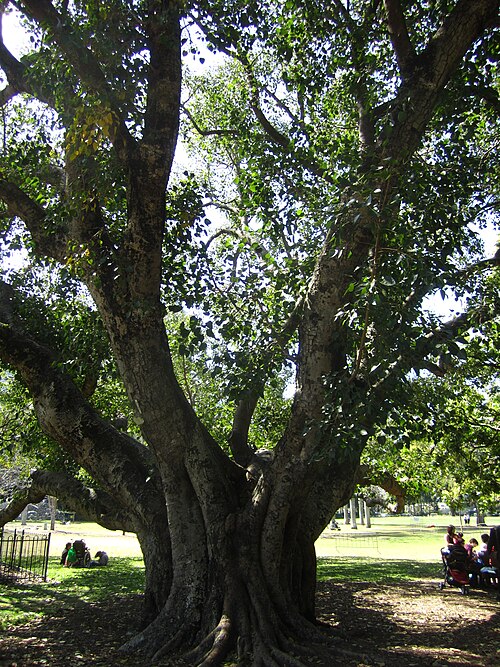
The Big-leaf Mahogany
It was planted in 1869 to be looked at, and the staging still works. Walk in from Alice Street and it is there on your left, positioned so that arriving visitors would meet it, which is what Walter Hill intended when he put it in during his curatorship of the gardens. This is big-leaf mahogany, the species behind most of what the world sells as mahogany. Across its native range in Central and South America it has been logged hard enough to sit under CITES protection. Here nobody has ever come for the timber, and 157 years have produced a tree 22 metres tall, a metre through the trunk and a little over three metres around. Worth knowing before you go looking, because these gardens hold two mahoganies planted eight years apart. The other is Swietenia mahagoni, a different species, planted in 1861 and standing about 400 metres away in the middle of the rainforest section. This one is the Alice Street tree, the big-leaf, near the entrance rather than deep in the planting. Queensland had been a colony in its own right for ten years when it went into the ground, and Brisbane was still a small colonial town rather than a city. The planting date, like everything else here, comes from the National Trust of Australia's significant tree register, which recorded the tree in good condition in 2014 and is the only source we found naming it.
City Botanic Gardens, left of the path near the Alice Street entrance, Brisbane City QLD 4000You can recognise it by its position, left of the path just inside the Alice Street entrance, 22 metres tall with a trunk a metre through. It stands apart from the gardens' other mahogany, 400 metres away.
Free. City Botanic Gardens is open 24 hours, 7 days a week; the cafe and information kiosk keep their own hours.
Short walk from Central Station (about 10 minutes) or the QUT Gardens Point ferry terminal (about 5 minutes)
Sources
Where the facts on this page come from.