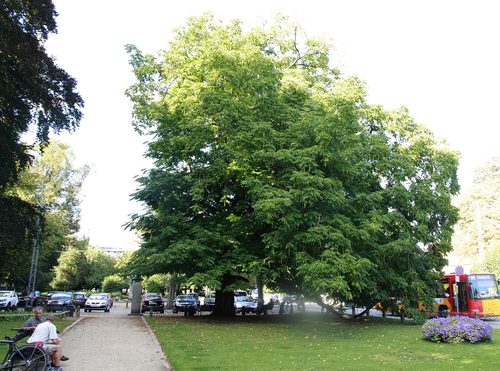
In 2009 Leiden held a public vote to decide which of its trees had the X-factor.
Caucasian Wingnut
Pterocarya fraxinifolia
The Caucasian wingnut is a walnut relative from the humid forests between the Black and Caspian Seas, and Amsterdam has more remarkable ones than almost any city outside its native range. We map 33 of them, in 21 cities.
It reached Europe around 1782 and thrives in exactly the wet, soft ground that much of the Dutch capital is built on. In summer it hangs curtains of green winged seeds, the catkins that give it its name, sometimes half a metre long. Left alone it suckers into a small grove from a single tree, which is why several of the city's specimens read as thickets rather than trunks. Amsterdammers have gone to court to keep them: one felling permit fight over a pair of wingnuts ran all the way to the Raad van State, the country's highest administrative court. These are the wingnuts mapped on the site so far.
Leiden
Amsterdam
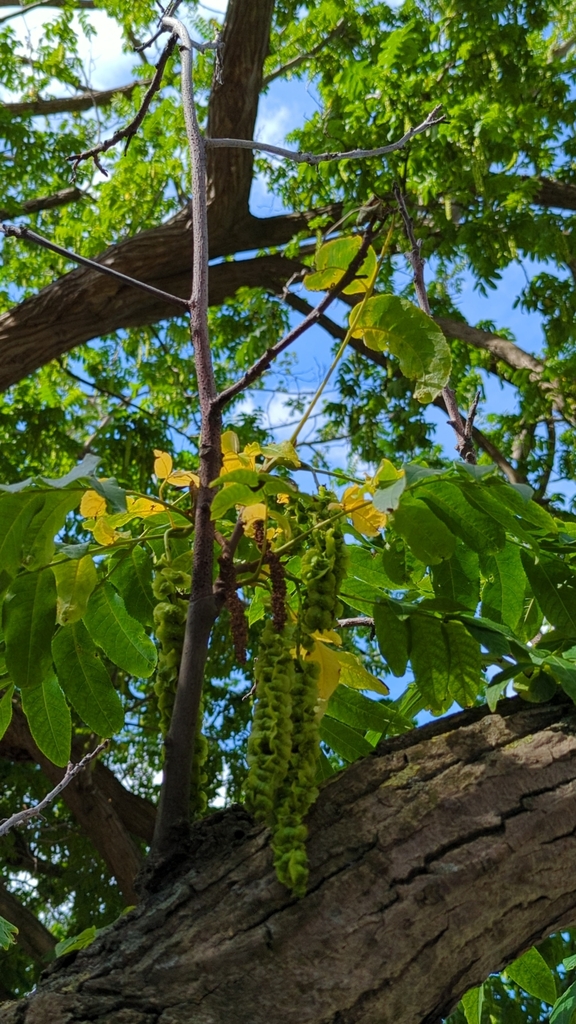
The Rijksmuseum's own architect planted this tree in his own garden design, and it outlived every renovation the museum went through afterward.
Photo: Noland Martin, iNaturalist (CC BY)
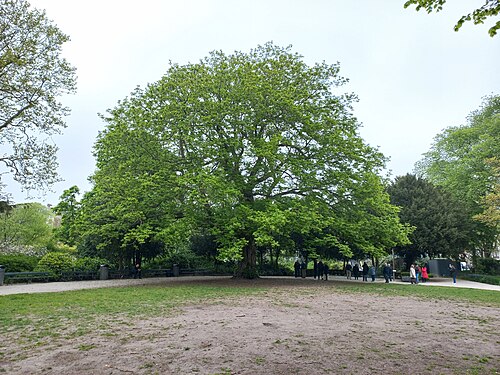
This tree has outlasted the park's own name twice.
Photo: Ceescamel (CC BY-SA 4.0)
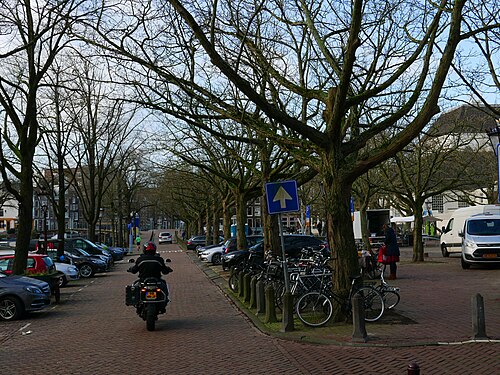
In 2006 the city government tried to cut down 14 of these trees, and lost.
New York
This tree came from Rome in 1922, and one of its limbs now rests on a crutch.
Paris
Come up the steps from the Trinite metro and it is right there, twenty-six metres of it, reported to be the oldest living Caucasian wingnut in France.
There are two Caucasian wingnuts in this square and only one of them has a birthday.
Haarlem
This Caucasian wingnut grows in the garden of a private villa at Statenbolwerk 1, and the honest way to see it is from the footpath outside rather than at the trunk: the Dutch national monumental-t...
Milan
Autumn colour
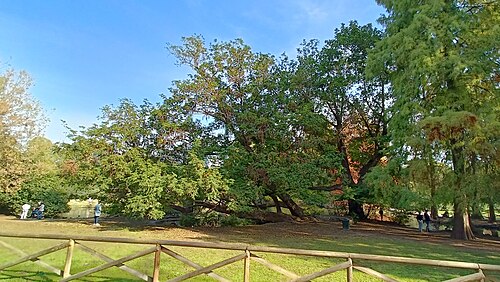
This walnut grows almost horizontally over the water, its lower limbs bending so far toward the pond in Parco Sempione that locals joke it is trying to drink from it.
Photo: Carlodell (CC BY-SA 4.0)
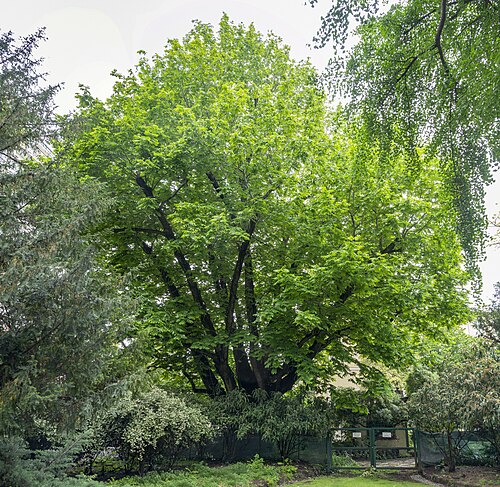
Autumn colour
Milan has three Caucasian wingnuts worth crossing town for, and this is the widest of them: 5.5 metres around, against 4.7 in the Brera botanical garden and 4.35 for the better-known specimen leani...
Photo: Sordelli (CC BY-SA 4.0)
The famous trees in this garden are the two ginkgos of 1775, and neither of them is the one the state decided to protect.
Berlin
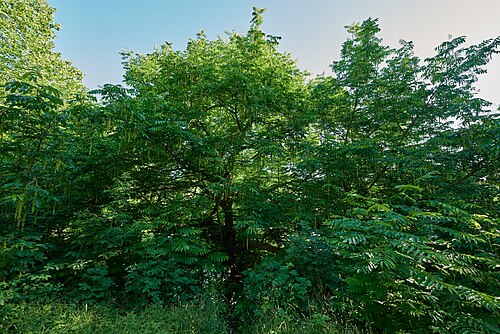
Berlin has five Caucasian wingnuts on record, and this one is not yet a hundred years old.
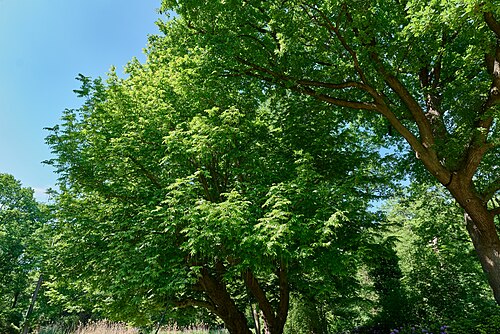
Berlin protected this tree in 1993 on two stated grounds, Eigenart und Schönheit, character and beauty, and recorded nothing else at all.
This is the third Caucasian wingnut on this list, which says more about nineteenth-century German gardeners than it does about the Caucasus.
Vienna
Come in July and this tree is hung with several hundred green ropes.
The city protected these two trees for a reason that is almost modest: rarity.
Its crown is wider than it is tall.
Vienna protects only a handful of Caucasian wingnuts, and this one stands not in a grand park but on a village square at the city's southern edge.
Maastricht
Two trees, ten metres apart, one stop.
Brussels
Caucasian wingnut takes its name from what it does with its seeds rather than what it looks like: long, pendulous strings of winged fruit that hang from the branches through late summer, an unmista...
Eindhoven
A wingnut on a residential verge is an odd choice, which is the point.
Turin
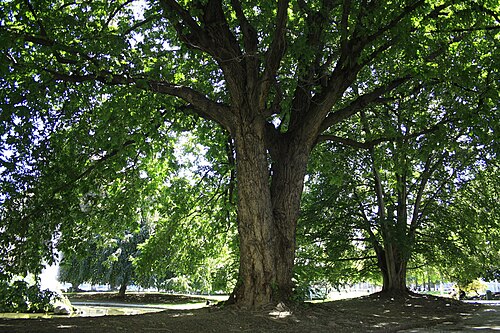
The first monumental tree on this walk is sixty seconds from the platform you arrive on.
Photo: Matthewlunas (CC BY-SA 4.0)
Copenhagen
Everything about this tree is settled except whether you can walk up to it.
Photo: Hans Erik Lund
Vancouver
Vancouver's street tree inventory has 43 wingnuts on its books, and this one, on a residential corner in the West End, is the largest Caucasian wingnut among them.
Tilburg
For seventeen years, up to a thousand students a season walked this path and had to name what they saw.
Delft
A wingnut gets its name from a seed built with two papery blades, and this one has grown for well over a century on ground that used to be Delft's city wall.
Breda
A tree from the mountains between the Black and Caspian Seas has been growing in Breda's oldest park for close to two centuries.
This wingnut carries its seeds in chains that can run half a metre long, dozens of winged nuts strung like beads down a single stalk.
Leeuwarden
An ice storm in March 1987 damaged this wingnut badly enough that the scar is still visible behind an old branch, and decades on it is one of two enormous trees flanking the path where Vosseparkje...
A large branch tore out of this tree and took much of the trunk with it.
Cologne
The Great Wingnut of the Flora sends up fourteen trunks from a single base, which is not how Caucasian wingnuts usually grow.
Haarlemmermeer
When Hoofddorp built a new shopping centre around its market square, the municipality made saving this tree a condition of the plan.
Portland
Nine Caucasian wingnuts line two blocks of NE Knott Street, five in front of the church and four across the road from it, and the city numbered every one of them when it designated the lot in 1996.
Explore by city: Leiden · Amsterdam · New York · Paris · Haarlem · Milan · Berlin · Vienna · Maastricht · Brussels · Eindhoven · Turin · Copenhagen · Vancouver · Tilburg · Delft · Breda · Leeuwarden · Cologne · Portland · every city · or browse all species.