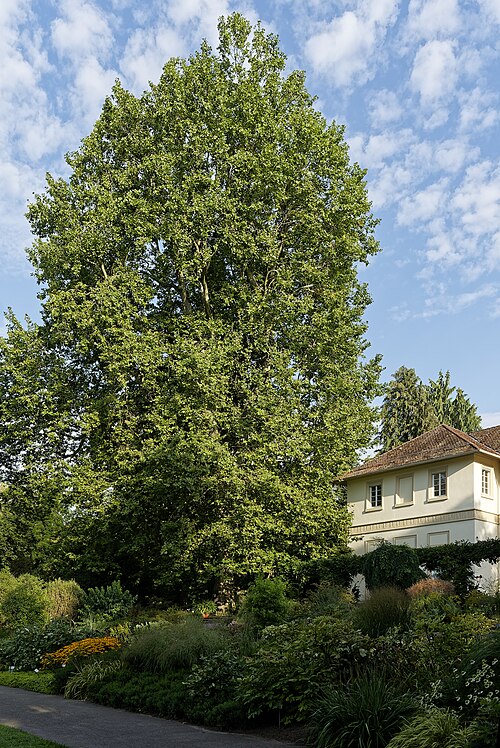
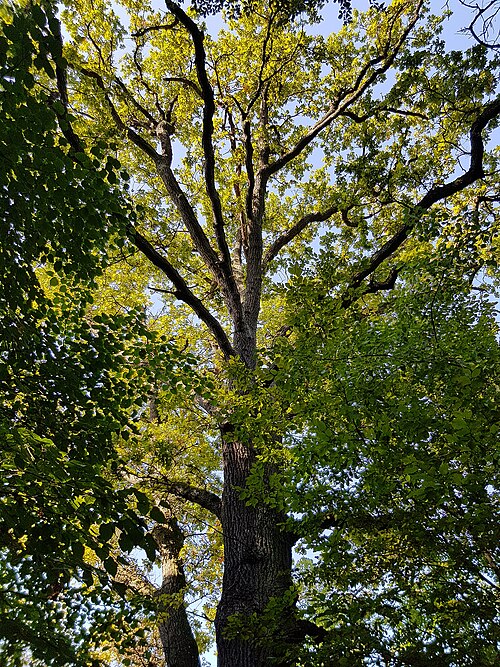
Stuttgart protects this mulberry for three reasons, and one of them is culture. The city's register normally gives a tree character and habitat value and leaves it there. This one was designated in June 2003 for its character, its rarity and its cultural significance, a combination that says the register is protecting the kind of tree as much as the individual trunk. It stands on the Oberdorfplatz, the square of the old village centre of Möhringen, which is now a Stuttgart district with trams running through it. Nobody has written down who put the tree there or why, and mulberries have been planted in Europe for two reasons, their fruit and their leaves, which feed silkworms. What is on record is that this one has watched the village around it stop being a village. Two things we cannot tell you. Nobody has published an age or a girth for it, so we are not going to invent one. And no source says whether it is a black mulberry or a white one, which is a thing you could settle standing in front of it: white mulberry leaves are glossy, black mulberry leaves are rough as sandpaper. Tell us which you find. The last photograph we can point to was taken in March 2017, and it names the tree by its exact register number.
In fruit
July and August, when the fruit ripens and drops onto the square
Oberdorfplatz, 70567 Stuttgart-MöhringenYou can recognise it as the mulberry standing on Oberdorfplatz, in the old village centre of Möhringen. Look closely at the leaves, glossy if white mulberry, rough as sandpaper if black.
On Oberdorfplatz, a public square in the old village centre of Möhringen; free, open at all times.
Stadtbahn to Möhringen Rathaus, short walk
Sources
Where the facts on this page come from.