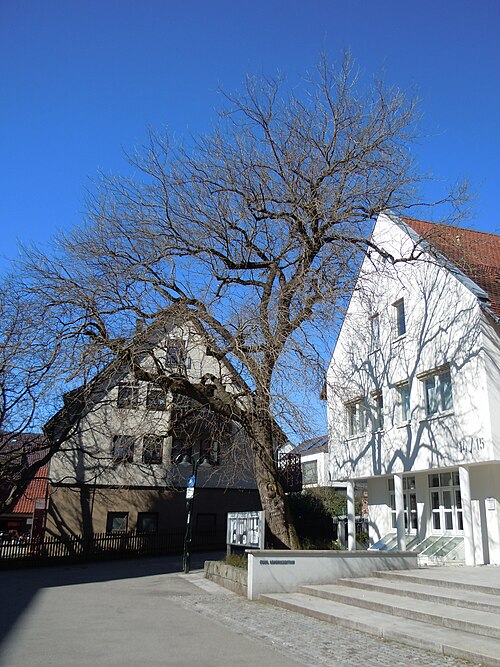
Three swamp trees from the American south, standing in a German spa park, protected by law for being unusual. Bald cypresses belong in the floodplains of the Mississippi and the Carolinas; Stuttgart designated this group a natural monument in June 2003 for its character and its rarity, which is the register admitting outright that these do not grow here by themselves. They are also the conifer that breaks the rule about conifers. A bald cypress drops its needles every winter, and before it does, the whole crown turns a rust orange that nothing else in a German park does. In wet ground the roots send up woody knees around the trunk, so look down as well as up. The Kurpark is Bad Cannstatt's spa park, and its tree stock dates largely from the nineteenth century. That stock is being renewed a few trees at a time, which is the ordinary fate of a maintained park. Here is what we cannot confirm. The most recent evidence we have that these three are standing is a photograph from May 2017, tagged with their exact register number, and nothing since names them. They are almost certainly fine, and we would rather tell you that than pretend to a fresher check. If you walk past them, tell us what you find. No age or girth has ever been published for them.
Autumn colour
November, when the needles turn rust orange and then fall
The line is our estimate of how much there is to see, not a measurement. Typical for this species where this tree stands; exact weeks shift with the year.
Kurpark, Bad Cannstatt, StuttgartYou can recognise them by their needles, turning rust orange before dropping in autumn, and by woody knees rising from wet ground around the trunks. They stand in the Kurpark in Bad Cannstatt.
In the Kurpark in Bad Cannstatt, a free public park; open at all times, no ticket.
Stadtbahn to Bad Cannstatt, short walk through the Kurpark
Sources
Where the facts on this page come from.