The Caucasian Wingnut of the TU Schaugärten
Dahlem, Steglitz-Zehlendorf
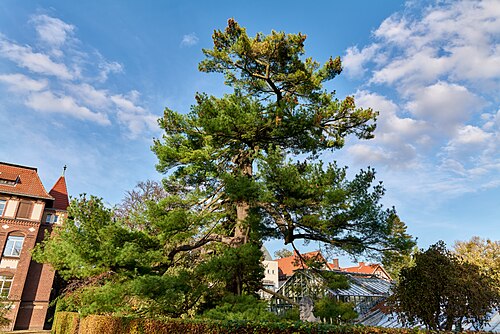
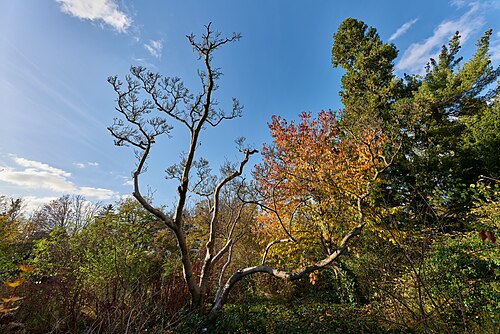
This is the third Caucasian wingnut on this list, which says more about nineteenth-century German gardeners than it does about the Caucasus. Berlin protected it on 2 March 1993 as natural monument 6-40/B and recorded almost nothing else: a species, a place, no age, no girth. The place is the point. From 1903 until 1966 these grounds in Dahlem were the Koenigliche Gaertnerlehranstalt, the Prussian state's teaching institute for gardeners, where the planting was the syllabus. Species came here to be studied, which is how a walnut relative from the forests between the Black Sea and the Caspian ended up behind what is now a computing institute. The school closed, the garden went quiet for decades, and TU Berlin restored it between 2012 and 2014 as a teaching garden again. Late summer is when a wingnut declares itself. The seed chains hang out of the crown in strings up to forty centimetres long, each nut carrying two papery wings, and nothing else in this garden does anything remotely like it. The leaves are long and pinnate, closer to an ash than to the walnut it is actually related to. Nobody has dated this one and nobody has published a girth for it. If you have put a tape round the trunk, tell us.
From people who stood here
No notes yet
Did you visit the tree? Leave a note for the next visitor.
Getting there
TU-Schaugärten (former Königliche Gärtnerlehranstalt), Königin-Luise-Straße 22, 14195 Berlin-Dahlem
You can recognise it by the long strings of winged seeds hanging out of the crown in late summer and the ash-like pinnate leaves. It stands at the south-western corner of the grounds, behind the Zuse Institute building.
Free, TU Berlin's own Schaugärten (educational display garden, restored 2012-2014); TU Berlin's own site gives seasonal opening hours (April/May and Sept/Oct roughly 10am-8pm, June-Aug roughly 10am-10pm); no confirmed winter access found, so treat as a growing-season destination
Podbielskiallee or Dahlem-Dorf (U3), roughly 10 min walk
In fruit
July to September: long green catkins of winged nutlets hang from every branch
The line is our estimate of how much there is to see, not a measurement. Typical for this species where this tree stands; exact weeks shift with the year.
Sources
Where the facts on this page come from. The story was written with AI from these sources, and readers who know the tree correct it.
- In the official register: Naturdenkmal Berlin (Verordnung zum Schutz von Naturdenkmalen, Land Berlin register, DL-DE-Zero 2.0), no. 6-40/B
- tu.berlin
- de.wikipedia.org