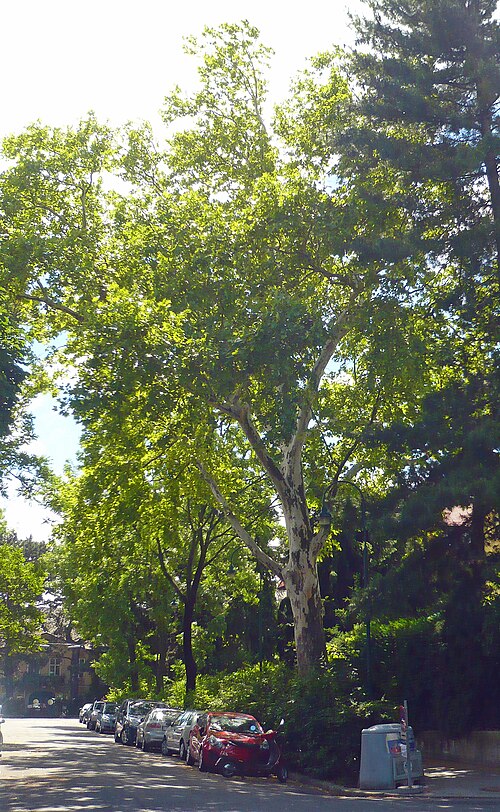
Its crown is wider than it is tall. When Vienna listed this Caucasian wingnut as Natural Monument 816, the measurements came out at about 26 metres across and about 18 metres high, a tree spreading sideways over the end of a suburban street in Hietzing. That shape is the whole reason it is protected. The monument list says the free-standing crown shapes the look of the place, and the place is unglamorous: the turning loop at the end of Wolkersbergenstraße, where it meets the Eugen-Jettel-Weg, in the small public Hugo-Pepper-Park. It is a tree that would not look out of place in a palace garden, standing where a road runs out. Wingnuts come from the Caucasus and northern Iran and were planted in European parks from the nineteenth century, prized for exactly this habit of growing big, fast and wide. The trunk measured 4.10 metres round at one metre when it was designated; the city's tree cadastre now gives 4.27 metres and puts the height in the 21 to 25 metre class. No source we have found records when it was planted, so we give no age. If you know, tell us. Come in early summer. That is when the wingnut hangs out the strings of winged seeds that give it its name, long green chains dangling all over that enormous crown.
Flowerslong green catkins of winged nutlets hang from every branchAutumn colour
June and July, when long chains of winged seeds hang all over the crown
The line is our estimate of how much there is to see, not a measurement. Typical for this species where this tree stands; exact weeks shift with the year.
Wolkersbergenstraße / Eugen-Jettel-Weg turning loop (Hugo-Pepper-Park), HietzingYou can recognise it by the crown, far wider than it is tall, spreading over the turning loop at the end of Wolkersbergenstraße. The trunk is about 4.3 metres round, and in summer long green seed chains hang from it.
Free. Stands in the public Hugo-Pepper-Park (MA 42 Parkanlage) at the end of Wolkersbergenstraße.
Nearest stop not verified.
Sources
Where the facts on this page come from.